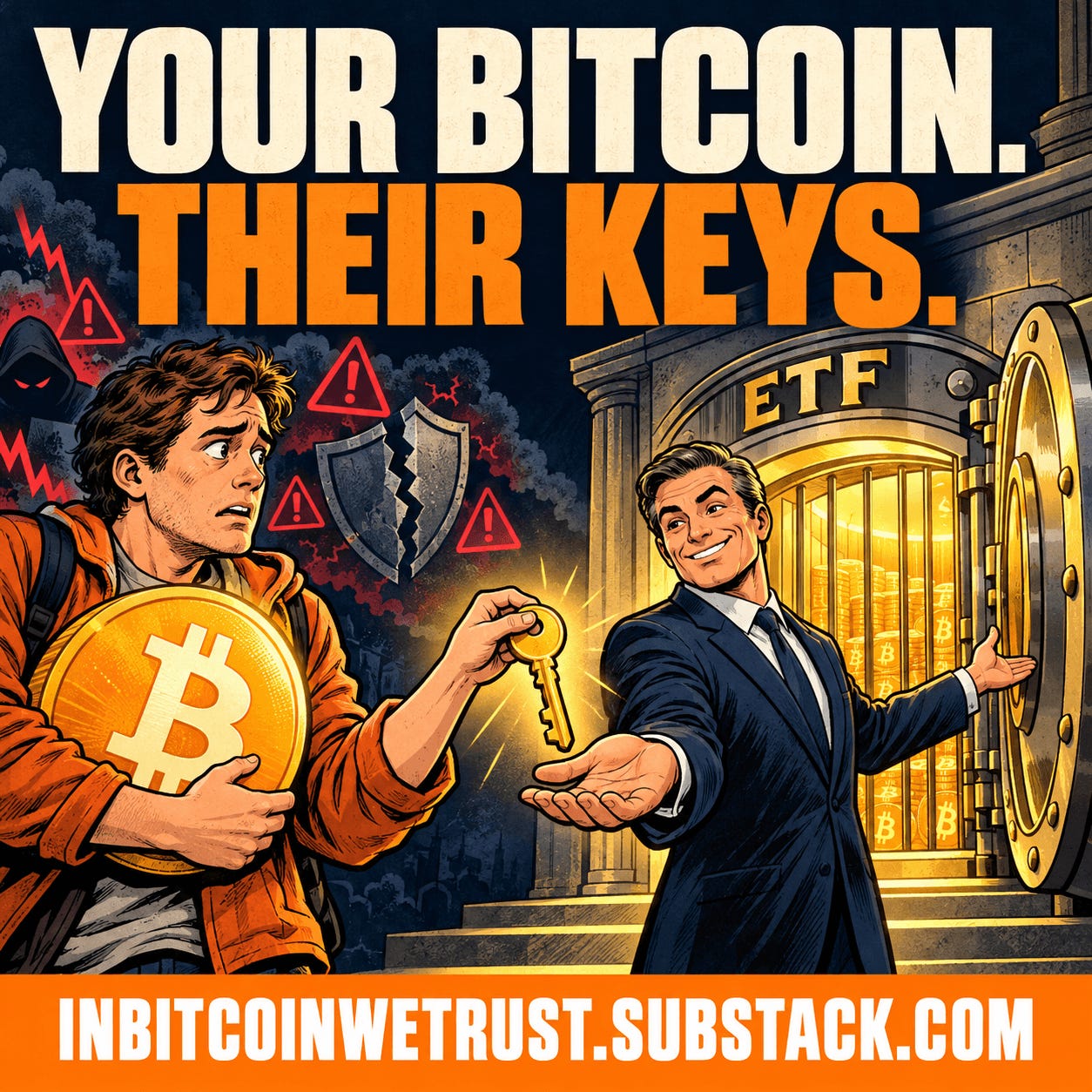
Imagine someone who has spent years saving in Bitcoin.
They bought a hardware wallet. Wrote down their recovery words. Stopped leaving their savings on an exchange. Followed the advice they kept hearing from people who seemed to know what they were talking about.
Then the headlines started piling up.
Customer information leaked. A support provider was breached. A shipping company exposed home addresses. An email platform distributed phishing messages. A seed-generation flaw weakened wallets. Physical implants turned genuine devices into traps.
Now this person is sitting at the kitchen table, wondering whether the thing they bought to protect their savings has become another thing they need protection from.
They have a job. Children. Bills. They never wanted a second career in cybersecurity.
And somewhere between the latest security advisory and the next urgent warning, a thought appears:
Maybe I should just buy the ETF.
That thought is completely understandable.
It is also where this story gets uncomfortable.
What if the easiest way to control Bitcoin holders is to convince them that holding their own Bitcoin is too dangerous?
Bear with me. This is a thought experiment, not an accusation. The incidents discussed here do not establish a government operation, coordinated sabotage, or collusion between hardware manufacturers and Wall Street.
The question is what a government seeking that outcome could do with failures that already exist.
It might not need to create the fear.
It might only need to give that fear a destination.
Before going further, we need to respect the facts. Different failures create different risks, and collapsing every incident into “hardware wallets were hacked” helps nobody.
Ledger’s 2020 breach exposed customer information. Its ** subsequent disclosure** described more than a million email addresses and approximately 272,000 detailed customer records. That was a serious privacy failure, with obvious implications for phishing and personal security. It did not mean those customers’ private keys had been extracted from their devices.
Trezor’s incidents also require precision. The company disclosed unauthorized access to a ** third-party support portal in January 2024**, a
Coldcard’s July 2026 incident was different. According to its ** security status page**, a firmware bug weakened seed generation, and attackers regenerated corresponding private keys offline to steal funds. Fixed firmware addresses future seed generation; updating a device does not repair an existing affected seed. That distinction has direct consequences for affected users.
Then came the Ledger tampering investigation. In October 2026, Ledger confirmed that an affected user’s device contained an unauthorized hardware implant, as documented in ** reporting that links its statements.** The investigation was ongoing, and the company had not confirmed the overall number of victims or total losses.
Ledger’s own
explains a crucial limitation: its Genuine Check authenticates the Secure Element but cannot detect every unauthorized physical modification when that chip remains intact.[purchasing guidance]
These are different failure modes. They demand different remedies.
But ordinary people do not experience security news as a neatly organized technical report.
They experience it as another reason to worry.
And telling someone that their private keys remain secure can sound painfully incomplete when their home address has just been exposed.
Security has to protect the person holding the device, too.
That emotional accumulation matters. A reader may understand every distinction above and still finish with the same conclusion: I do not want this responsibility anymore.
Nobody has to be stupid for that to happen. Nobody has to hate Bitcoin. They simply have to become exhausted.
Consider a detail from Trezor’s email-provider incident. The malicious message presented itself as a security alert about an entropy vulnerability. It directed recipients toward an application that asked for their wallet backup.
A warning about danger became the delivery mechanism for danger.
That is a documented phishing tactic. It is not evidence of the government scenario we are considering.
But it illustrates why the promise of protection deserves scrutiny: frightened people are looking for a safe next step, and someone else gets to suggest what that step should be.
Now return to the thought experiment.