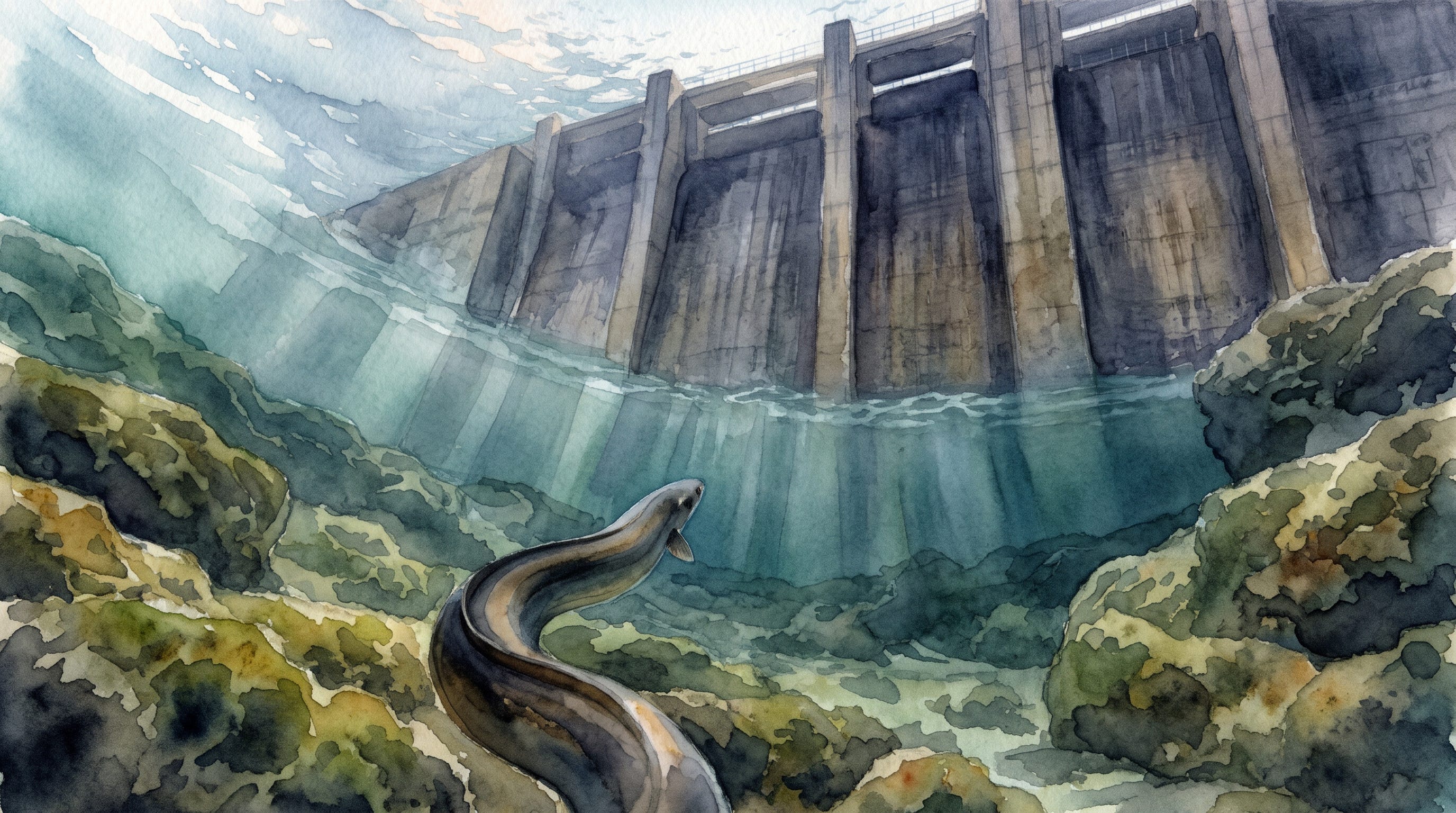
Eels born off Bermuda once swam to the mountains of Albania. Then, at the end of their lives, they swam back from a remote Balkan lake all the way home to Bermuda.
For millennia they made this journey, until dictators interrupted it with dams.
From the Albanian shores of Lake Ohrid, learning of these stranded eels, I thought of the Ukrainians who cannot go home because Russia has destroyed their cities.
POGRADEC, ALBANIA—Clear-watered Lake Ohrid is Europe’s oldest lake, they say. The lake is known for a fish found nowhere else on earth, the koran, a trout that tastes like a brown trout crossed with an Atlantic salmon, which locals say Byzantine emperors once had delivered to Constantinople. The koran, like most of the life in this lake, never leaves it. There is one great exception.
We publish this newsletter every day at 9:05am NYC time / 4:05pm Kyiv.
Your subscription fuels our work.
Subscribe now
Give a gift subscription
For millennia, the European eel was born nowhere near Europe but in the Sargasso Sea, in the Atlantic near Bermuda, some 600 miles off the Carolina coast. Somehow it crossed the ocean, slipped through the Strait of Gibraltar, swam the length of the Mediterranean and up the Adriatic, and climbed the Drin into this lake. I write on its sandy Albanian shore, looking toward the mountains of Macedonia. Then, and this is the marvel of it, near the end of its life, each eel would make the whole journey in reverse, more than four thousand miles back to Bermuda, to spawn and die.
Albanians ate an eel that had come from waters off the New World long before Europeans alighted there.
For most of history, no one knew the eel’s origin. Aristotle believed eels rose out of the mud. As a young student in Trieste, Sigmund Freud dissected hundreds of eels looking for their sex organs and never found them. The Danish scientist Johannes Schmidt spent nearly two decades trawling the Atlantic for ever-smaller larvae before he traced them, in the 1920s, to the Sargasso Sea near Bermuda. We know now where the eel is born. We still don’t know exactly how it finds its way.
Or how it found its way. Like Ukrainian refugees from Donbas cities destroyed by Russia, the eel can’t go home again.
Read more