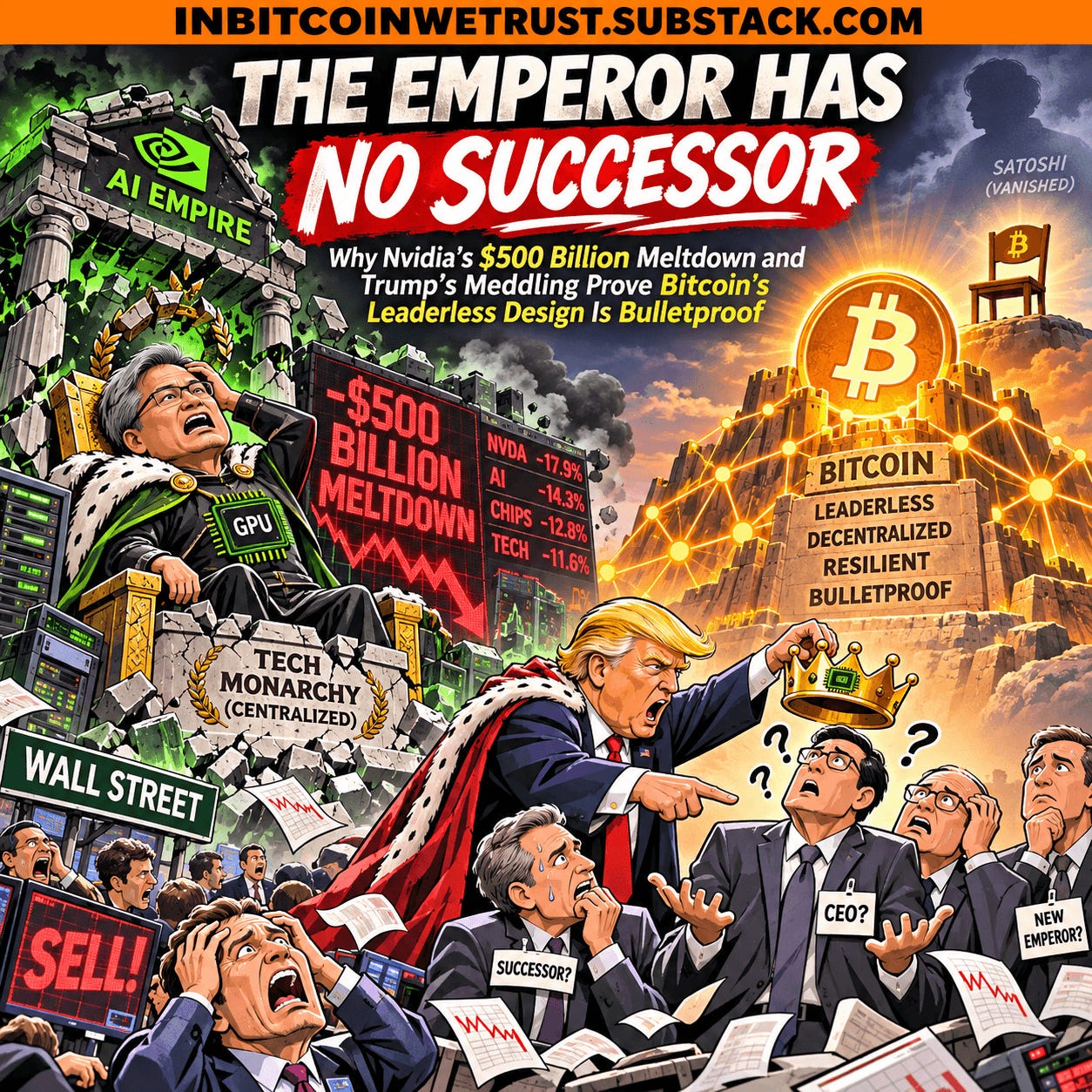
A suspected spy, a shattered tech monarchy, a Truth Social coronation for Tim Cook, and a panic on Wall Street—how the chaos of November 2026 exposes the fatal flaw of centralized empires and vindicates Satoshi Nakamoto’s disappearance.
On Thursday, November 12, 2026, the most powerful corporate monarchy of the twenty-first century collapsed under the weight of the oldest vulnerability in human history: human nature.
For the past four years, Wall Street, Silicon Valley, and Washington operated under a shared delusion. They believed that the global artificial intelligence revolution—and by extension, the entire valuation of the modern stock market—could safely rest on the shoulders of a single man in a trademark black leather jacket. Jensen Huang was not merely the chief executive officer of Nvidia; he was treated as the indispensable high priest of the machine age, the solitary visionary whose silicon roadmap dictated the economic destiny of nations.
Then, in less than a week, the illusion shattered. Following explosive revelations of two extramarital affairs—one involving Alice Huang, an executive at the Singapore-based firm Megaspeed whom United States intelligence suspects of operating as an intelligence asset for Beijing, and a second involving an Nvidia executive who reported directly to him—Jensen Huang resigned both as chief executive and as a member of the board. By the time the opening bell rang on Wall Street on Thursday morning, Nvidia shares plunged by 14 percent, capping a brutal five-day stretch that saw the stock drop more than 27 percent and incinerate nearly $500 billion in shareholder wealth.
As shockwaves ricocheted across global trading desks, the panic spilled into every corner of the financial markets. Bitcoin tumbled 6.63 percent in twenty-four hours to $68,801.70, dragging its total market capitalization down to $1.38 trillion and extending its thirty-day slide to 17.76 percent as leveraged funds scrambled for dollar liquidity. Meanwhile, inside Nvidia’s Santa Clara headquarters, stunned employees grappled with a power vacuum of historic proportions, wishing their founder could somehow turn back the clock, while outside, President Donald Trump took to Truth Social to declare that former Apple chief Tim Cook was the “only one man” who should be installed on the vacant throne.
To the casual observer, this looks like a tabloid scandal colliding with a market correction. To anyone who understands the architecture of power and money, however, November 2026 is a watershed moment. What we are witnessing in real time is the catastrophic failure of the “Single Point of Failure” model of civilization—and the ultimate vindication of why Satoshi Nakamoto built Bitcoin without a ruler, a boardroom, or a throne.
Why a tech-stock crash in 2027 will unlock the rest of the economy rather than trigger a recession.
To understand why Nvidia lost nearly half a trillion dollars in market value over the course of a single week, you have to look past the salacious headlines and examine how modern technology giants are actually governed. For the last several years, Silicon Valley has been intoxicated by a management philosophy popularized as “Founder Mode.” The premise is seductive: traditional corporate hierarchies, middle managers, and bureaucratic checks and balances slow down innovation. To build world-changing technology, a company supposedly needs a benevolent dictator—a founder who micromanages every detail, bypasses institutional guardrails, and holds the entire strategic blueprint inside their own head.
Nobody embodied this philosophy more completely than Jensen Huang. Having co-founded Nvidia in 1993, Huang spent thirty-three years constructing an organization that revolved entirely around his personal bandwidth. Uniquely among mega-cap corporations, Huang refused to build a conventional executive pyramid. He operated with roughly sixty direct reports, eschewing divisions, vice-presidential fiefdoms, and—most crucially—any designated “Number Two”. There was no chief operating officer groomed to take the baton, no shadow architect prepared to reassure customers that the five-year compute roadmap would survive the founder’s absence.
When the stock price is going vertical, investors celebrate this structure as genius. They praise the speed of execution, the absence of internal politics, and the purity of the founder’s vision. Yet they ignore the hidden price tag of centralization: extreme fragility. By concentrating all strategic authority, customer trust, and institutional memory into one biological human being, Nvidia turned its chief executive into a multi-trillion-dollar single point of failure.
When the board of directors gathered this week to confront the fallout of the FBI’s investigation and the second internal affair, they had no succession playbook to open. They were forced to name Chief Financial Officer Colette Kress as interim CEO and appoint former Synopsys head Harvey C. Jones as Nvidia’s first board chair just to begin an emergency search for a permanent leader from scratch. Within the company, the emotional whiplash has been paralyzing. Engineers and rank-and-file employees who spent years executing Huang’s vision found themselves rudderless overnight, hoping against hope that their leader might reverse his decision, even as legal reality and national security probes made his return impossible.
This is the fatal paradox of centralized corporate empires. The stronger the leader, the weaker the institution becomes without them. When a system requires a hero to function, the humanity of that hero eventually becomes the system’s undoing.
Let us speak plainly about the human element, because Wall Street analysts prefer to sanitize it behind euphemisms like “key-man risk” and “governance headwinds.” Human beings are flawed, emotional, mortal creatures. Regardless of how many billions of dollars they command or how many transistors they can pack onto a silicon wafer, human leaders remain susceptible to vanity, temptation, exhaustion, hubris, and compromise.
In Jensen Huang’s case, the vulnerability was not merely personal indiscretion; it was the collision of personal indiscretion with the most dangerous geopolitical fault line on Earth. Nvidia sits at the exact epicenter of the technological cold war between the United States and China. Washington has spent years erecting export controls to prevent advanced artificial intelligence chips from reaching Beijing’s military and intelligence apparatus, while Nvidia constantly navigated the tightrope of trying to service the Chinese market without crossing federal red lines.
According to reports from the New York Times and the Financial Times, the woman at the center of the primary scandal, Alice Huang—also known as Huang Le—was a top executive at Megaspeed, a Singapore-based firm that touted its partnership with Nvidia on its website. United States intelligence officials strongly suspect her of working for China’s top intelligence agency and facilitating the shipment of restricted chips to Chinese entities, with reports even suggesting links to businesses that benefited Nvidia’s chief Chinese rival, Huawei. Add to that a separate romantic relationship with a direct subordinate inside Nvidia—and an alleged attempt to cover it up—and every corporate governance rule in the book was shredded simultaneously.
Think about the systemic absurdity of that situation. Trillions of dollars of global retirement funds, sovereign wealth capital, and enterprise infrastructure investments were tied to the assumption that one sixty-something executive would never make a catastrophic error in personal judgment. One compromised relationship in Singapore, one failure of personal discipline in Santa Clara, and half a trillion dollars of market capitalization vanish into thin air while the FBI opens a counterintelligence investigation.
Now compare that reality to the architecture of Bitcoin.
Bitcoin does not have a chief executive officer who can be honey-trapped by a foreign intelligence agency in Singapore. Bitcoin does not have a board of directors that can be blindsided by a Wednesday evening investigative report in the New York Times. Bitcoin does not have a sixty-person executive layer that collapses into chaos when its founder steps down. The SHA-256 cryptographic hash function does not have extramarital affairs. The difficulty adjustment algorithm does not have an ego, cannot be blackmailed, never suffers from burnout, and never lies to a compliance committee.
In a world run by humans, any system that relies on the moral perfection of its leaders is guaranteed to fail. Only systems built on verifiable mathematics and decentralized consensus are immune to the bedrooms and boardrooms of the elite.
If the implosion of Nvidia’s leadership structure were the whole story, it would already serve as a textbook case study in the fragility of centralization. What happened in the hours surrounding Huang’s resignation, however, elevated the crisis from a corporate scandal into a terrifying preview of state-directed capitalism.
Look closely at how President Donald Trump inserted himself into every stage of the Nvidia drama. Throughout his second administration, Trump and Huang had cultivated a close alliance. Huang had become a fixture in Washington, praising the administration’s agenda and attending the lavish White House state banquet Trump hosted for Chinese President Xi Jinping in September. When the scandal first broke, Trump publicly defended Huang at a Monday news conference. Even after speaking with Huang on Wednesday—a conversation after which Trump told broadcaster Stephen A. Smith that Huang was “going through hell” and expressed deep regret over what he had done to his wife and family—the President openly mused about whether Huang really needed to step down.
“Well, the big thing is, was the woman a spy? And I don’t know if that’s been determined yet,” Trump remarked, adding that if she was not a spy, “perhaps it would be different”.
In other words, the President of the United States wanted Huang to remain at his post if at all politically survivable, viewing the CEO of a publicly traded company as a vital chess piece in his administration’s economic strategy.