by DAVID KIRICHENKO
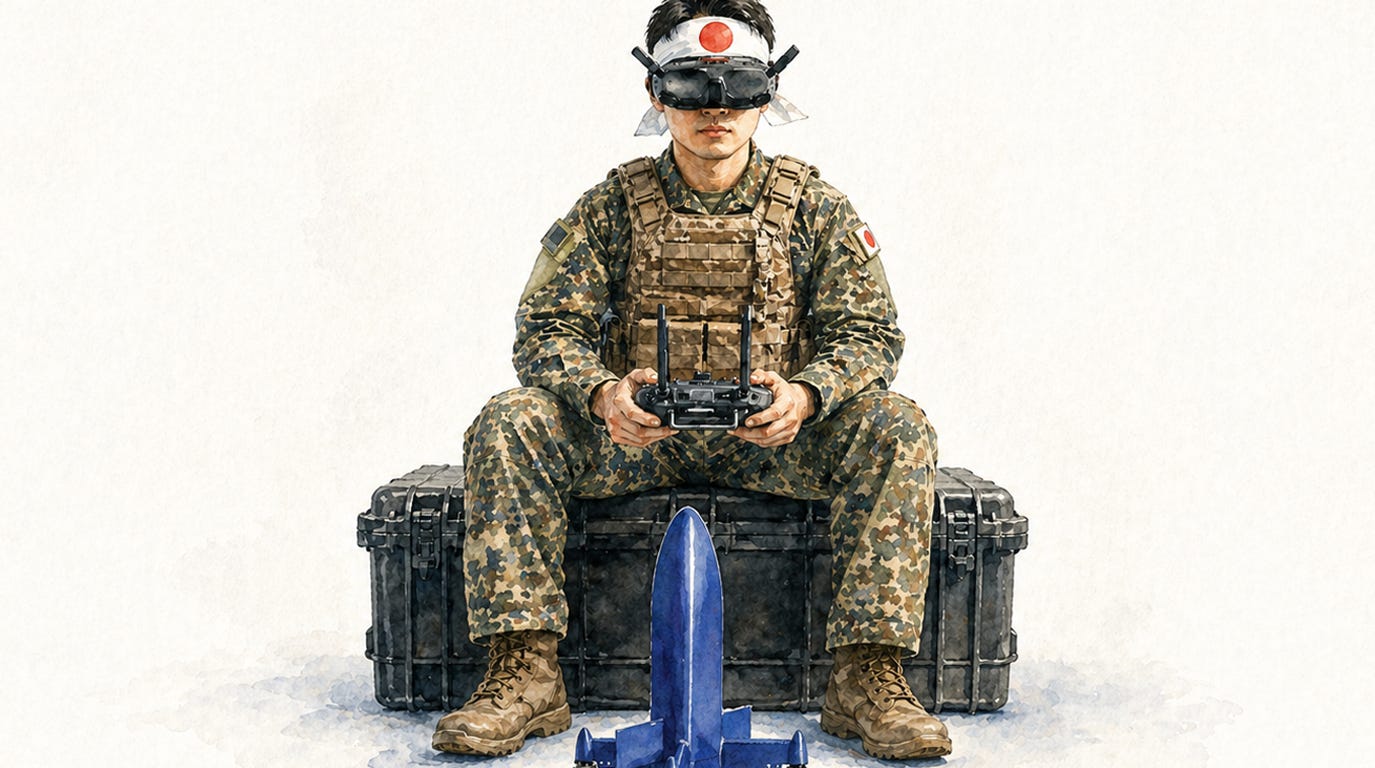
Japan’s postwar defense industry was built for caution. Ukraine’s drone war rewards speed. That tension is now playing out in Terra Drone Corporation’s deployment of the Terra A1, an interceptor drone developed with Ukrainian partner Amazing Drones. The rollout is modest. Its implications are not.
We publish this newsletter every day at 9:05am NYC time / 4:05pm Kyiv.If you’re not already subscribed, why not do so now?
For Toru Tokushige, CEO and founder of Terra Drone, the logic behind the move is straightforward. “Drones have become a game changer in the new world,” he says, recalling his first exposure to Ukraine’s battlefield innovations. His firm, which built its business in industrial drones, had “technology, good experience in mass production, and some money.” What it lacked was something harder to manufacture: “combat-proven experience.”
Ukraine offers precisely that. Since Russia’s full-scale invasion, the country has become a laboratory for rapid military innovation, particularly in unmanned systems. Iteration cycles that would take years in peacetime procurement now unfold in months. “In Ukraine, every two or three months, a new product or solution appears,” Tokushige says.
Japan’s postwar defense industry was
built for caution.Ukraine’s drone warrewards speed.
The Terra A1 reflects those conditions. It is not a technological marvel so much as an economic proposition. With a top speed of roughly 300 kilometers per hour and a range of about 32 kilometers, it is designed to intercept slower, cheaper drones such as Iran-designed Shaheds. But its real advantage lies in cost. Where interceptor missiles can run into the millions, drones like the A1 aim to offer a scalable alternative.
The imbalance has become difficult to ignore. “A Shahed costs around $30,000 to $50,000, while a missile costs $2 million or $3 million,” Tokushige says. “Using missiles to strike Shaheds is not a good approach.” The conclusion is increasingly shared across modern battlefields: high-end systems are ill-suited to counter mass-produced threats.
For decades, such a partnership would have been unlikely. Japan long restricted arms exports under its postwar pacifist framework, limiting them largely to non-lethal categories.
That realization is reshaping not only tactics but also industrial strategy. Rather than exporting finished systems, Terra Drone has chosen to partner with a Ukrainian firm that has already adapted to the realities of electronic warfare, supply constraints, and constant battlefield feedback. The arrangement is, in Tokushige’s words, “like a marriage”—one that required repeated visits to build trust and understanding.
For decades, such a partnership would have been unlikely. Japan long restricted arms exports under its postwar pacifist framework, limiting them largely to non-lethal categories. That changed in April, when Prime Minister Sanae Takaichi’s government scrapped the remaining ban, opening the door to exports of combat drones and other weapons as part of a broader effort to strengthen the country’s defense industry and deepen cooperation with allies.
“We have to consider a situation where many missiles and many Shaheds come at the same time,” Tokushige says. “That has already happened in Ukraine. We have to take it seriously.”
The shift reflects mounting concern in Tokyo over regional threats, particularly from China and North Korea.