The Epstein files debacle may go down as one of the most insane and reckless public investigations in American history.
Having one’s name appear somewhere in the vast trove of documents haphazardly disseminated by the administration is widely seen as legitimate grounds for public denunciation. In many cases, public figures like have been castigated for the severe crime of having once briefly exchanged an email with Epstein, in which Harris turned down an invitation to meet.
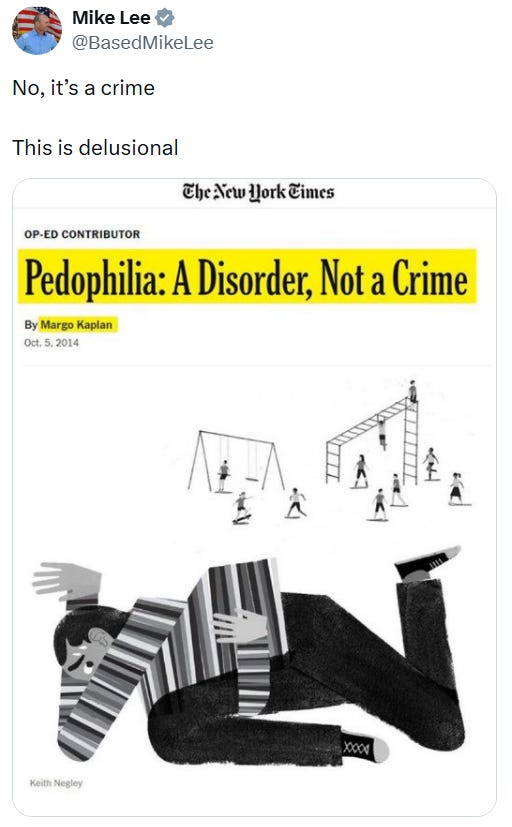
We read repeatedly that Epstein “went to jail for pedophilia,” in the decades before high-profile figures consorted with him. This would be surprising because no one in history has gone to jail for pedophilia. Pedophilia refers to attraction to minors. That is not a crime. What is a crime is sexual abuse of minors. If you are attracted to minors but do not sexually abuse them, then you don’t go to jail. If you are not attracted to minors but DO sexually abuse them, you still go to jail. This is entirely appropriate; the law should punish people based on their actions, not their mental states. This point is apparently too complex for various members of Congress who either don’t get it or are pretending not to.
The crime for which Epstein pled guilty was having sex with a 17-year-old on the day before her 18th birthday. That is surely not all he did, and for his other sex crimes, he should have been imprisoned. But it simply isn’t true that he was jailed for pedophilia. Pedophilia, as one will learn if they even so much as skim the Wikipedia page on the topic, is “sexual attraction to prepubescent children.” It is not true that Epstein was jailed for sexual attraction (or even sexual contact) with prepubescent children preceding his interactions with the cast of characters routinely being excoriated for their associations with him.
Why do I point this out? Because [If It’s Worth Your Time To Lie, It’s Worth My Time To Correct It](http://If It's Worth Your Time To Lie, It's Worth My Time To Correct It)**. **And how to think about those who consorted with Epstein is partly a function of what Epstein was actually convicted of. If you say things that are false, and other people point that out, the burden isn’t on them to explain why they would correct the record: it’s on you to explain why you were willing to publicly lie about something easily checkable.
It has been widely seen as legitimate to share all of Epstein’s emails, with a few names redacted here and there. Those with whom he exchanged brief chit-chat have been pilloried. Those closer to Epstein—like Noam Chomsky—have been publicly lampooned by many of their former friends and acolytes. Being “in the Epstein files” is seen as sufficient proof of malfeasance even if one only briefly spoke with Epstein and no evidence of misconduct was uncovered.
This seems like a rather severe violation of privacy. Having tens of millions see confidential emails that you sent is bad enough (and this is the fate of a sizeable fraction of people who emailed Epstein at any point, for any reason). Yet when many of these people believe hysterical conspiracy theories including—in the case of one of our esteemed representatives—that Epstein and co were eating babies, it is particularly irresponsible. In any other case with less deranged public hysteria, there would be serious unease with sharing *nearly all of a man’s private correspondence *with the world. Amazingly, the administration so thoroughly botched the release of the documents that they made public the names of many of the alleged victims, against their will—an event described as “the single most egregious violation of victim privacy in one day in United States history.”
We learn from the Epstein files that a certain Yale professor emailed Epstein describing one of his students as “a perfect editoress” in part because she was a “v small goodlooking blonde.” This is undoubtedly gross behavior. But the public does not have some blanket right to know every immoral thing everyone ever did. Mere curiosity does not license trampling over the privacy of random citizens, who are neither public figures nor implicated in any way beyond sending creepy emails. This remains equally perverse even if the private citizen briefly consorted with Jeffrey Epstein.
Certainly Epstein committed serious crimes. Had he survived, it would have been appropriate for him to spend many years in jail. But this is a far cry from the almost mystical belief that mere association with Epstein is enough to taint one’s character.
Take Chomsky, as an example. His correspondence with Epstein began in 2015. This has been claimed, by those shrilly denouncing him, including former book coauthors and friends, to be evidence of such hideous misconduct that they cannot in good conscience even sit this one out. They are apparently compelled by their conscience, as a matter of duty, to publicly denounce their 97-year-old former hero, debilitated by a stoke so thoroughly that he can’t even mount a defense.
So Chomsky’s crime is that he consorted with Epstein about a decade after Epstein had finished serving prison time. Now, Epstein was accused of far more, but I don’t think it can be reasonably expected that one go judiciously snooping through old newspaper articles about the alleged misconduct of a friend, for which the friend was not even convicted. If one actually reads Chomsky’s correspondence with Epstein, there is no indication that he is aware of the severity of Epstein’s offenses.
As it happens, many years ago my family had over a convicted murderer, who had served his sentence, for Passover Seder. Does this merit public denunciation? Should I perhaps, like Chris Hedges, write a polemic denouncing my mother and father? The general standard, at least in most other cases, seems to be that once a person has finished serving their jail time, they are integrated back into society. If this is done with thieves and murderers, is there any reason that it shouldn’t be done with those convicted of having consensual sex with a 17-year-old? (Note: I am not saying this is all that Epstein did, only that this was all Epstein was convicted of at the time many of his friends knew him).
Perhaps this was irresponsible behavior. Perhaps even Chomsky and others acted somewhat badly by consorting with Epstein. But in the hierarchy of sins, this one seems minor. Consorting with a criminal who went to jail for thirteen months almost a decade after he was released is much less bad than a number of things that most people would do.
America is not unfamiliar with these kinds of moral panics. Sexual abuse of children is a real thing and it is among the worst crimes a person can commit. The world should do what can be done to root it out. Yet this noble impulse led, decades ago, to jailing innocent preschool teachers based on wild and hysterical claims of Satanic cabals sexually abusing children. We would be wise not to make the same mistake today.
There is always a new scandal used to justify the erosion of civil liberties. For McCarthy, it was communism. For Japanese internment, it was the war with Japan. Yet we have civil liberties precisely so that people’s rights aren’t trampled on whenever the public demands it. The Epstein overreach similarly starts from a legitimate impulse. Yet it has become hysterical madness, more reminiscent of Salem than the modern criminal justice system.
Unfortunately, in this case, nobody (save ) is willing to call out the lunacy. For left-wingers, vague Epstein-related innuendo has become politically beneficial. For high-profile right-wingers, denouncing the hysteria would lead to their base turning on them and claiming that they are implicated. Nobody has any incentive to call out the overreach or admit that a brief appearance in the maelstrom of documents that comprise “the Epstein files” is no decisive evidence of egregious misconduct.
The sensible response to the Epstein affair is the same as the response to other crimes. If people are credibly accused of crimes, they ought to be convicted. The fact that this case is higher profile than others is no reason for Epstein’s emails to be shared with the world, any more than Ted Bundy’s infamy is a reason for the sharing of his private letters. The public has no right to know everyone Epstein was ever in contact with, nor do those who briefly interacted with Epstein have any duty to apologize or explain their actions. The madness, at some point, must end.