For daily news, updates, and analysis, be sure to follow us on Instagram. If you are able to support independent journalism, please make a tax-deductible donation to News Not Noise here.
We have entered the era of permanent technical difficulties.
Last week it was Microsoft and the FAA. Today it’s the banks. And now United Airlines. Let’s hope social media is next. (Kidding. Not kidding?)
Perhaps this was inevitable when our lives depend on technology, our infrastructure is decades overdue for an upgrade, and our politics treats keeping things working as sinister acts of big government.
The theory is that last week’s FAA outage involved aging infrastructure overwhelmed by new technology. But there’s another possibility: a cyberattack. So how do we distinguish a hostile act from a government that can’t keep the lights on?
I asked a national security source. The response: “In a sufficiently stupid administration, gross incompetence and an attack are indistinguishable.”
Which makes it reassuring that the next Congress will finally conduct some oversight. Until then, back up your devices.
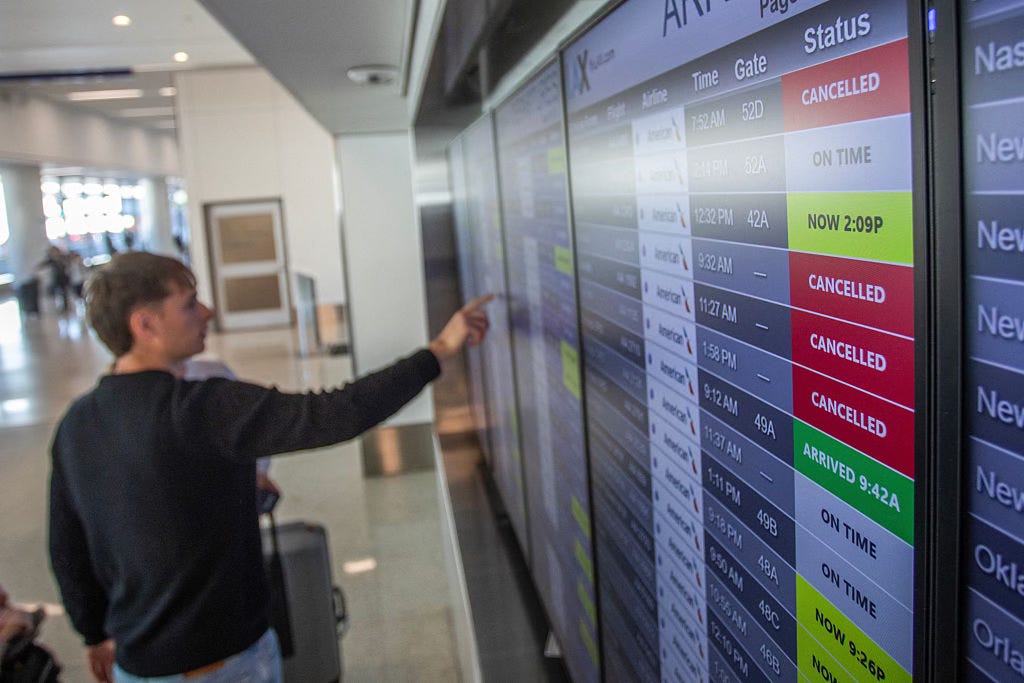
More SNAFUs: Two more massive technical issues struck in quick succession today:Stuck on the Ground: United Airlinesapologizedfor a technical issue that it said caused a “widespread system outage” impacting departing flights. Though the problem lastedless than an hourbefore being resolved, it delayed hundreds of flights Monday afternoon. It wasreportedly unrelatedto the issue that forced the FAA to ground flights nationwide.Don’t Bank On It: Thousands of people across the countryreported problemsaccessing key banking services. Chase blamed a “technical issue,” not a cyberattack, whichapparently causedknock-on effects in the financial system. They assured customers accounts are still secure; the issue is with online banking.
Up In The Air: The effects of the FAA’s rare nationwide ground stop are mostly worked out, but key questions remain about what caused it and how to prevent a repeat. The Trump administration blamedtwo routers, one in an Arkansas facility that was just upgraded from copper wire to fiber optic cable, and one in a Texas facility that had been upgraded weeks ago; they claimboth floodedthe FAA’s outdated telecommunications network, causing failures and forcing the agency to shut the whole thing down. Officials aren’t sure why the routers failed. Multiple aviation and national security sources News Not Noise spoke with suspect the rollout of a new AI system and other software upgrades overloaded old infrastructure; they also wouldn’t rule out cyberattacks. See my reporthere. There are reports that the𝕏FBI may have taken possessionof therouters. Officials𝕏denied that, saying the FBI is merely “assisting” the FAA and L3Harris’ investigations. Transportation Secretary Sean Duffyrefused to apologize, blaming previous administrations andL3Harris, the contractor responsible for maintaining and upgrading the FAA’s telecommunications network. Not everyone buys it. One expertsaidthe idea a router could “take down a national network is just not plausible.”Sky-High Request: The administration wants Congress to give the FAA$50 billion, which Duffy claims is necessary to fund an entirely new telecommunications network. Hehasn’t broken downwhere the money would go, and his previous request, for about $30 billion, wasmostly intendedfor improving airport terminals. Democratsnotedthe FAA has spent less than 10% of the $12.5 billion Congress gave it last year. Duffyclaimshe can’t use those funds for new telecommunications architecture — but lawmakersspecifically earmarked$4.75 billion for “telecommunications infrastructure modernization.” Critics see the request as another way for Team Trump to funnel taxpayer dollars to private companies.Long Haul: America’s air traffic control communications network isinfamously outdated, and modernization is taking far longer than in other countries. The Trump administration accelerated things last year, prompting the nonpartisan Government Accountability Office towarn recentlythat its plan “could be prioritizing speed over costs and air traffic disruptions.” L3Harris, the contractor thatownsand is updating the FAA’s communications system, makes about75% of its revenuefrom the federal government, and earns roughly $1 billion a year in profit. Last year itagreed to pay$63 million to settle accusations it lied about prices of contracts with the Pentagon. Shortly before that it wastapped to handletheretrofittingof Trump’s Qatar-gifted Air Force One. The administrationwants to payAT&T, which reportedly donated millions to Trump’sinaugurationandballroom, to build an entirely new network.
Follow the Money: Administration officialsinsistedthere is no evidence that a cyberattack or the FAA’s new AI toolwere involved. That tool, called “SMART,” cost $875 million, and was recently rolled out nationwide. The contract went to a startup called ASI, whichgave thousandsof dollars in campaign donations to Duffy’s son-in-law and is backed by companies like Andreessen Horowitz that havedonated millionsto Trump-aligned PACs.
Reboot: The Nvidia scandal is dividing Silicon Valley and the Trump administration. The company’s boardreportedlyruled out reinstating disgraced founder Jensen Huang, who was said to bediscussinga potential comeback with a “war room” of key allies in Silicon Valley. He has widespread support, including from fellow tech titans like Elon Musk, Trump, and more than 186,000 people — including tens of thousands of shareholders and thousands of employees — who signed anopen lettercalling for his reinstatement. One problem, his alliesadmit, is rehabilitating his reputation — not to mention the legal liability of extramarital affairs with an alleged Chinese spy and two work subordinates. Not everyone is on board. Treasury Secretary Scott Bessentcalled fora “dramatic shake-up” in Nvidia’s leadership. Heaccused the companyof using “seemingly illicit sales to goose their revenues.”Chipping Away: Nvidia will report itsquarterly earningstomorrow. Investors are paying close attention to the money coming from sales to China. They’ll also look at sales to Southeast Asia, where companiesbuild data centerswith advanced Nvidia chips and sell access to Chinese firms. It’s a major loophole in America’s AI chip restrictions. Commerceclosed it todayby restricting chip sales to companies in several countries. Commerce Secretary Howard Lutnickreportedly resistedthe move for months; his family firm, Cantor Fitzgerald, has done huge business with data center companies it affects (and holds millions in Nvidia stock). Trump𝕏acknowledgedthat Lutnick delayed blacklisting Megaspeed, the firm suspected of smuggling billions of dollars of advanced Nvidia AI chips to China. But hedefended Lutnick, saying he’s trying to keep relations with China on track.**Coincidence?**Last year, Nvidiaquietly stopped breaking outrevenue from Singapore, where Megaspeed is based. In the quarter before the change, more than a fifth of Nvidia’s revenue came from Singapore.Just Reward: Commerce isexpectedto name Nvidia as one of more than two dozen AI “national champions.” Theprogramoffers faster export approvals and government support, including federal funding, for overseas sales.
Oh, Also: Trump’sNvidia investmentsgained millions in value over the past two years.
Jetsetter: Trumpheads to the Philippinestoday for the annualASEAN summit, where he’s expected to meet with the leaders of India, Japan, and Australia, America’s partners in a group calledthe Quad. Then Trump will go to China, where he’ll hold a raretrilateral meetingwith China’s Xi Jinping and Russia’s Vladimir Putin. (One might theorize that if we are under cyberattack, the timing of this meeting is no coincidence.) Expertsdon’t expectmajor deals, but topics could includenuclear disarmament, Iran, andUkraine. Trump mayalso meetNorth Korea’s Kim Jong Un, whom herecently calleda “friend.”Round 2: Lindsay Clancy, the Massachusetts mother accused of killing her three young children in 2023, will beretriedin March on thesamefirst-degree murder charges. Her first trial ended in a mistrial when asingle juror held out. (Catch up on thathere.) The judgerejectedthe defense’s motion to dismiss.More Meddling: Ukraine’s access to Starshield, the military version of SpaceX’s satellite internet service Starlink, is againbeing restricted, this time in Russian-occupied areas. SpaceXdeniesit; Volodymyr Zelenskyyaccusedthe Musk-owned company of lying. He warned the restrictionsexposethe country’s energy infrastructure to Russian attacks as winter approaches, andhave“very dangerous” political implications — i.e., “partially recognizing the temporarily occupied territories” as belonging to Russia. Zelenskyyalso saidU.S. negotiators Jared Kushner and Steve Witkoff asked if Ukraine would cede the Donbas region to Russia in return for NATO membership or similar security guarantees.New Approach: New York City isdisbandingthe NYPD’s Strategic Response Group, a controversial policing unit that dealt with both terrorism and protests, Mayor Zohran Mamdani announced. Created in 2015, the unit drewwidespread criticism, including from aformer officialwho helped create it, andmultiple lawsuitsover…