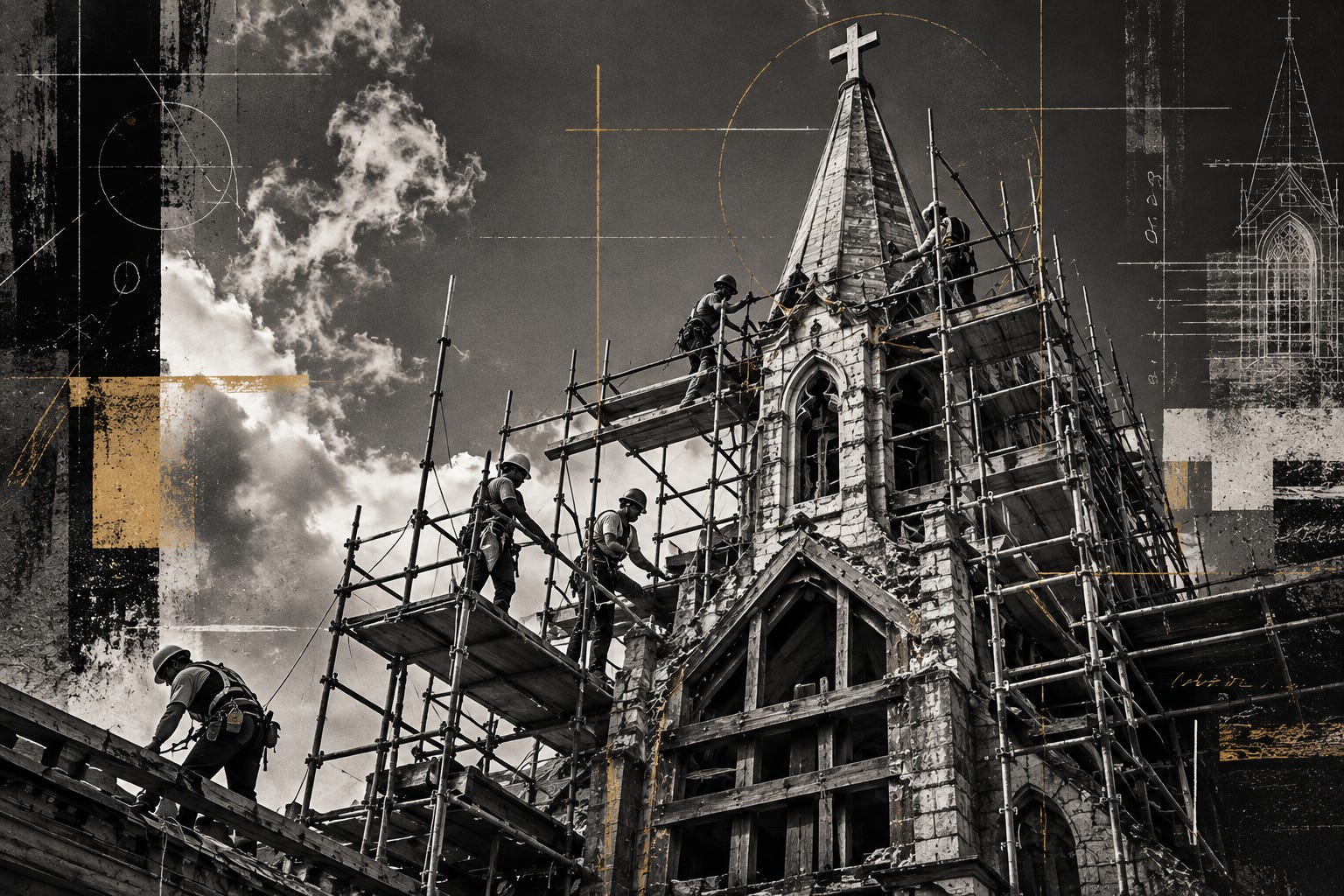
Religious reformations rarely begin because institutions decide it is time for renewal. They emerge when inherited structures no longer seem adequate to the world people are actually inhabiting. The Protestant Reformation challenged concentrations of ecclesial authority and transformed the relationship among scripture, church, and individual conscience.
Earlier and later reform movements confronted corruption, institutional power, theological rigidity, access to sacred knowledge, and the distance between religious ideals and religious practice. Whatever judgments we make about their outcomes, reformations occur when the existing religious architecture no longer holds the questions of its age.
We are living through another such historical threshold, though the pressures now extend far beyond religion. What is increasingly described as the metacrisis brings together ecological instability, technological acceleration, political fragmentation, institutional distrust, loneliness, information saturation, and the weakening of shared cultural narratives. Alongside it sits a meaning crisis: a growing difficulty locating our lives within frameworks capable of sustaining identity, belonging, purpose, and orientation.
Artificial intelligence intensifies the stakes. Humanity is building systems capable of participating at extraordinary scale in the production of knowledge, interpretation, persuasion, creativity, and meaning. The challenge concerns more than what these technologies might become. It includes what human beings are becoming while developing and living alongside them. Our capabilities are expanding faster than many of the psychological, moral, social, and existential capacities required to bear them wisely.
This is why I believe our moment calls for another reformation. Not primarily a rearrangement of doctrines, denominations, worship styles, or institutional strategies, but an existential reformation - one that asks what religion is forming in the human beings who inhabit it.
For much of the last several years, when I have written about religion, I have been writing about what happens when religion goes wrong. I have been interested in the damage done by high-control religious systems, the erosion of self-trust, the outsourcing of authority, the fear that follows people long after they stop believing, and the difficult work of constructing a life when the worldview that once held everything together no longer does.
That work remains necessary. There are people carrying injuries inflicted in the name of God who deserve language for what happened to them. Religious deconstruction has exposed forms of coercion and spiritual abuse that were too easily defended as faithfulness. Those realities should not be minimized simply because they make religious institutions uncomfortable.
But critique has its limits. Religion is not disappearing, nor do I think the only meaningful future available to humanity is one in which it does. Billions of people continue to inhabit religious traditions, communities, practices, symbols, rituals, and stories. For many, these are not merely inherited remnants from an earlier age. They remain living sources of identity, moral imagination, belonging, consolation, transcendence, and meaning.
There are also important nuances in any serious conversation about religion that deserve investigation beyond familiar arguments over whether it is simply good, bad, true, or false. Fields such as the anthropology, philosophy, and psychology of religion reveal a far more complex human phenomenon: a carrier of ritual and collective memory, a structure for meaning-making, a source of social cohesion and moral imagination, and an enduring response to mortality, uncertainty, suffering, and the unknown.
I recently explored some of these dimensions in ** How Religion Saved Our Species: Why Big-R Religion Was Humanity’s Greatest Evolutionary Innovation**, arguing that organized religion should be understood partly as an extraordinary human adaptation that helped large populations create shared worlds and coordinate life together.
None of this history excuses religious coercion or institutional harm. It makes the present challenge more consequential: religion has been one of humanity’s most powerful technologies for organizing our existential lives, and that power could now be consciously directed toward developing our capacity to be human.
This leaves us with a question that interests me more than whether religion will survive modernity. What if religion itself underwent an existential reformation?
Not another rearrangement of doctrine. Not a new worship style, denominational structure, political strategy, or attempt to make church more culturally relevant. I mean something more fundamental: a reformation organized around what religion is doing to the human beings who inhabit it.
The central question would no longer be only whether a religious system successfully transmits its beliefs. It would also ask whether participation in that system strengthens a person’s capacity to inhabit reality, exercise agency, live with uncertainty, encounter mortality, sustain meaningful belonging, develop self-trust, and participate responsibly in the unfinished experience of being human.
That is where I believe Existential Health offers religion something it urgently needs. If you have not been following my development of the field of existential health, you can explore my series, ** The Existential Health White Papers: Volume One**.
Religion is usually discussed in theological categories. We debate what different traditions believe about God, salvation, revelation, morality, scripture, human nature, suffering, death, and whatever might exist beyond it. Sociologists examine institutions and communities, historians trace traditions through time, psychologists study belief and behavior, while critics assess religion’s relationship to power, politics, violence, sexuality, gender, and social control.
All of these perspectives matter. Yet beneath them lies something more elemental. Religion has always been one of humanity’s primary responses to the existential conditions of being alive.
We arrive in a world we did not choose, inhabit bodies we did not design, and find ourselves among people whose recognition matters enormously to us. Love exposes us to loss. Consciousness allows us to anticipate our own death. Suffering arrives without asking whether it fits our philosophy. Identity must somehow be constructed amid histories, cultures, families, bodies, accidents, relationships, and circumstances that preceded our ability to choose them.
Meaning is not an abstract philosophical hobby inside such a life. Neither are belonging, mortality, uncertainty, agency, identity, or purpose. They are part of the terrain through which every human being must travel.
Religion emerged, among other things, as a way of inhabiting that terrain.
Its stories located individual lives inside larger narratives. Rituals gave communities ways of marking birth, adulthood, union, separation, suffering, death, harvest, catastrophe, gratitude, and renewal. Myths placed human existence within a cosmic frame. Prayer provided language for longing and fear. Communities carried people through experiences too large to carry alone. Traditions preserved encounters with questions no generation had solved once and for all.
Seen this way, religion is not merely a collection of metaphysical claims. It is an existential technology developed across generations for helping human beings live inside realities they could neither control nor completely understand.
That does not make religion inherently healthy. Powerful technologies amplify possibilities in more than one direction.
The paradox of religion is that a system created to help people inhabit the human condition can gradually become a way of escaping it.
Uncertainty becomes especially difficult for institutions organized around certainty. Mystery threatens systems built upon authoritative explanations. Individual discernment becomes dangerous when institutional stability depends upon obedience. The ambiguity of human identity creates problems for communities that require clearly defined roles. Reality itself becomes disruptive when evidence contradicts interpretations that the group considers sacred.
At that point, religion begins doing something existentially significant. Rather than increasing people’s capacity to encounter reality, it increasingly filters reality through an authorized framework.
I have seen the consequences of this both personally and through years of conversations with people leaving high-control religion. Many were given answers before they had developed the freedom to ask their own questions. They learned where authority resided, which emotions were trustworthy, which desires were suspicious, what kind of person they were supposed to become, and what interpretations of their experience were permitted.
For some, the system worked remarkably well ** until reality exceeded it**.
A marriage collapsed despite years of prayer. A child rejected the family’s beliefs. Scientific knowledge complicated inherited doctrine. Sexuality refused to conform to theological categories. Grief resisted explanation. Moral conscience came into conflict with institutional teaching. A trusted leader abused power. Prayer stopped producing the sense of divine presence it once had. The person discovered that questions they had been taught to regard as dangerous were actually their own.
The crisis that followed was often described as a crisis of faith. I increasingly understand it as something larger. It was frequently a crisis of existential development.
A religious structure had supplied coherence, identity, belonging, authority, and meaning, but the person had not necessarily developed the internal capacities required to negotiate those dimensions of life when the structure stopped supplying them. What appeared to be spiritual failure was sometimes the painful beginning of self-authorship.
This distinction matters because it changes the problem religion must confront.
Religious communities understandably care whether people believe their teachings. Christianity, Islam, Judaism, Buddhism, Hindu traditions, and other religious worlds contain distinct truth claims that cannot simply be collapsed into a generic spirituality without losing something important.
Existential Health does not require that collapse.
It does not need to decide whether God exists, whether revelation occurs, whether consciousness survives death, whether mystical experience discloses an ultimate reality, or whether a particular religious tradition correctly understands the cosmos. Those questions belong to philosophy, theology, metaphysics, personal conviction, and ongoing human inquiry.
Existential Health asks a different kind of question. What is happening to the human being in relationship with these beliefs?
A doctrine can be held with intellectual humility or enforced through fear. Scripture can deepen moral imagination while also becoming an instrument for shutting down moral discernment. Community offers durable belonging at its best, yet acceptance sometimes becomes conditional upon conformity. Prayer can deepen a person’s contact with reality or provide a means of refusing realities they cannot tolerate. Spiritual authority, practiced wisely, offers guidance and companionship while respecting agency; practiced differently, it gradually teaches people to distrust themselves.
The same religious vocabulary sometimes conceals profoundly different existential environments.
This is why arguments about whether religion is generally beneficial or harmful rarely get us very far. Its expressions are too diverse, and human participation in them too complicated, for such sweeping judgments. A more useful question concerns what particular environments cultivate in the people who inhabit them.
That is the question beneath the theological questions: What kind of human being is this religious world helping someone become?
My work in Existential Health begins with the relationship a person has to the fundamental conditions of being human. Meaning, identity, belonging, agency, mortality, uncertainty, spirituality, self-trust, relationship, and reality itself are not problems we solve once and leave behind. They remain dynamic dimensions of a life.
Health in this context does not mean permanent psychological comfort. A person with strong existential health still grieves, doubts, changes, fears death, experiences disorientation, and encounters periods when life does not make sense. The difference lies in the capacity to remain in relationship with those realities without requiring immediate escape, denial, or externally supplied resolution.
Bringing this framework into religion changes what we notice.
Consider uncertainty. A church might regard uncertainty primarily as a deficiency of faith and devote enormous energy to resolving it. An existential approach would ask whether people are developing enough capacity to remain present when certainty is unavailable.
Consider belonging. A congregation might appear extraordinarily close-knit while its cohesion depends upon agreement with a prescribed worldview. Existential Health asks whether belonging is sturdy enough to survive difference, development, questioning, and change.
Agency raises similar questions. Religious communities inevitably transmit values and shape moral imagination; every culture does. The relevant issue is whether this formation eventually strengthens a person’s ability to discern and choose responsibly, or whether maturity remains defined as continued submission to external authority.
Even meaning looks different through this lens. Religion has often excelled at supplying comprehensive explanations for why things happen. Existential maturity sometimes requires something harder: remaining present when an explanation is unavailable, resisting the temptation to make suffering meaningful before the person suffering has even had the freedom to experience it.
None of these questions require religion to surrender its theology. They require religion to examine the human consequences of how theology is held.
Religious communities already possess a language of formation. Christianity speaks of discipleship and spiritual formation. Other traditions have their own disciplines through which people are shaped by practices, teachings, rituals, communities, and ways of life.
The existential reformation would widen our understanding of what formation means.
A mature religious community would not measure development solely by doctrinal knowledge, devotional consistency, participation, moral conformity, or loyalty to the institution. It would also become curious about whether people were growing in their capacity for reality.
Could someone encounter information that complicated a cherished belief without experiencing the information itself as a threat? Could a person disagree with a religious leader without losing access to their own belonging? Would someone know how to make a difficult moral decision when no rule clearly settled it? Could grief remain unresolved without being hurried toward a theological conclusion?
Formation would also include learning to distinguish faith from certainty. The two have often been treated as synonyms, even though much of what human beings call faith begins precisely where guarantees end. A spirituality incapable of tolerating uncertainty eventually requires increasingly elaborate defenses against reality.
Religious formation at its best should not create people who need the world to confirm everything they already believe. It should develop people capable of encountering the world without immediately retreating from whatever complicates their understanding.
That would represent a profound shift in religious imagin…