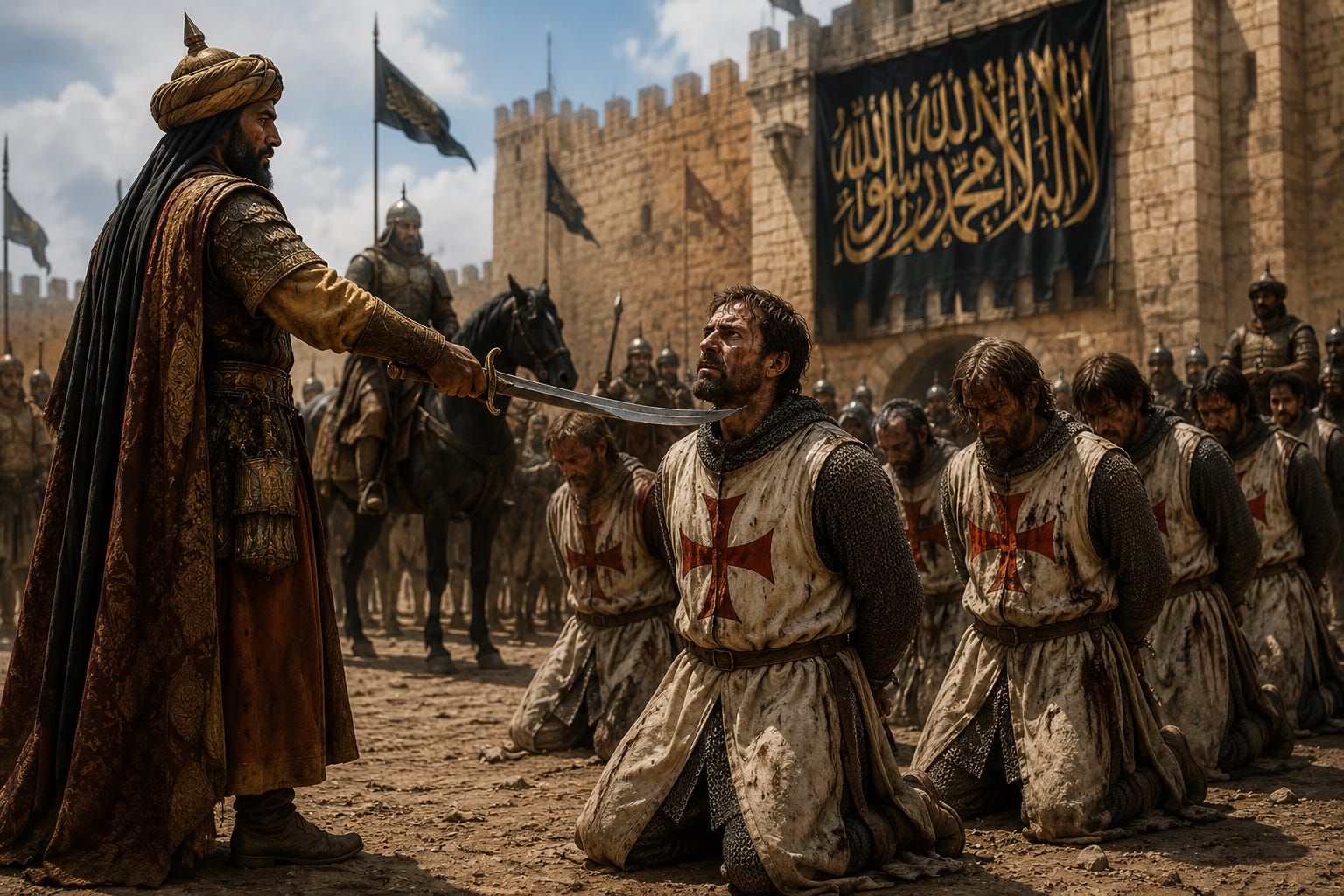
Today in history, on July 23, 1266, one of the greatest fortresses of Christendom—and one of Islam’s most hated—fell after six weeks of heroic resistance.
The mighty Templar castle of Safed dominated Upper Galilee from its lofty summit. To Christians, it was a bastion of security, protecting pilgrims, villages, and the roads leading inland from Acre. To Muslims it was, as a contemporary Arab writer described it, “an obstruction in the throat of Syria and a blockage in the chest of Islam.”
On this day, that obstruction was finally removed.
Its conqueror was the Mamluk sultan Baybars, the greatest practitioner of jihad since Saladin. Through relentless warfare, calculated deception, and uncompromising brutality, he would systematically dismantle the Crusader states, paving the way for their final destruction a generation later.
Safed was not his first victim.
The previous year, Baybars invaded the Kingdom of Jerusalem and laid siege to the great Hospitaller fortress of Arsuf—even though he was bound to its defenders by treaty. For over a month the Knights of St. John held out against constant bombardment, mining operations, and repeated assaults. At last, with their walls shattered and nearly half their defenders dead, they agreed to surrender only after Baybars personally guaranteed safe passage to Acre.
The promise proved worthless.
The moment the gates opened, every Christian—knights, soldiers, women, and children alike—was seized and enslaved. Many were enslaved and forced to demolish the very fortress they had so valiantly defended before being marched off in chains. Weeks later, Baybars celebrated his triumph in Cairo by parading the captive Hospitallers through the streets with broken crosses hanging around their necks as jeering crowds mocked and assaulted them.
Safed, however, represented a far greater prize.
Originally entrusted to the Knights Templar in 1168, the fortress stood at one of the kingdom’s most strategic locations. After Saladin captured it following the Battle of Hattin in 1187, it eventually returned to Christian hands in 1240—but only as a ruin.
At first, the Templars hesitated to rebuild it. The undertaking would require staggering sums of money and years of labor.
Then Bishop Benedict of Marseille returned from Damascus with astonishing news.
While speaking with local Muslims, he discovered that no fortress inspired greater fear than Safed. According to his companions, there was “no other fortress in that land from which so much damage could be inflicted on the Saracens, so much help brought to Christians, and Christendom so enlarged.”
Benedict immediately sought out the Templar Grand Master, Armand of Périgord, urging him to rebuild the castle. When the Grand Master explained that the project would cost a fortune, the bishop turned to the assembled brethren to remind them—“Your Order was founded... for the protection of Christians and the attacking of the Saracens.”
He then repeated what Muslims themselves had admitted: “There was nothing they feared as much as the building of Safed.”
His words carried the day.
For three years more than one thousand laborers worked almost continuously. The reconstruction consumed over 40,000 bezants—an enormous fortune—but the result justified every coin. By 1243 Safed had become perhaps the strongest fortress in the Holy Land, capable of housing roughly 2,200 defenders during wartime.
Its influence extended far beyond its walls.
The roads became safer. Agriculture revived throughout Upper Galilee. Christian pilgrims once again traveled with greater confidence. Templar cavalry launched raids deep into Muslim territory, sometimes approaching Damascus itself. One contemporary observed that thanks to Safed, “the faith of our Lord Jesus Christ can be preached without hindrance,” while “the blasphemy of Muhammad can be publicly disproved.”
Small wonder that Muslim chroniclers viewed the fortress with such dread.
Hence why one Egyptian writer bitterly lamented that Safed was “an obstruction in the throat of Syria and a blockage in the chest of Islam.”
On June 13, 1266, Baybars at the head of a vast Muslim army surrounded the fortress.
Inside stood some two thousand Christians, including roughly fifty Templar knights, several hundred supporting troops, and large numbers of civilians who had sought refuge behind its massive walls. Though vastly outnumbered, the defenders resisted with extraordinary determination.
For six weeks the Mamluks battered Safed with mangonels, siege towers, and relentless assaults. Again and again the Christians repelled attacks that might have broken less formidable men. Yet Baybars possessed one great advantage: time. His army completely encircled the fortress, cutting it off from relief, while incessant bombardment gradually reduced even Safed’s mighty defenses.
Recognizing that brute force alone might prove too costly, Baybars resorted to a tactic he had already demonstrated at Arsuf.
He offered generous terms.
If the defenders surrendered, he promised, every Christian would be permitted to depart safely for Acre.
Many within the fortress, not aware of Baybars’s treachery at Arsuf, urged acceptance. Food supplies were dwindling. The walls had suffered extensive damage. No relief army appeared on the horizon. After nearly six weeks of resistance, exhaustion and despair overcame caution.
The gates were opened.
Once again, Baybars’s solemn oath proved utterly worthless.
The consequences were immediate—and horrifying.
Rather than honor his pledge, Baybars ordered the defenders seized. The Templars were then offered the same choice that had confronted countless Christians before them under jihad: Islam or death.
Continue reading below.
If you value unflinching, historically grounded analysis that mainstream outlets soften or ignore, consider upgrading. Paid subscribers get:
**Several new, full-length articles every week.**Carefully researched pieces you won’t find elsewhere.
Full access to the complete premium archiveArchive of in-depth writing, research, and commentary — all in one place.
Entry into the subscriber chatA private space for serious readers and thoughtful discussion.