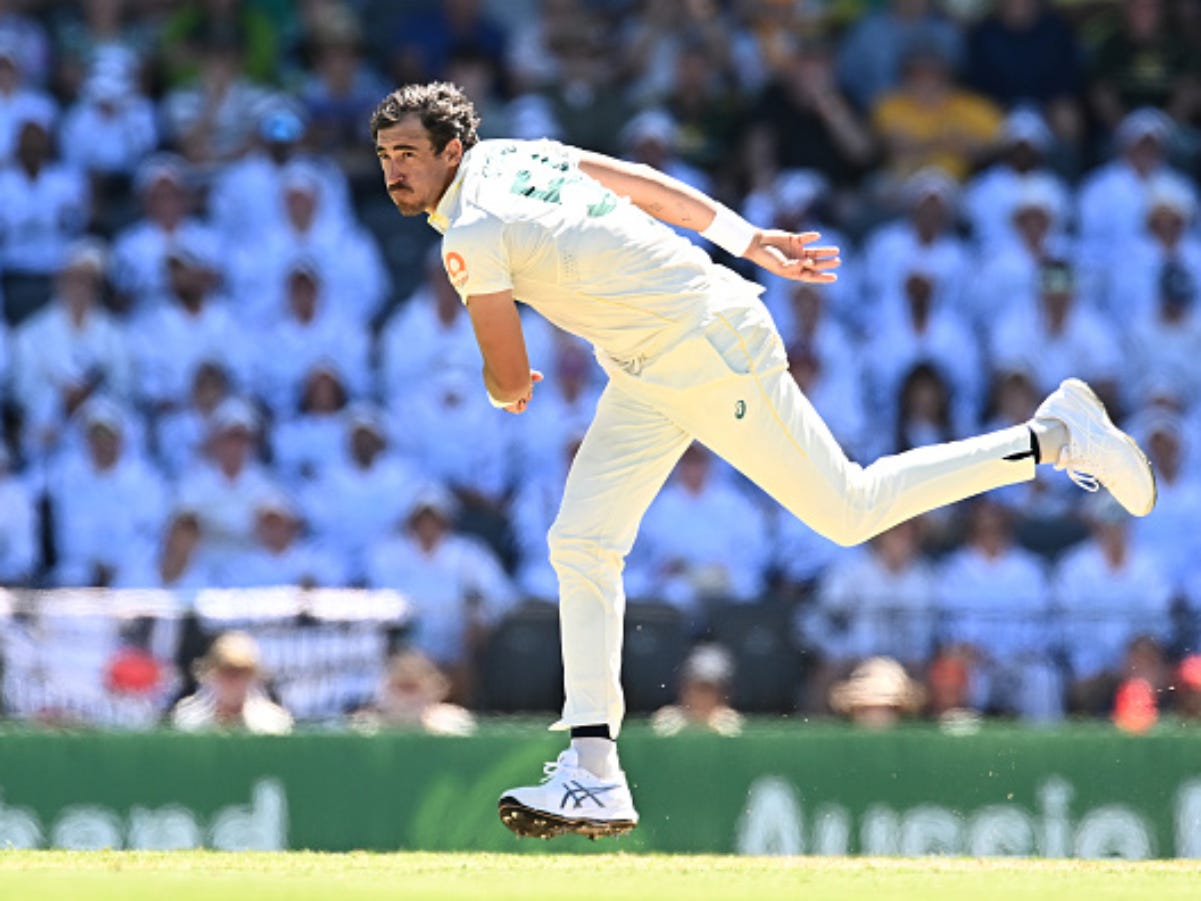
Mitchell Starc needed only one delivery to set the tone in Mackay. Shadman Islam fell to the first ball of the second Test against Bangladesh, the fourth time Starc had struck with the opening delivery of a Test. By the end of the innings, Bangladesh had been bowled out for just 64 and Starc had figures of 6/12 from 10 overs. Five of those wickets came within 22 deliveries, making it the sixth-fastest five-wicket haul in Test history.
The damage did not stop there. Starc returned 4/39 in the second innings to finish with match figures of 10/51, his fourth 10-wicket haul in Test cricket. Australia completed an innings-and-51-run victory inside two days to level the series 1-1. The performance took Starc to 445 wickets from 107 Tests and pushed him into the top 10 among Test cricket’s all-time wicket-takers.
At 36, those numbers would ordinarily be presented as evidence of longevity. In Starc’s case, however, something far more unusual is happening. He is not merely surviving as an ageing fast bowler. Statistically, he has become significantly more destructive.
For a consistent age comparison, Tests can be classified according to Starc’s age when the match began. Australia’s first Test in Galle in January 2025 started one day before his 35th birthday, so the post-35 sample begins with the second Test of that series. Across the 12 Tests beginning after his 35th birthday, Starc has taken 66 wickets while conceding 1,151 runs from 1,898 deliveries. That gives him a bowling average of 17.44 and a strike rate of around 29 balls per wicket.
Compare that with everything that came before.
Across his first 95 Tests, Starc took 379 wickets. He conceded 10,475 runs from 18,415 deliveries, giving him a bowling average of 27.63 and a strike rate of around 48.
Before 35, Starc required around 48 balls for each wicket. In Tests beginning after his 35th birthday, he has required only around 29. The number of deliveries needed for each wicket has fallen by nearly 41 per cent.
Even more remarkably, Starc is doing this while bowling less. Across his first 95 Tests, he delivered 193.84 balls per match. Over the next 12 Tests, that workload has fallen to 158.16 balls per Test. That is a reduction of 18.40 per cent.
His wicket output, meanwhile, has moved sharply in the opposite direction. Starc averaged 3.98 wickets per Test across his first 95 matches. Since then, he has taken exactly 5.50wickets per Test. That is an increase of 37.8628 per cent. Australia are effectively getting substantially more wickets from substantially fewer Starc deliveries.
The Benjamin Button reference is an easy one to understand. In the fictional story, Benjamin Button ages in reverse, appearing to grow younger while everyone around him gets older. Starc obviously cannot reverse the biological clock, but his career numbers increasingly resemble the sporting equivalent.
Fast bowlers are normally expected to lose some combination of speed, penetration and durability as they enter their mid-30s. Starc’s wicket-taking numbers have instead improved dramatically.
The clearest example came in 2025. Starc took 55 wickets from 11 Tests during the calendar year. He conceded 953 runs from exactly 1,560 deliveries, leaving him with a bowling average of 17.32 and a strike rate of 28.36.
There have been 108 instances in Test history of a bowler taking at least 50 wickets in a calendar year. None produced a better strike rate than Starc’s 2025 campaign. Waqar Younis took 55 wickets in 1993 at a strike rate of 29.5, while Jasprit Bumrah’s 71 wickets in 2024 came at 30.1. Starc’s 28.36 was better than both.
He also needed only 1,448 deliveries to reach his 50th Test wicket of 2025. Only Waqar, who required 1,393 balls to reach 50 in 1993, has reached that landmark faster within a calendar year.
And 2026 has not brought the expected regression. Across three Tests this year, Starc has taken 17 wickets while conceding 310 runs from 548 deliveries. His bowling average is 18.23, and his strike rate is 32.23.
Perhaps nothing captures his unusual ageing curve better than the timing of his most destructive spells. In his 100th Test against West Indies in Jamaica in July 2025, Starc completed a five-wicket haul in just 15 balls.
It was the fastest five-for in Test history. At Mackay, in his 107th Test, Starc required only 22 balls to reach five wickets. Two of the six fastest five-wicket hauls ever recorded in Test cricket have therefore come after Starc turned 35.
His frequency of major hauls tells a similar story. Across his first 95 Tests, Starc collected 15 five-wicket innings hauls and two 10-wicket match hauls. Across his next 12 Tests, he has already added four five-fors and two 10-fors. Half of the 10-wicket match hauls in his entire Test career have come in these 12 Tests alone.
Nor can the improvement simply be attributed to favourable Australian conditions. Across five Tests played away from home or at a neutral venue in this period, Starc has taken 23 wickets while conceding 388 runs. His bowling average is 16.86. Across seven home Tests, he has taken 43 wickets for 763 runs at an average of 17.74. His numbers have been exceptional, almost regardless of location.