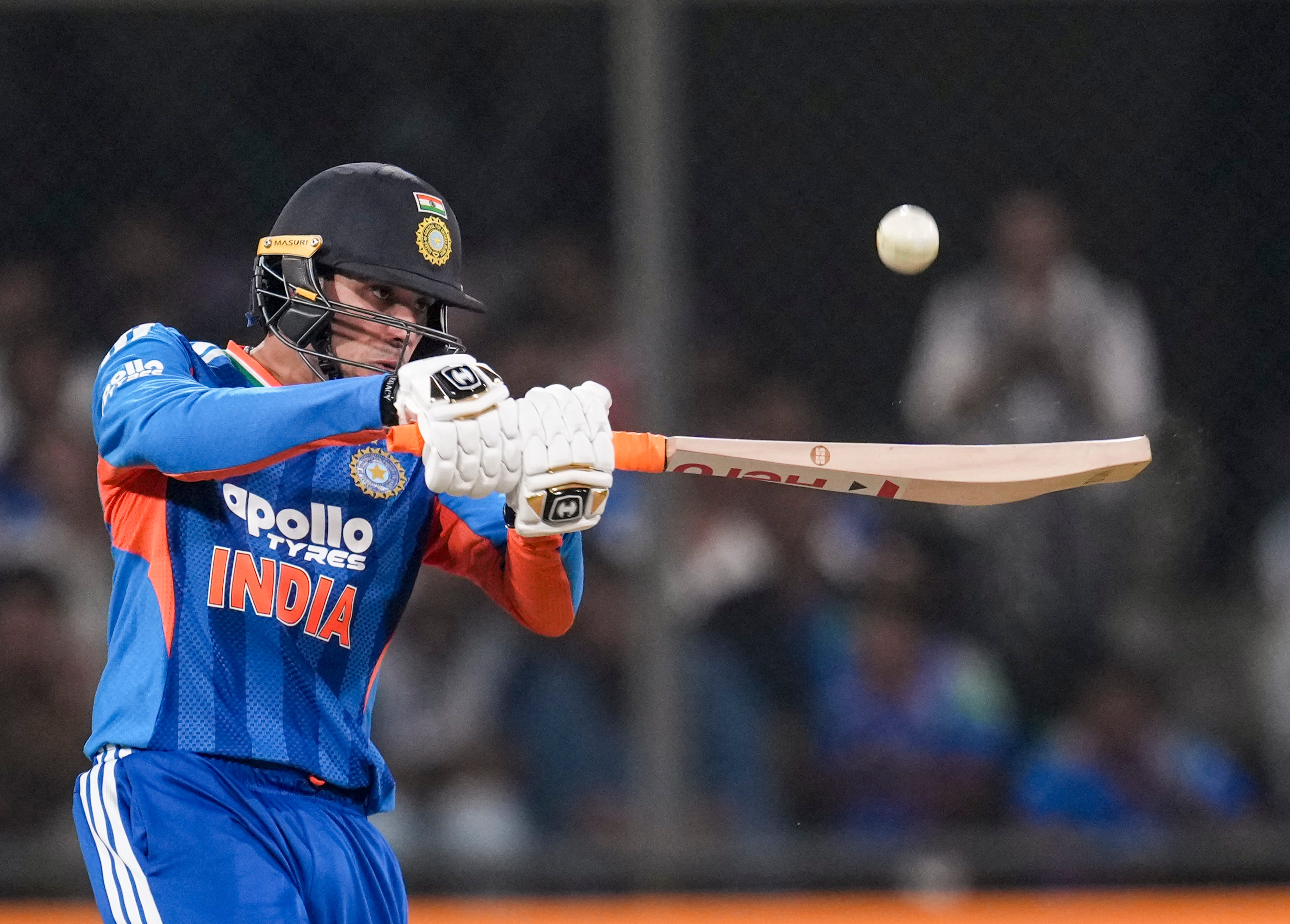
India are currently 2-1 up in the ongoing five-match T20I series against West Indies. But that lead does not reflect a problem apparent in their two latest batting performances. In Ranchi, they posted 249 and lost; in Indore, they won after scoring 223. However, in the third match, the home team was in a position to reach a total well beyond what they eventually posted.
Abhishek Sharma gave India a blazing start with 69 runs off just 30 balls. Ishan Kishan continued the momentum, scoring 37 runs off 18 balls. After 8.2 overs, India were 115/1. But from there, they managed to score 108 runs while losing nine wickets. The team’s scoring rate dropped from 13.80 to 9.26.
While it would be easy to derive that the middle order is failing to sustain the momentum provided by the top order, a deeper look into the second T20I. prevents such an easy conclusion. In that match, they were 127/1 after the first 10 overs and then added 122 more. Shreyas Iyer and Tilak Varma made considerable contributions in the middle order, scoring 40 off 18 and 44 off 18, respectively. The batters from numbers 4 to 7 collected 95 runs off 47 balls. The finish could have been even stronger, but the performance could hardly be termed a failure. India lost the match despite a largely explosive finish, not because the finish was missing.
The Indore match was not an isolated incident. Against Afghanistan on September 17, India raced away to 142/1 after ten overs. Abhishek Sharma scored a blistering 108 off just 34 deliveries. A massive total was within India’s reach; however, they managed just 79 runs in the remaining overs, finishing with 221/7. The batters coming in at numbers 4 to 7 scored 54 runs off 42 deliveries at a strike rate of 128.57.
The same pattern was evident during India’s T20 World Cup 2026 campaign. Against Namibia, India had 120 runs on the board in the first 10 overs, losing only two wickets. But in the next ten, they managed only 89 runs, finishing with 209/9. In this case, Hardik Pandya scored 52 runs off 28 deliveries. So, the failure to sustain the momentum cannot be attributed to every middle-order batter. Still, one cannot ignore that despite having a platform of 120 in the first ten overs, India produced fewer than 90 runs in the final ten.
Against England in February 2025, India had 143/2 after the end of the 10th over. In the second half of the innings, the Men in Blue scored 104 runs for the loss of seven wickets. Abhishek Sharma batted till the 18th over in this case and scored 135. While the deceleration was real, it was not the sole responsibility of the middle order.
While there are cases of India slowing down after a brilliant start, there is another side to the spectrum. Against the Netherlands in the T20 World Cup 2026, India managed to score only 74 runs in the first 10 overs, losing three wickets. In the next ten, India added 119/3, courtesy of Shivam Dube’s 66 off 31 and Hardik Pandya’s 30 off 21.
There are more examples where the middle order boosted the Indian innings after relatively poor starts. Against Zimbabwe in the same tournament, India finished with 256/4 after having 109/1 at the halfway stage. Suryakumar Yadav, Hardik Pandya and Tilak Varma, batting in the middle order, added 127 runs off just 52 deliveries. In the semi-final against England, India had 119/2 on the board in the first ten overs and then went on to score 253/7. In this case, their Nos. 4–7 contributed 102 off 50 deliveries at a strike rate of 204.
The opening game of the ongoing West Indies series presents another example. While chasing 172, India were struggling at 35/2 inside the first four overs. Then Shreyas Iyer, batting at number four, scored 102 off 43 deliveries as India chased down the target in just 14.4 overs. So, the same series raising questions about India’s middle-order batting also offers evidence to the contrary.
These selected examples do not establish that India’s middle order is succumbing to the pressure of maintaining a scoring rate comparable to the top order. Therefore, the question is not whether India’s middle order can score quickly. There is enough evidence to show that it can. That perhaps explains why it sometimes looks more decisive when asked to repair an innings and post a formidable total than when given the freedom to sustain an exceptional start and post an even bigger score.