By Ryan McMaken, Mises Institute
The August personal consumption expenditures price index, the Fed’s main inflation gauge, saw an increase of 3.4%, year over year. Meanwhile, the core PCE, excluding food and energy, rose by 3%.
This now means that the Fed’s preferred measure of price inflation has been above the two percent target for 66 months in a row.
That is, the last time price inflation came in somewhere below two percent—according to the federal government’s own data—was February 2021, in the early days of the Biden presidency. That’s how committed the Fed has been to so-called “price stability.”
The result has been repeated periods of falling real wages, and housing affordability at historic lows. It turns out that there is a downside to having the central bank buy up trillions in Treasurys and mortgage-backed securities with newly created money.
Some new outlets have made much of the fact that the reported PCE number was slightly below “expectations,” but even this very minor bit of “good news” is more likely attributable to a change in the methodology of the PCE measure. That is, new benchmarks are now being used, but even with the change, the PCE number remains well above the target level.
The media narrative around this slight steadying in the PCE level states that the Federal Reserve now has more breathing room to back off rate hikes since price inflation is now allegedly more under control.
That’s reading a whole lot into an extremely minor downward blip in price inflation rates. Indeed, the bond markets appear to be unimpressed by the new PCE number, and bond investors apparently see no reason to think that price inflation is now being reined in. The 10-year Treasury rose to a new 24-year high today. The benchmark yield climbed as high as 5.31%, up 5 basis points in afternoon trading, reaching levels last seen in spring 2002. This also took the yield above its previous peak from 2007. The 10-year yield has risen about 55 basis points this month.
This was not limited to the 10-year, and yields climbed today across the yield curve. The two-year Treasury yield rose 2 basis points to 4.89%, while the five-year yield gained 4 basis points to 5.10%. The 30-year yield is now over 5.6 percent, the highest since 2002.
As Barron’s puts it, “The 10-year note hasn’t had a quarter this ugly in over 3 decades.”
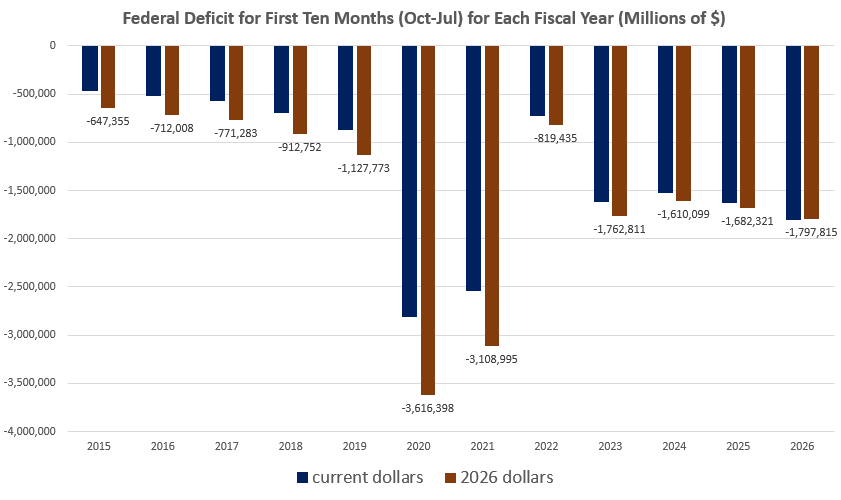
The bond markets have every reason to believe two things: that federal deficits will continue to pile up, meaning more Treasurys will need to be dumped into the market as the federal government borrows to the tune of more than two trillion per year going forward. Meanwhile, price inflation can be assumed because the central bank clearly has no stomach for tightening monetary policy, and is likely to inflate away a portion of its debt rather than rein in spending. Thus, we can expect more upward pressure on yields, especially in the longer-term bonds.
Of course, the situation could change substantially once a financial crisis or recession hits. At that point, the Federal Reserve will frantically attempt to bring down interest rates, although it’s unclear that the Fed has the power to do push down rates beyond short term debt. One thing is for sure: the current situation is volatile, and we are witnessing something quite different from the past thirty years of relentlessly falling interest rates.
Indeed, the US is in uncharted water because the last time interest rates rapidly increased, during the early 1980s, the total public debt as a percentage of GDP was about 30 percent. Today, the federal debt is more than 120 percent of GDP, and the US is paying out more than a trillion dollars per year just in debt service. This, of course, is thanks to the US’s $40 trillion debt. Continued upward movements in yields will place far greater pressure on the Treasury than was the case during the large run-up in deficits during the 1980s.
QTR’s Disclaimer: Please read my full legal disclaimer on my About page here.
I also may or may not own names I write about and are watching. Sometimes I’m bullish without owning things, sometimes I’m bearish and own things I’m bearish on. Just assume my positions could be exactly the opposite of what you think they are just in case. If I’m long I could quickly be short and vice versa. I won’t update my positions.
I cannot guarantee the accuracy of any or all facts and figures included in this article though I made an effort to get them right. I have been wrong before and will be wrong again, and encourage you to always double check, do your own research and speak to a licensed financial professional, which I am not.
Contributor posts, guest posts and curated posts have been hand selected by me, but have not been fact checked and are the opinions of their authors. They are either submitted to QTR by their author or reprinted under a Creative Commons license with my best effort to uphold what the license asks, or with the permission of the author.
Since 2026, I have been making an attempt to no longer actively trade as much as I once did ( read my story here). In an attempt to lead a healthier lifestyle, I’ve also excluded myself from most fantasy sports, sports betting, online and in-person casinos and prediction markets.
My goal is for my investing/saving to be done by recurring contributions mostly to sector ETFs and a few select equities, trusted third parties who oversee my accounts, and advisors. Such advisors or funds, through individual equities, options, index funds, mutual funds, ETFs, or other securities, may have positions in, exposure to, or holdings of names mentioned herein that I know nothing about. Basically, it is possible I could own, have exposure to, or not own anything, at any point.
You are on your own. Do not make decisions based on my blog. I exist on the fringe. Again, I get shit wrong a lot, both in the market and in life, but am trying my best. If you see numbers and calculations of any sort, assume they are wrong and double check them. I failed Algebra in 8th grade and topped off my high school math accolades by getting a D- in remedial Calculus my senior year, before becoming an English major in college so I could bullshit my way through things easier. Hence, I am a writer. I write these posts after a couple beers sometimes. Many times I edit after my posts are published because I’m impatient and lazy, so if you see a typo, check back in a half hour. Thanks, you’ve been a great crowd and don’t forget to tip your servers.