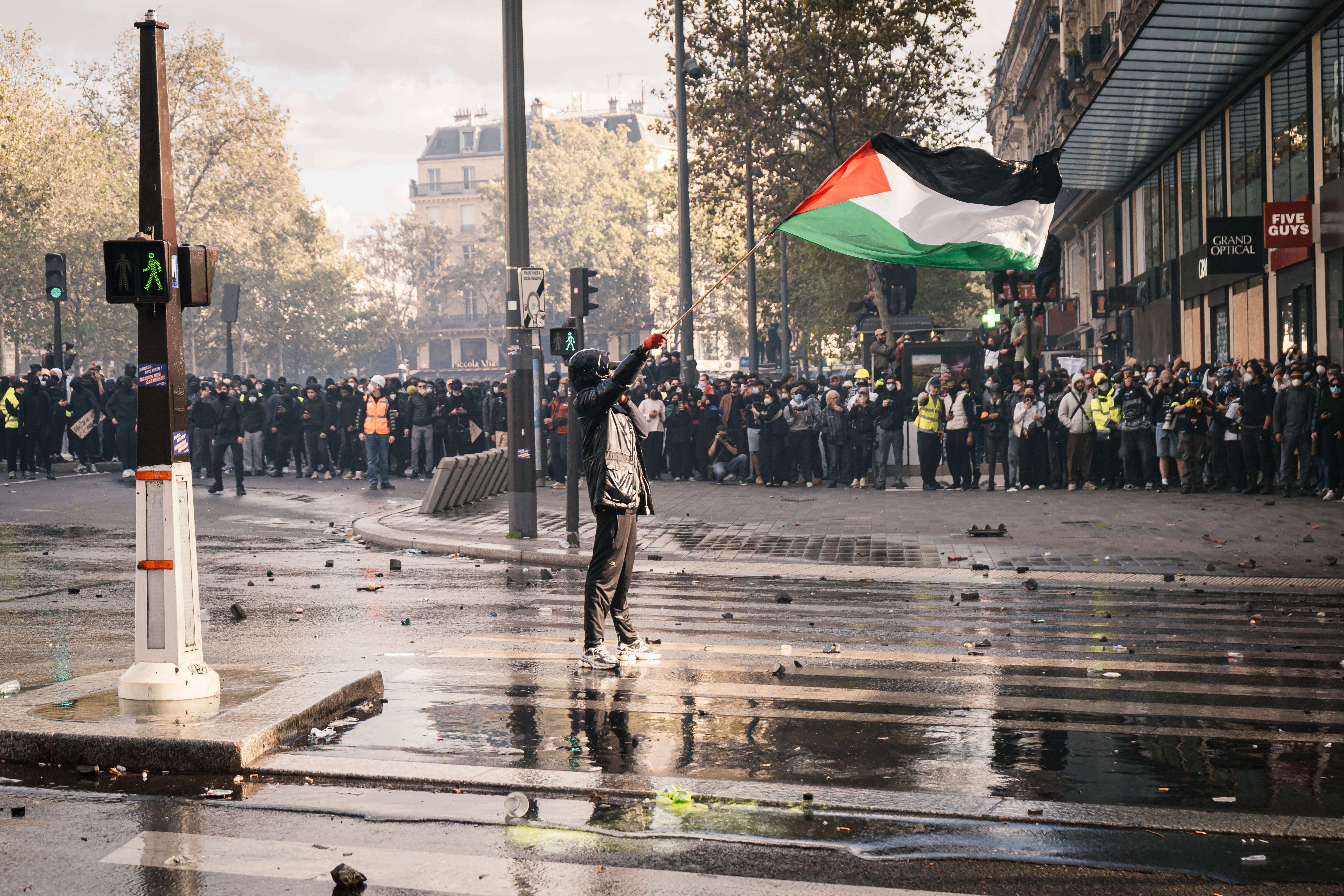
On Saturday night, a group of rioters in Limoges, France, stormed the city’s town hall, broke its windows, and set the ground floor on fire. The building was 143 years old and had survived two world wars. Before the night was over, its bell tower had collapsed and most of the building was lost. In Marseille, protesters forced their way into city hall and knocked over a bust of Marianne, the symbol of the French Republic. Lyon’s tourism office burned, and violence spread to Bordeaux, Rennes, Toulouse, Grenoble, Nice, and Strasbourg. More than half a million people marched across France, and France’s interior minister said 1,800 of them were arrested.
In Paris that same day, protesters climbed the statue of Marianne in the Place de la République and raised 2 flags. The first was the French tricolor. The second was the Palestinian flag. The demonstrations were supposed to be about fuel prices, the cost of living, and the state of French schools. None of those grievances has anything to do with Gaza, yet the Palestinian flag has flown over these protests for weeks — beside hammer-and-sickle banners in Paris, next to Antifa flags in Strasbourg, and in Italy on Saturday.
This has been playing out on American college campuses and in American cities over the past few years. A march about climate change becomes a march about Israel. A rally for a teachers’ union ends with chants about intifada. Activists carry “Queers for Palestine” signs in defense of a Gaza ruled by Hamas, an organization that executed one of its own commanders, Mahmoud Ishtiwi, in 2016 over an accusation that he had sex with another man. Before killing him, Hamas torturing him by whipping him and hanging him from a ceiling. The activists see no contradiction at all.
Time named Greta Thunberg its Person of the Year in 2019, when she was 16 and the most famous climate activist on the planet. By 2024, she was wrapped in a keffiyeh at the Eurovision Song Contest in Sweden, protesting because an Israeli singer had been allowed to perform. In 2025, she sailed toward Gaza on a boat that Israeli officials mocked as a “selfie yacht.” The climate did not change between 2019 and 2025, but Thunberg’s cause did.
My friend Dr. Michael Youssef wrote about Thunberg in his new book, * An Unholy Alliance: How Progressivism Brought About an Islamist Invasion*. He called her “well indoctrinated but poorly educated” and argued that radical activists hijacked her passion for the planet and twisted it into something much darker. Youssef grew up in Egypt under Gamal Abdel Nasser’s Islamo-socialist regime and eventually immigrated to the United States. He has seen this coalition form before, and he knows how the story ends.
An Iowa accountant named Alysia Ames coined the term “Omnicause” to describe the amalgamation of protests on the Left. Ames coined the term out of frustration with her fellow progressives who made every crusade the same. The British journalist Hadley Freeman sharpened the definition: a good progressive must care about trans rights, Palestinian rights, and the environment all at once, because in the progressive imagination everything is connected.
Everything is connected because every cause in the Omnicause can be reduced to the same story. There is an oppressor and there are the oppressed. The oppressor is always, in the end, the West — its capitalism, its Christianity, its borders, its Jews, and its carbon emissions. The oppressed are everyone the West supposedly victimizes. Once you embrace critical theory, fuel prices in Lyon and rockets out of Gaza are the same fight, and a single flag can stand for all of it.
A decade ago, the rainbow flag was the universal banner of progressive protest, flown at marches that had nothing to do with gay rights. Then it gave way to the Progress Pride flag, with the trans colors and chevrons stitched onto the old rainbow, as the movement moved on to its next cause. Today, both have been pushed aside by the Palestinian flag, which now shows up at nearly every protest in the Western world, regardless of its subject.
In June 2024, hundreds of pro-Palestinian protesters brought Philadelphia’s Pride march to a halt, and one of them carried a Pride flag with “No Pride in Genocide” scrawled across it. The new cause was written over the old one in marker. Each new banner absorbs the causes that came before it, and each one is more hostile to the West than the last. The rainbow asked Western societies for tolerance. The trans flag demands acceptance. The Palestinian flag, as it is flown in Paris and on American campuses, demands the surrender of everyone and every cause into itself.
Youssef explains why such contradictory movements hold together. The secular left and radical Islamists are bound by what he calls shared hate. Both despise Christianity, the Jews, the State of Israel, Judeo-Christian morality, the United States, and Western civilization itself. Their common enemy matters more to them than their irreconcilable differences.
Shared hate explains why the two march together, but it does not indicate who is leading. For the progressive, the Palestinian flag is a symbol of victimhood in general. For the Islamist, it stands for a specific and very old goal — the elimination of the Jewish state and the advance of Islamic political rule wherever the West is too tired to resist it. The progressive marches for an abstraction, while the Islamist marches for a defined outcome. In any coalition, the faction that knows exactly what it wants will eventually lead the faction that only knows what it is against.
Progressives believe they are tearing down Western civilization to rebuild it as something more equal and more just. The Islamists marching beside them have no interest in egalitarianism. They want the West’s destruction, and they have their own blueprint for what goes up afterward.
The journalist Eli Lake calls this the Red-Green Alliance. Red is the color of the left, and green is the color most associated with Islam. Lake traces the alliance to the Iranian Revolution and, ironically, to France.
In 1978, the exiled Ayatollah Khomeini received Western reporters at his home outside Paris, sitting under an apple tree. The reporters portrayed Khomeini as a pious democrat and perhaps even a progressive. Andrew Young, Jimmy Carter’s ambassador to the United Nations, predicted that history would remember Khomeini as a saint. Any of them could have read Khomeini’s 1970 book, Islamic Government, which laid out his contempt for democracy and his plan to impose sharia. Almost none of them bothered.
Iran’s own left made the same mistake. The communist Tudeh Party and much of the secular left helped bring down the Shah because they shared Khomeini’s enemies: the monarchy, the Americans, and Western capitalism. They assumed they could use the mullahs and then push them aside. By 1983, the regime had banned the Tudeh Party and arrested its leaders. Many were then executed.
Britain ran a softer version of the experiment in 2004, when the Socialist Workers Party joined Muslim activists to found the Respect Party under George Galloway. The Marxists organized it. The Islamists brought the votes. Over time, the socialists discovered that their partners were more interested in Sharia than in socialism.
The same institutional capture has happened here. Students for Justice in Palestine was founded at Berkeley in 1993 as a voice of moderation. In its first year, it co-sponsored a forum on Israeli-Palestinian peace with Berkeley Hillel and a progressive Zionist group, and its founder wanted a movement free of political factions and religious influence. Thirty years later, on the day of the October 7th massacre, the national SJP network sent its chapters a toolkit hailing the attack as “a historic win for the Palestinian resistance.” Its founder has since said publicly that he worries the movement is drifting into support for Hamas.
The alliance runs on the old Popular Front rule of “no enemies to the left, no friends to the right.” The left supplies the ideology of grievance, the organizing machine, and access to universities, unions, and media. The Islamists supply the zeal, the numbers, and the money, and much of that money comes from Qatar. The tiny Gulf monarchy hosts the political leadership of Hamas and gave the Muslim Brotherhood’s leading cleric a television show on Al Jazeera, while also paying for the largest American air base in the region.
According to The Free Press, Qatar has spent more than $6.3 billion on American colleges and universities since 1986, which makes it the largest foreign funder of American higher education, ahead of China. Georgetown received $760 million to open a campus in Doha and roughly $248 million more between 2021 and 2024. In 2025, Georgetown gave one of its highest honors to Sheikha Moza bint Nasser, the emir’s mother, who had publicly praised Yahya Sinwar, the architect of October 7th, after his death.
Qatar’s reach extends into public schools as well: a Brooklyn elementary classroom funded through Qatar Foundation International hung a map of the Arab world that left out Israel, though Qatar says it had no role in the map. In France, a Qatari state fund owns Paris Saint-Germain, the most famous football club in the country.
Unfortunately, Qatar’s money is a bipartisan problem. After October 7th, Qatar’s lobbyist Jim Moran, a former Democratic congressman who once blamed Jewish leaders for the Iraq War, met with House Minority Leader Hakeem Jeffries, and a week later Moran donated to a PAC supporting Jeffries’ reelection. In December 2023, two months after October 7th, Sen. Lindsey Graham, one of the Senate’s fiercest hawks, told an audience in Doha that Qatar is more the solution than the problem. President Trump called Qatar’s offer of a $400 million Boeing 747 a great gesture. Qatar spent $225 million on lobbying and public relations in Washington between 2017 and 2025, and it has spread that money across both parties. Each side of the Red-Green Alliance thinks it is using the other. So do the American politicians who take Qatar’s hospitality.
Defenders of the Red-Green Alliance, or those who deny it exists, raise a number of objections worth considering.
The first objection is that the Palestinian flag is simply an expression of sympathy for suffering civilians in Gaza. But that raises the question of why that sympathy is never extended to Sudanese Christians, Uyghur Muslims, or Iranian women beaten to death for removing their hijabs. Most of these young people are not idiots. They are intelligent kids who have been taught what to think rather than how to think, and the UnHerd columnist Mary Harrington has observed that many of them are mostly there for the vibe. It is a reflection of indoctrination.
The second objection, which the liberal publication Haaretz made on Sunday, is that there is scant evidence linking the French protests to pro-Palestinian activism beyond the flags themselves. That understates what is on the streets. Fox News Digital identified 50 organizations in the French protest movement and its network of supporters, and only 15 of them are student or youth groups. The rest include a dozen labor unions, eight communist or socialist organizations, four political parties, including France Unbowed and the French Communist Party, and Urgence Palestine, whose members marched in the student protests carrying the Palestinian flag. A Muslim student association is among the youth groups. Nobody needs to argue that Hamas is organizing French school blockades, because it no longer has to. The Omnicause does not need a central committee, because it has achieved something better than a conspiracy: it has become the default.
The third objection is that all of this is just Islamophobia dressed up as analysis. It is not. Most Muslims in France, Britain, and the United States want safe streets, good schools, and a decent living. Many fled precisely the regimes Islamists want to build. Michael Youssef is a Christian born in the Middle East, and his warnings come from love for that part of the world. Islamism is a political ideology, not a synonym for a faith, and its earliest victims are always Muslims who refuse to submit to it.
The fourth objection is that the alliance is too incoherent to last. In 2024, the Wall Street Journal columnist Andy Kessler predicted the Omnicause would collapse under the weight of its own contradictions, noting that “Queers for Palestine” makes about as much sense as chickens for KFC. Youssef calls that wishful thinking, and the events since have proven him right.
The Philadelphia pride rally hijacked by Islamists did not end the alliance, and two years later, the Palestinian flag flies over French riots about fuel prices. The Tudeh Party expected its partnership with the mullahs to come apart, and it did, but only after the mullahs had the power to put its leaders in prison and execute them. Incoherent alliances do not need to last forever to do lasting damage; they only need to last long enough for one partner to seize power.
The deeper problem is not the Islamists. The deeper problem is a West that no longer believes in itself. A civilization that teaches its children that it is uniquely guilty will raise children eager to tear it down, and others will gladly hand them the tools. Critical theory, based on Marxist post-modern beliefs, has polluted brains and corrupted institutions.
Michael Youssef argues that Western moral relativis…