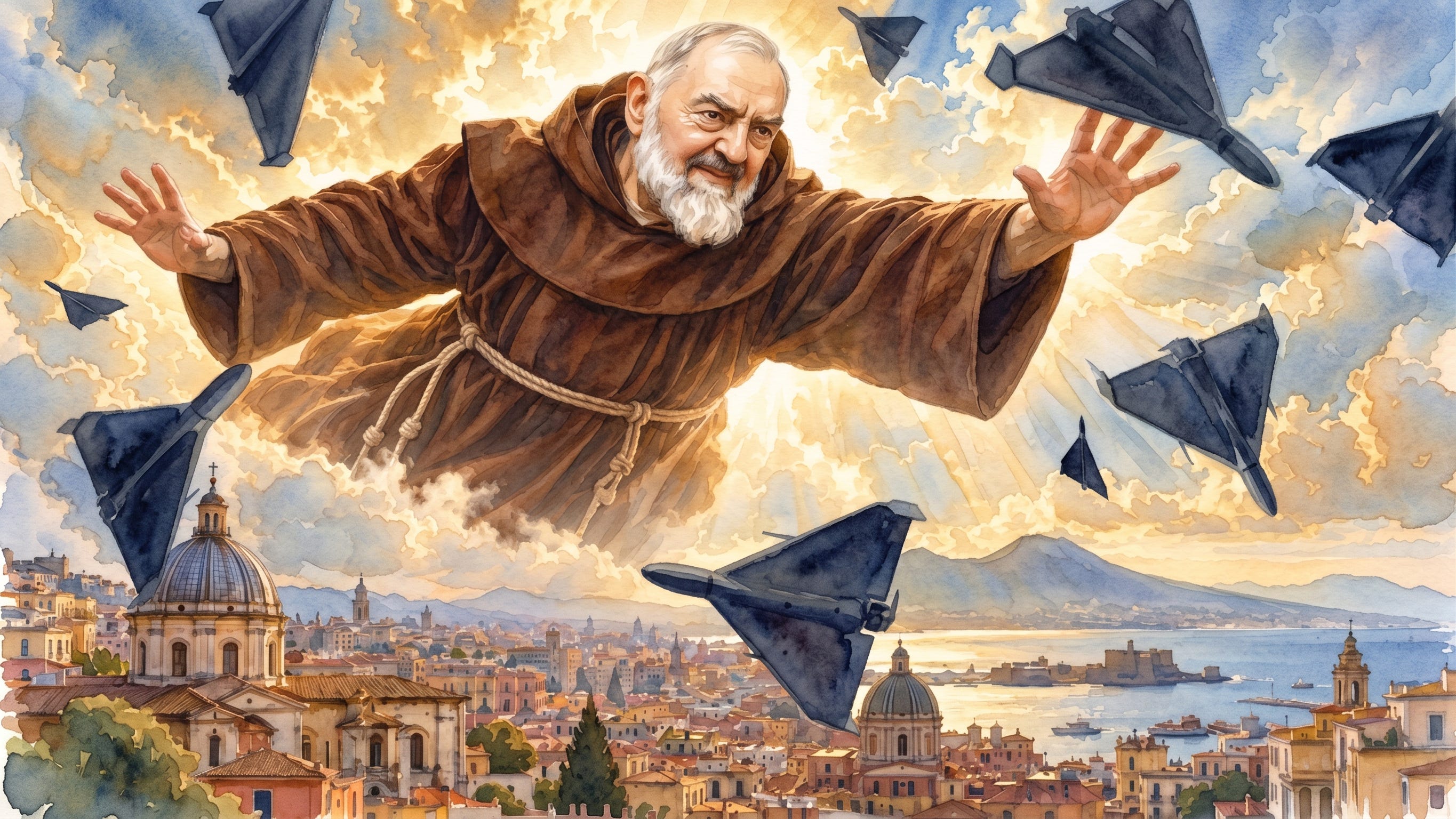
POGRADEC, ALBANIA, on LAKE OHRID—On 29 March 1944, a British intelligence officer stationed in Naples wrote in his diary that there were miracles galore in the past few days. Among them:
At Pomigliano we have a flying monk who … claims that [while] an aerial dog-fight was in progress,
he soared up to the sky to catch in his arms the pilotof a stricken Italian plane, and bring him safely to earth. Most of the Neapolitans I know—some of them educated men—are convinced of the truth of this story.
At the foot of the page, in a footnote added years later, the intel officer, Norman Lewis, identifies the flying monk: Padre Pio.
We publish this newsletter every day at 9:05am NYC time / 4:05pm Kyiv.Your subscription fuels our work.
Later, the story grew: Italian and American airmen were said to have seen Padre Pio in the sky above the town near his friary. Today, Pio, named a saint by John Paul II, is patron of civil defence volunteers.
The flying monk is one of the rich details in Lewis’s * Naples ‘44*, published in 1978—his diary of the year he spent there with
Kyiv ’26 is be a very different and more hopeful story than Naples ‘44.
I was going to Albania—because it’s inexpensive, outside of the European Schengen that limits American stays, pro-USA, pro-Ukraine, and largely free of Russians. Before leaving, I stopped at Heywood Hill booksellers in Mayfair, known for its good advice. I explained my situation: a writer, based in Ukraine, going to Albania to reset and read.
I finished Lewis’s memoir just a few days ago, at a table on the sand at Bar Konti, watching the sun go down over the million-year-old Lake Ohrid as a near-full moon rose. In the chilly autumnal lake air, Annie Lennox’s “Into the West,” a soothing song from the * Lord of the Rings* about reflecting on life after battle, was in my earbud: “
Lewis saw horrible things. I have seen horrible things. He also witnessed beautiful and honourable moments, as have I, often in the same hour and the same street. He wrote them down.
Looking at Lake Ohrid in the moonlight, I write now about Norman Lewis, Naples, Padre Pio, and Ukraine. I say: Read Lewis’s book now to be ready for what’s ahead.
He writes with clarity and a poetic sensibility about something horrible, but through the mess and the horror you see nobility in the sadness and struggle.
Lewis, a British intelligence officer, candidly describes what he saw, colorful and horrible:
Formerly-aristocratic, now-destitute woman renting a nice house for a day to get permission from the Allied authorities to marry a British soldier.
Very broke people still caring about appearance and so hiring “special mourners” at Neapolitan funerals—either pretending to be posh folk from Rome, or scratching at their own faces in agony.
Neapolitan women going to the opera, which still continued, in dresses made from Allied blankets.
Friendly Canadian soldiers bringing whiskey and a will to help but accidentally leaving not-so-friendly damage in their wake
A strange sense of honour: local police smothering bandits in their sleep rather than shooting them, because a deal had been struck for no more bloodshed.
Supposedly clean American officers working closely with American members of the Italian mafia for personal profit, disrupting the war effort
How generally everything is SNAFU—situation normal, all f-ed up, yet people (a) find ways to enjoy life a bit, (b) help others, and (c) hold on to win. And then even before the victory fully arrives, the political maneuvering starts for post-war power
Lewis’s job included investigating corruption—the theft of Allied food, kit, and weapons, sold openly on the black market. In time, to save friends, he turns to the black market himself. What can you do?
He writes with clarity and a poetic sensibility about something horrible, but through the mess and the horror you see nobility in the sadness and struggle.
Reading
Naples ‘44is good preparation for the bigger war that might come.
The aspect of Lewis’s book that resonates most to someone in Ukraine: Lewis’s descriptions of air raids. The technology has changed but the waiting, the noise, what people do with their faces, how quickly the extraordinary becomes routine, the close calls, the shattered feeling in the ruins afterward—are the same.
Otherwise, Ukraine is nothing like Naples in 1944. Well—a little. There is grift and corruption, as there is always everywhere in war and peace, and not only on the Ukrainian side but on the American side too and beyond. There is, as we see recently in the open though it’s always been there, political maneuvering.
But in general Ukrainian society, rather than some outside force, is the resistance—and united in resistance. Ukrainians refuse to be victims and generally instead of grabbing for their own, they cooperate, and that’s why they’ve stayed free so far through this hell. And I think those who have studied other wars completely misunderstand or ignore this cooperative spirit of the Ukrainians.
Kyiv ’26 is be a very different and more hopeful story than Naples ‘44.
Despite Russian attempts, there is no starvation in free, unoccupied Ukraine. There are people missing arms and legs, but they have modern prosthetics. The opera continues, and people have real clothes.
Life in the occupied territories, though—Oleshky, for instance—is a different hell, much more like Naples in the Second World War.
The Ukrainian word for victory,
peremoha, is built frompere—beyond—andmoha, might or ability. Victory beyond what one is able. The definition of a miracle.
23 September was the feast day of Padre Pio, coincident with my reading of the passage about him in Lewis’s book. So I wanted to dig deeper. Who was he? Did he really fly?