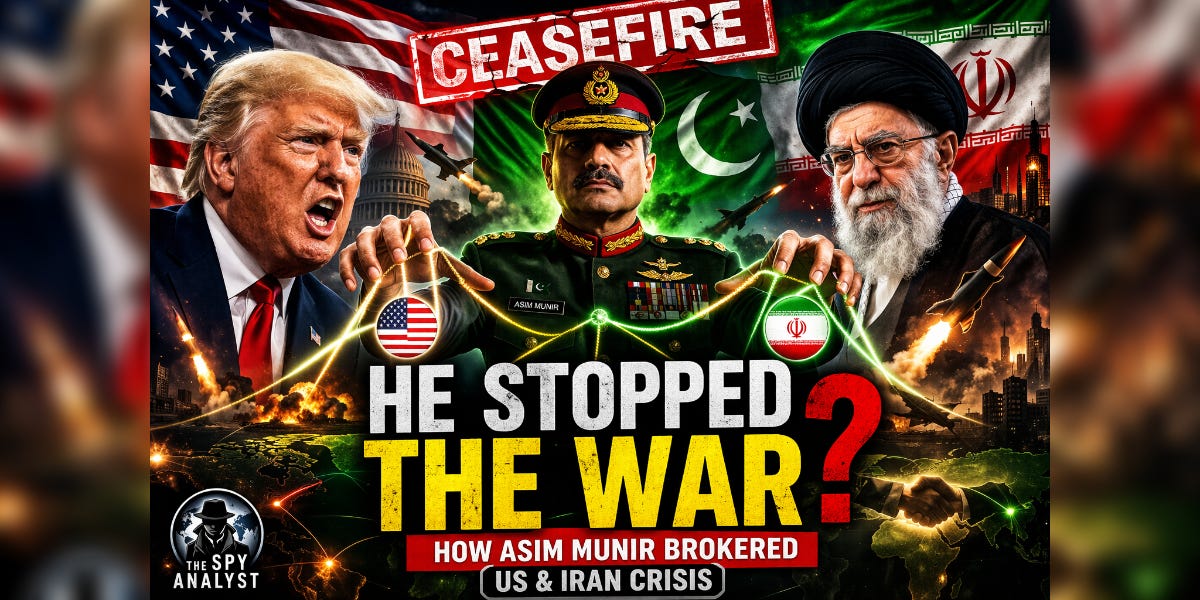
🕵️ The Invisible Broker: How a Broke, Isolated Country Just Tried To Stop a War!
A ceasefire just happened.
Iran. Israel. The United States.
Three of the most combustible forces in modern geopolitics — pulled back from the edge. Two weeks of breathing room, agreed upon quietly, without fanfare.
Fragile? Yes. Temporary? Absolutely.
But real.
And standing in the middle of it all — taking a small, deliberate bow — was Pakistan.
Not the United Nations. Not the European Union. Not some seasoned American envoy with a motorcade and a primetime press conference.
Pakistan.
Right now, there is an active debate raging among foreign policy analysts, intelligence watchers, and geopolitical commentators about what just happened and who made it happen. The mainstream media is largely missing the real story. They’re covering the ceasefire. They’re not covering the architecture behind it.
This is that architecture.
Here is Pakistan’s complete five-move playbook — sequenced, decoded, and explained from the inside out.
Before strategy, understand geography.
Pakistan shares over 900 kilometers of border with Iran.
This was never a distant conflict Pakistan was watching from a safe distance. A full-scale American military deployment into Iran — air campaigns, boots on the ground, the works — would have detonated a catastrophic refugee and security crisis directly on Pakistan’s doorstep.
Pakistan didn’t enter this as an altruistic peacemaker.
It entered this as a country fighting for its own survival — and turned that survival instinct into a geopolitical masterstroke.
“We are no one’s enemy. We are everyone’s bridge.”
Pakistan’s opening move was deceptively simple: refuse to pick a side.
But this was not fence-sitting. It was a precisely engineered doctrine — what Pakistani strategists deliberately framed as Limited Alignment.
The logic was built on a clear-eyed reading of Pakistan’s own interests.
If the United States deployed troops into Iran and a full-scale war erupted on Pakistan’s western border, Pakistan would face an immediate crisis on multiple fronts simultaneously — refugees, border instability, domestic radicalization, and economic collapse. Pakistan needed this war stopped not out of idealism but out of raw self-preservation.
So it turned that self-interest into a diplomatic position.
To Washington, Pakistan delivered this message: an American military deployment into Iran doesn’t just destabilize the Middle East — it creates an unmanageable crisis on our shared border. We are asking you, as strategic partners, to resolve this without boots on the ground.
To Tehran, Pakistan delivered a parallel message: we want this resolved diplomatically, without foreign troops on your sovereign soil. We stand by the principle — even if we cannot stand in the fight.
Two audiences. One consistent principle. Zero military commitment to either side.
This gave Pakistan something money cannot buy: a seat at every table, trusted by every party.
Neither Washington nor Tehran needed to view Pakistan as a threat. Both needed to view it as useful.
And the moment every side in a conflict sees you as useful — you become indispensable.
That’s the foundation. Everything else was built on top of it.
With positioning secured, Pakistan needed execution. And it deployed a dual-channel operation — two parallel tracks, running simultaneously, engineered to reinforce the same outcome.
Track One: Military-to-Military.
Pakistan’s most powerful man — Field Marshal Asim Munir, the army chief who holds real authority over foreign and security policy — opened a direct personal line to senior American military leadership.
Not through embassies. Not through press releases. Not through diplomatic cables.
General to general. Private. Professional. Completely bypassing the noise and theatrics of public diplomacy.
His message to American military leadership was consistent, specific, and repeated: do not deploy troops. Let diplomacy carry the weight. We can get to a resolution without a war.
Track Two: Political Theater — With Real Purpose.
While Munir worked the generals, he sent Prime Minister Shehbaz Sharif to work the politicians.
Here is what you need to understand about how Pakistan actually functions: Sharif doesn’t drive strategy. Munir does. Sharif is the public face — the elected, civilian, internationally presentable front. Munir is the architect operating in the shadows.
Munir assigned Sharif two distinct jobs on the political track. First: persuade American political leadership specifically that a diplomatic off-ramp existed and was viable. Second: reassure the broader international community — world leaders, multilateral bodies, regional partners — that Pakistan believed dialogue could work and that de-escalation was the responsible path.
Two audiences on the political track alone. Munir’s fingerprints on none of it.
Two channels total. One coherent message. Zero public contradictions.
This is not improvisation. This is intelligence-grade diplomatic coordination — the kind that usually only happens inside the world’s most experienced foreign ministries.
This is where Pakistan showed genuine strategic finesse — and where almost every Western analyst completely missed what was happening.
Throughout the conflict, Pakistan repeatedly and publicly condemned the violation of Iranian sovereignty.
Sounds straightforward — Pakistan taking Iran’s side, right?
Look closer.
Pakistan condemned the consequence — sovereignty being violated — without ever naming the cause. It never called out the United States. Never named Israel. Never condemned the military campaign itself.
This tactic has a precise name in strategic doctrine: Strategic Active Neutrality, executed through Calibrated Sympathy.
In plain English: Pakistan expressed exactly enough solidarity with Iran to keep Tehran’s trust and communication channels open — while expressing exactly little enough criticism of Washington and Tel Aviv to ensure their channels remained open too.
Iran heard: “Pakistan stands with our dignity and our sovereignty.”
America and Israel heard: “Pakistan is not targeting us.”
One carefully constructed public statement. Two entirely different audiences. Two entirely different readings.
Every channel — kept open.
It is the diplomatic equivalent of being the most trusted confidant in a room full of adversaries — without deceiving a single one of them.
This is the detail that will shape the next generation of international diplomacy. And almost no major publication is covering it.
Study carefully what did not happen during these negotiations.
No Pakistani diplomat flew to Washington for dramatic late-night sessions. No American envoy landed in Islamabad. No Iranian official made a surprise visit to a neutral capital. There were no leaked photographs of negotiators in hotel lobbies. No midnight motorcades. No “senior officials briefed on the matter” whispering to Reuters.
The entire back-channel infrastructure that produced this ceasefire was digital.
But here is the precise innovation — and precision matters here.
This was not Pakistan shuttling encrypted messages back and forth between Washington and Tehran like a traditional intermediary. That would be remarkable enough. What actually happened was more sophisticated: a real-time tripartite secured digital environment — the United States, Iran, and Pakistan simultaneously present in the same protected communication architecture, able to test positions and receive responses in real time, without any human intermediary carrying sensitive information between rooms.
The United States and Iran — two nations in active hostile confrontation for decades — were brought into the same digital negotiating space at the same time, with Pakistan as the structural connector holding the architecture together. All of it invisible. All of it deniable. All of it leaving no fingerprints anywhere.
Think about why that matters structurally.
Traditional diplomacy is slow and porous. Physical visits create optics. Optics trigger domestic political pressure from hardliners on all sides. Pressure creates constraints that kill deals before they form. Every time a diplomat boards a plane, three journalists write three stories, and three domestic political factions mobilize against whatever they imagine is being negotiated.
Pakistan stripped all of that away. It built a negotiating architecture with no friction, no leaks, and no public record — until the agreement was already locked.
The tell is in the timing. Watch what begins around April 10th: the physical movement of diplomats, the official statements, the handshakes for cameras.
That is not the negotiation. That is the announcement of a negotiation that was already completed in the dark.
Pakistan effectively invented a new template for modern ceasefire brokerage: real-time secured digital architecture first, public choreography second. Every serious foreign ministry in the world should be reverse-engineering this right now.
This is the argument that appears to have genuinely shifted American strategic calculations at the highest level. And it deserves to be unpacked with precision.
Pakistan walked into Washington’s back-channels carrying a warning dressed as a history lesson — and delivered it in three devastating layers.
“We share 900 kilometers of border with Iran. If your military enters and that country destabilizes, millions of Iranian refugees will pour across that border into Pakistan.”
But Pakistan didn’t stop there. It made the second, more dangerous step explicit.
Iran would not merely benefit passively from a refugee crisis. Iran would actively use that refugee crisis as raw material.
This is the mechanism — and it is precise: displaced populations, stripped of resources and political representation, become fertile ground for organized, externally sponsored groups that offer them identity, belonging, protection, and eventually purpose. Iran has refined this mechanism into an art form over four decades.
The evidence is Hezbollah.
To understand the full weight of Pakistan’s warning, you need to understand one of the most consequential geopolitical experiments of the 20th century.
In the early 1980s, Lebanon had a large Shia Muslim population with a specific and acute problem: they had no political representation. No meaningful voice in Lebanon’s power structure. No seat at any table that governed their lives. They existed as a significant community with real grievances and no legitimate channel to address them.
That gap — not just poverty, not just marginalization, but specifically the absence of political representation — is the precise entry condition Iran looks for. It is the vulnerability Iran has learned to identify and exploit with extraordinary consistency.
Iran moved in. It didn’t arrive with weapons first. It arrived with an offer: we will help you get the political representation you have been denied. It helped consolidate Lebanon’s scattered Shia communities. It provided social infrastructure — schools, hospitals, welfare networks. It delivered on the promise of a political voice.
The vehicle for all of this was a new political party: Hezbollah.
On paper, a legitimate political organization finally giving Lebanon’s Shia the representation they had been denied.
Underneath the paper: an Iranian-directed, Iranian-funded, Iranian-armed proxy military force — now one of the most capable non-state armed organizations on earth.
This is the model’s ruthless elegance: Iran doesn’t trick communities into accepting its help. It offers them something they genuinely need and desperately want — political representation and a real voice. It delivers it. Builds deep loyalty through that delivery. And then, once the loyalty is established and the organizational infrastructure is built, it militarizes what it created.
Here is what makes Hezbollah the textbook case: it is simultaneously a political party, a social welfare provider, and a fully equipped paramilitary force. It holds seats in Lebanon’s parliament. It also fields missiles that reach deep into Israel.
The United States has spent decades and billions of dollars trying to dismantle it. So has Israel.
Neither has succeeded.
What makes this model especially alarming is that it is not unique to the Middle East, to Shia Islam, or to Iranian foreign policy.
The same architecture — find a community with genuine grievances and no political representation, offer them that representation, build loyalty through delivery, quietly militarize the organizational infrastructure underneath — has appeared across multiple conflict theaters around the world.
In South Asia, the Communist Party of India (Maoist) adopted this identical model in 2001: beginning as a political organization representing dispossessed rural communities with no voice in India’s democratic system, then systematically building a parallel armed wing beneath the political structure. Different ideology. Different region. Different external dynamics. Identical blueprint.
The model has appeared in parts of Africa and Latin America under different names and different sponsors. The specific actors change every time. The entry condition — a community with real grievances and no political representation — and the sequence never do.
Iran is arguably the world’s most experienced practitioner. But the model belongs to no single country or ideology. It is a universal technology of destabilization, available to any external actor willing to be patient enough to deliver real value before extracting military utility.
Pakistan was telling Washington: you know exactly what this looks like. You have been fighting one version of it for four decades in Lebanon. Do not create the conditions for another — this time next door to a nuclear arsenal.
Pakistan then delivered the final piece — the one that appears to have made American planners go quiet.
Pakistan has its own substantial Shia Muslim population. If hundreds of thousands of displaced, destabilized Iranian refugees crossed Pakistan’s 900-kilometer border in the aftermath of an American military campaign — Iran would have both the motivation and the proven operational capability to identify politically underrepresented communities inside Pakistan, make them the same offer it made Lebanon’s Shia in 1980, and cultivate a Hezbollah-equivalent organization inside Pakistan over the following decade.
The United States has spent forty years failing to neutralize one Hezbollah in Lebanon — a country with no nuclear weapons.
Pakistan has nuclear weapons.
A Hezbollah-equivalent embedded inside a nuclear-armed state is not a counterterrorism problem. It is a civilizational-level strategic catastrophe.
Washington flinched. And it should have.
Pakistan didn’t rely on fear alone. It had already spent months quietly planting the seeds of economic indispensability in Washington. And when the crisis came, it didn’t need to make new offers — it simply reminded Washington of commitments already made, and dreams already sold.
Carrot One: The Dream Sold in a Suitcase.
In the months before this crisis, Asim Munir made a personal trip to the United States. He arrived carrying a suitcase.
Inside that suitcase: raw rock samples, physically collected from near Pakistani railway lines. Unprocessed. Unpolished. Still carrying traces of dirt and residue from the ground where they had been picked up.
He placed them in front of Donald Trump. Trump picked them up, turned them over in his hands, examined them — and smiled.
The pitch was pointed and deliberate: *China currently controls the global supply chain of rare earth minerals — the materials essential for semiconductors, advanced military hardware, electric vehicles, and the entire technological backbone of the 21st-cen…