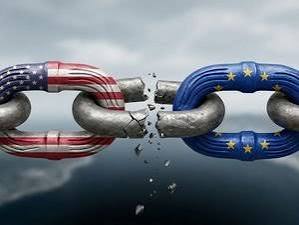
The bipolar world during the Cold War and unipolar world after the Cold War created distinctive conditions that preserved the internal cohesion of the political West. However, in the current multipolar order, the West will predictably continue to fragment, and Europe will unleash a crisis in the international system due to its failure to adjust.
The Cold War & Post-Cold War Era
The world order defined by transatlantic unity was formed by the unique outcome of the Second World War. The world had two centres of power, and the political West based its unity on balancing the Soviet bloc. The bipolar distribution of power was also supported by two competing ideologies that defined the differences between the in-group ‘us’ and the out-group ‘them’. Economic rivalry within the Western bloc was tempered by the need for cohesion, as military rivalry with the Soviet bloc took priority.
After the Cold War, there was only one centre of power in the world: the United States. Western solidarity during the unipolar era was based on the principle of collective hegemony in Europe, which manifested itself in NATO expansion, as opposed to pursuing an inclusive pan-European security architecture in accordance with the Charter of Paris for a New Europe (1990) that also accommodated Russian security interests. The US required Europe as a key partner and node to ensure global primacy, while the Europeans aspired to collective hegemony based on two equal pillars – the US and the EU. The objectives and expectations for the unipolar moment did not fully harmonise, as is evident from the Wolfowitz Doctrine, based on the Defense Planning Guidance from February 1992, in which the US even considered the rise of Germany a threat to US primacy. Yet, the contradictions between the US desire for global primacy and the European approach to collective hegemony were managed.
The shared ideology of the unipolar moment was ‘liberal hegemony’, in which the dominance of the West would supposedly benefit all of humankind by elevating the role of democracy and human rights. The aspiration for hegemony is predictably supported by the claim of representing universal values, as this lays the foundation for a world order based on sovereign inequality. Democracy promotion, humanitarian interventionism, and other post-Cold War policies had the common denominator of promoting sovereignty for the liberal democratic in-group ‘us’, but limited sovereignty for the out-group ‘them’.
The Inevitable and Chaotic End of Hegemony
The unipolar moment was predictably transitional and would eventually come to a disorderly end. Hegemons exhaust their resources as resource are diverted from the core to the periphery, and encourage rising powers to collectively balance the dominant power.
The political West is now trapped with unsustainable debt and an excessively financialised economy, and it is increasingly balanced by the BRICS nations seeking a multipolar distribution of power and a world that elevates civilisational distinctiveness above universal values. The political legitimacy of ‘liberal hegemony’ is also exhausted, as the pretence of supporting equality, self-determination and democracy contradicts the hegemonic structures and sovereign inequality. For three decades, the world has learned that whenever the West spoke of liberal democratic values, it was loading bombs onto planes in the pursuit of strategic interests.
The hegemonic hangover undermines the ability of the West to adjust to a multipolar world. Strategic thinking declines as a hegemon seeks to be everywhere and, thus, fails to prioritise. A hegemon is under the constant lure of imposing its will through military force, and warmongers on both the left and right predictably rise to the top. A hegemon can absorb a lot of costs and can thus make many costly mistakes. A hegemon forgets about diplomacy as mutual understanding and compromise are replaced with ultimatums and threats. Peace for a benign hegemon is achieved by defeating rivals and with good values overwhelming evil, not by managing security competition under a balance of power. Empathy for the security of adversarial countries diminishes as a hegemon considers itself benign and a force for good, which implies that dissent is illegitimate and dangerous. The incompetent political leadership across the West is thus partly the legacy of ‘liberal hegemony’.
The Multipolar World & Fragmentation of the West
The multipolar distribution of power is already a reality. Whether or not people think it is a good thing is irrelevant, yet the costs of ignoring reality are immense. The US will need to start prioritising, and it will prioritise the Western Hemisphere as its own backyard and East Asia, where its peer competitor China is positioned – Europe is, for the first time, a distant third. A formidable US presence in Europe consumes too many of its resources and threatens Russia, which will then pivot excessively towards China. The former US hegemon will see an interest in pulling back to restore its strength and allow the other great powers to instead balance each other.
The US will have to adjust to the new international distribution of power and these new realities, or it will be compelled to do so. The US could attempt to be everywhere at the same time, but by prioritising everything, it would prioritise nothing. Case in point, the US sent its interceptor missiles to fight the proxy war against Russia, which left it with too few interceptor missiles to fight Iran. To make up for the shortage of interceptor missiles in the war against Iran, the US then diverted missiles from Europe and East Asia to the Middle East. Consequently, East Asian allies now recognise the vulnerability of being frontline states of a declining hegemon, and the Europeans will slowly come to the same realisation. The Gulf states are also reaching this conclusion, as Israel took priority in terms of the interceptor missiles that were sent to the Middle East. Subsequently, the US can either scale back its empire in an organised manner and set priorities, or see a disorganised collapse.
As US and European security interests diverge, we will see NATO decline and likely die. NATO expansionism was a manifestation of the unipolar world order, as the political West established collective hegemony by reviving the dividing lines in Europe and gradually pushing them east towards Russian borders. Making an enemy out of Russia was the price the Americans and Europeans paid for the transatlantic partnership and collective hegemony in Europe. NATO expansion to Ukraine was a bridge too far, which has now been balanced by Russia. In the Middle East and East Asia, the US has been balanced by Iran and China. The initial assumption in Europe was that the new war with Russia would recommit the US to Europe, although defeat has instead intensified the US departure.
The reason why most small and medium-sized countries welcome the multipolar world is their ability to diversify economic connectivity and strategic partnerships, which elevates their strategic autonomy as they are not beholden to any one state. The systemic incentive for the Europeans is therefore also to diversify by connecting with Russia, China, India and other great powers. Europe is thus at a crossroad. The political leadership still aspires to revive a collective hegemony that is already gone, yet it results in hostile policies that sever ties with China, Russia and other rivals of the US – yet the Europeans then discover that they will not be rewarded but instead become vulnerable vassals due to excessive dependence on the US. An autonomous Europe also cannot build its unity on having Russia as a common enemy, as Europe will not have economic prosperity or security without working relations with Russia. In short geopolitical Europe destroys geoeconomic Europe.
The European leaders who insist on continued war with Russia are collapsing in the opinion polls. New leaders will thus emerge who will question why the European continent is being redivided and the Cold War logic revived when unipolarity is over and the US is departing. New European leaders, especially in Germany, will recognise that peace and prosperity demand friendly relations with Russia. Furthermore, removing Ukraine from the frontlines of a divided continent will also save that nation from destruction. However, the current political leadership will then be exposed for having deceived its own public – after all, if this war was a conflict over the European security architecture, why did European leaders boycott diplomacy for years as hundreds of thousands of young men died, European economies fell apart, and we took new steps towards nuclear war? The current political leadership will thus attempt to hold on to power and keep the war going, and in the process threaten to unleash a crisis of political legitimacy at home and another world war.