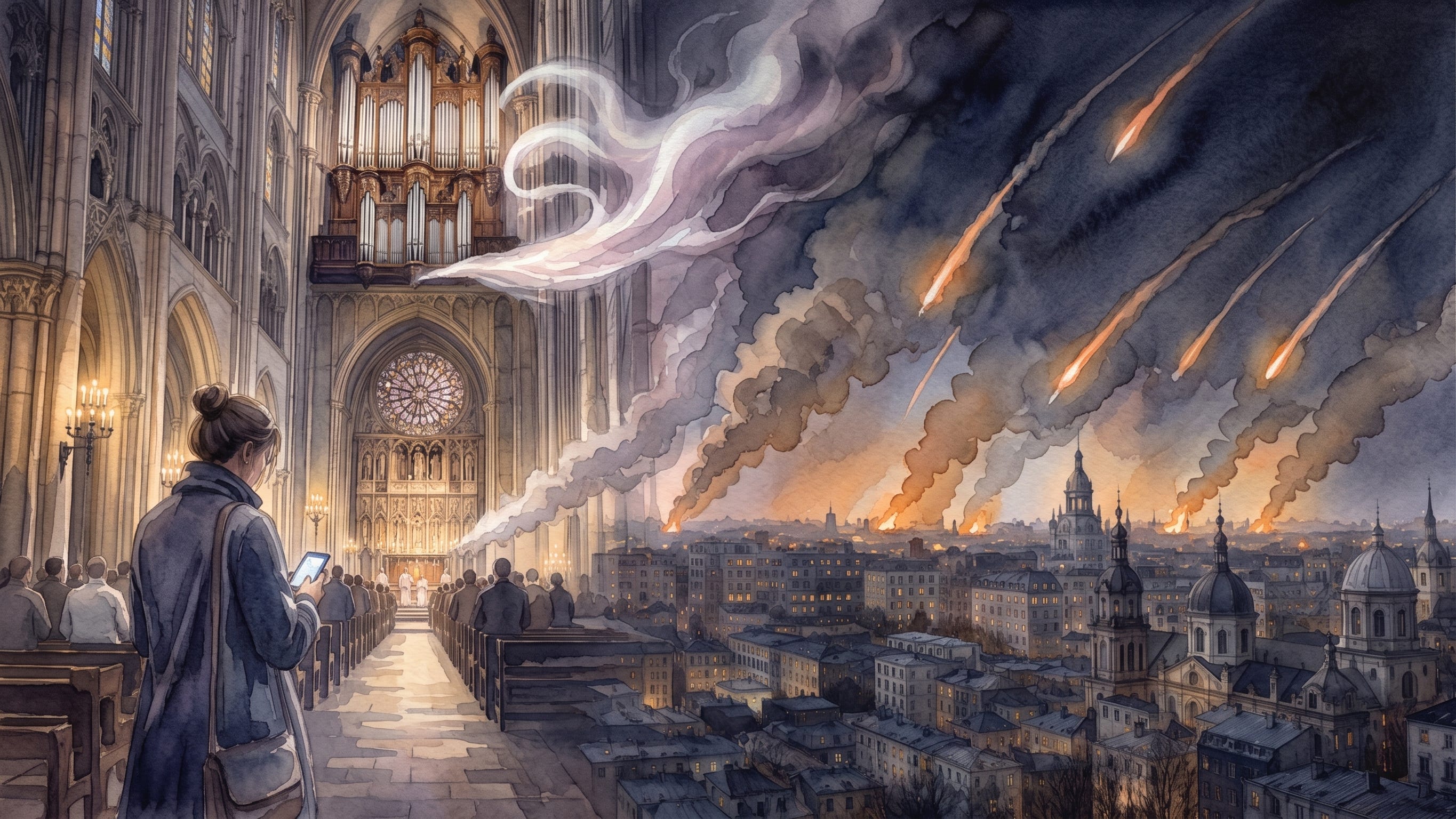
EVREUX, FRANCE—The organ thundered with a flourish at the end of Mass in this white limestone thousand-year-old cathedral in Normandy. Standing in the back, after four years of being in Ukraine every day of the war, I felt in the organ’s thunder the same intensity of missiles landing around me. And just at that moment, my phone dinged—air raid alert in Kyiv.
In this gleaming, towering church, people walked around in awe feeling the pounding of the organ. At that moment, people in Kyiv were ducking in terror feeling the pounding of the missiles.
This church has also been under hellfire. The Cathédrale Notre-Dame d’Évreux burned in 1119, and Henry I of England—who had ordered the town burned—paid to rebuild it as penance. Philip Augustus, King of France, burned it again in 1198 in his wars with Richard the Lionheart. It was rebuilt in the thirteenth century.
Then modern wars found reasons to come here. Évreux sits on the rail line to Cherbourg on the Normandy coast, with an airfield two miles east. The Germans took the airfield in 1940 and flew from it against Britain. In June of that year their bombs fell on the town and the centre burned for nearly a week. In 1944 the Allies came for the railway and the airfield, and the town caught it too. The wooden spire on the south tower was never replaced.
On a sweltering June Sunday, I sat within the vast coolness of the white cathedral. The organist was making his post-Mass flourish with heart-pounding drama that amid the lofty pillars became something majestic. That organ can depict the whole drama of salvation history, the fear and hope of mankind. It’s not there for entertainment but to stir us to think of our purpose, pitfalls, and possibilities.
The organ’s thunderous soundtrack is in fact an accurate representation of the soundtrack of life in Ukraine. And it was warning us of the weight and majesty of eternity: what we do in this short space of life governs what comes after for us and for others.
The people in Kyiv know that weight. They face it daily. I felt it listening to the organ in a French cathedral watching the air-raid alerts for Kyiv—recalling so many of the attacks I have endured along with the Ukrainians.
Does the rest of the world feel this weight as something real, or as a curiosity? Does the rest of the world realize that what now might be loud sounds in movies or churches can quite quickly become the real soundtrack of our lives?
*JP Lindsley, an American journalist based in Ukraine, is co-founder and editor-in-chief of UnderFire.News. *
**Russia Produces Ballistic Missiles Faster Than the West Produces Answers—**A new Financial Times editorialarguesthat Ukraine’s worsening ballistic-missile vulnerability is no longer explained by a lack of suitable Western technology. Patriot works, but there simply are not enough launchers and PAC-3 interceptors. Russia is reportedly producing around 70 ballistic missiles monthly and recently approached 200 launches in a single month, while Western production remains unable to provide ammunition at comparable scale.
The uncomfortable implication is that Ukraine’s air-defense crisis is increasingly a manufacturing failure. Spain and Greece still hold Patriot capacity, European alternatives remain scarce, and plans for expanded production will take years. Russia has succeeded in turning air defense into a factory race.