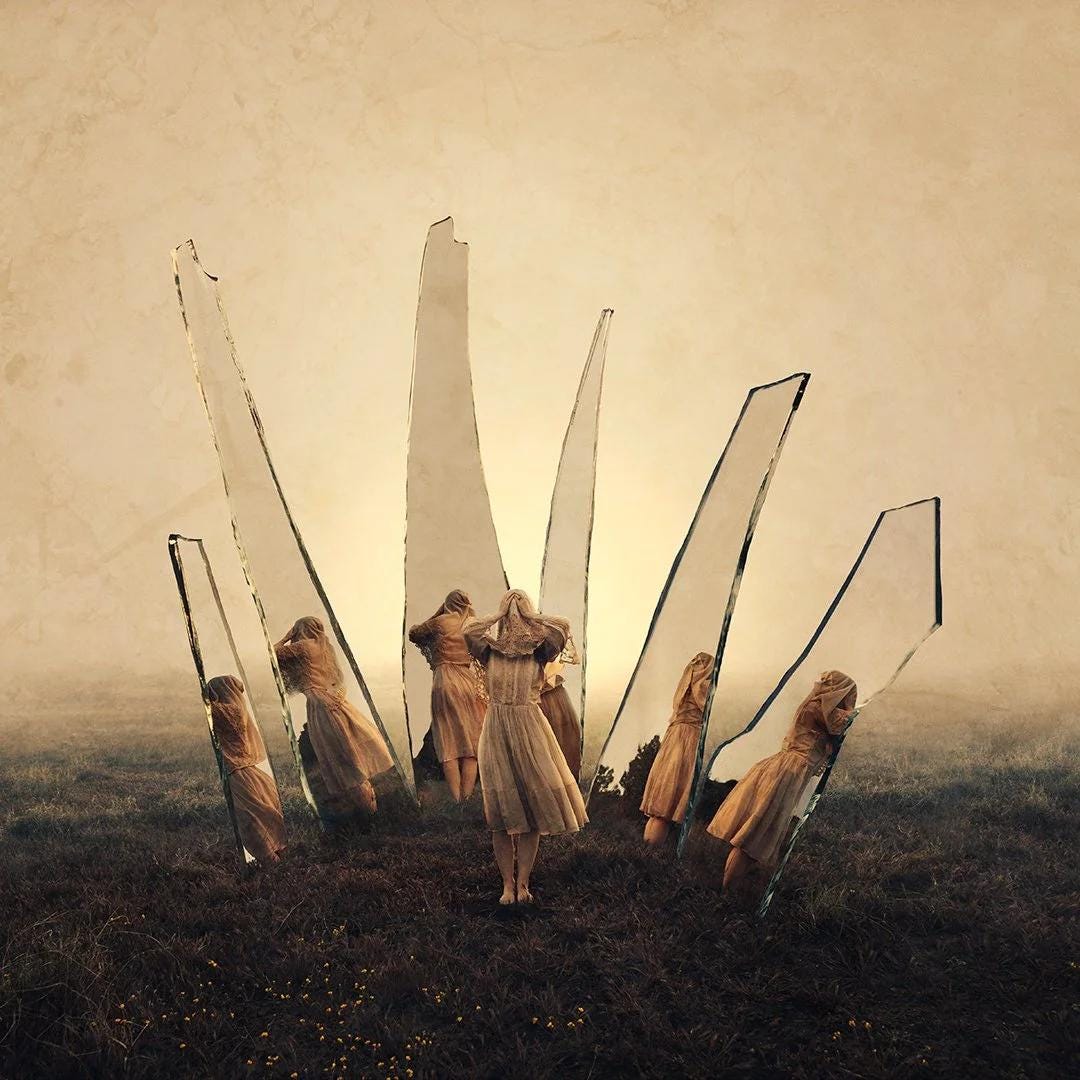
Eight articles in one week is more than I typically publish. I have written before about why I publish as frequently as I do in ** Why I Publish So Much: The Difference Between Content Creation and Field Building**. I am not trying to keep a content machine fed. I am trying to develop a body of thought, language, and practice around Existential Health, and writing is one of the primary ways I do that work.
Some of what I publish is planned. I keep an editorial calendar with articles and series I want to develop, and this week’s three-part series, The Life That Is Yours**,** had been on that calendar. I knew I wanted to explore self-authorship, the unfinished nature of identity, and the challenge of living a life before we fully understand it.
But some of the most interesting writing is never on the calendar. At the beginning of the week, I had no plans to write “What Are We Reconstructing?”, my piece on adrienne maree brown, or “The Existential Reformation”. Those articles emerged while I was already inside the questions of the week.
That happens often. An unexpected conversation stays with me. Someone says something that connects two ideas I had previously held apart. A book opens a door I was not looking for. A question surfaces while I am walking, making coffee, or doing something entirely unrelated to writing. Sometimes I wake in the middle of the night with a thought that suddenly makes visible something I could not see the day before.
I have learned not to treat those interruptions as distractions from the writing plan. Often they are the writing. The editorial calendar gives me direction, but the unplanned pieces tell me where the work is alive. I want enough structure to keep developing the field intentionally and enough openness to follow an idea when it arrives unexpectedly.
This week happened to contain a lot of those arrivals. That is part of why eight articles appeared instead of the few I had planned. Looking back, what surprises me most is that the unplanned pieces did not pull the week in different directions. They kept finding their way back to the same questions, as though the writing itself was revealing a thread I had not fully seen when the week began.
We are living through the collapse of maps that told generations of human beings who they were, what mattered, where they belonged, and how a life was supposed to be lived.
Religion no longer commands the authority it once did. Institutions that promised stability inspire less trust. Identities once treated as fixed are becoming more fluid and contested. Technology is altering the conditions of human life faster than our cultures can make sense of them. The old coordinates have not simply disappeared; they have left millions of people standing in territory for which no authoritative replacement map is coming.
That is the territory I found myself writing from this week.
The Practice of Being Alive reached the end of its long journey toward publication just as I was writing three essays about the difficult freedom of becoming the author of a life that will never be finished.
From there, the questions moved outward. What becomes of spiritual practice after religion, and what does reconstruction require when we refuse to exchange one authority system for another? adrienne maree brown offered a way of thinking about how we move through a world that cannot be mapped in advance. The inquiry eventually reached religion itself and what it might become if its central task shifted from preserving certainty to developing human capacity.
Eight articles emerged from these questions, tracing a movement from identity and self-trust toward spirituality, community, religion, and the capacities our moment demands. Beneath them is one question: if the future has no map, what kind of human beings will we need to become to meet it?
The week included a milestone I have been working toward for a long time: The Practice of Being Alive is finished. In ** The Practice of Being Alive Is Finished: A Book Update, and What Comes Next**, I wrote about reaching the strange moment when years of thinking, writing, revising, questioning, and shaping finally become an object you can hold in your hands.
There is a certain irony in finishing a book whose central concern is unfinishedness itself. The Practice of Being Alive asks what modern human beings need to inhabit their lives more fully: moving from observation to participation, developing the capacity to hold what our capabilities have created, and learning to inhabit existence rather than endlessly explain it.
Finishing the book has only widened the inquiry. The manuscript has reached its conclusion, but the work it opened is becoming something larger.
That became evident almost immediately in The Life That Is Yours, the three-part series I published this week. The first essay, ** Nobody Is Coming to Tell You Who You Are**, begins with one of the most consequential realities of life after an authoritative system: the responsibility for interpreting your life comes back to you.
For many of us, institutions, families, religions, and communities once supplied the boundaries of identity. Leaving them can feel like freedom until we discover that escaping an externally authored identity is not the same as learning to author a life.
Self-authorship begins there: developing the discernment, reality contact, and self-trust to encounter our experience without requiring an external authority to interpret or certify it.
The second and third essays in the series complicated that picture further. ** There Is No Final Version of You** takes aim at one of the quieter assumptions beneath much of our contemporary language about personal growth: the belief that somewhere ahead of us there is a completed self waiting to be achieved.
We speak of finding ourselves, reaching our potential, and finally becoming who we were meant to be. Beneath this language often lies the fantasy of arrival: that enough insight, healing, or growth will eventually deliver us to a stable, finished self.
Human lives do not unfold that way. We are creatures of time, continually changed by experience, love, grief, relationships, and circumstances. Sometimes an identity that faithfully carried us through one chapter becomes too small for the next.
In ** Living Unfinished**, the third essay, I explored the limits of understanding. Much of life happens before we know what it means. We make choices, enter relationships, and endure experiences whose significance may only become clear years later or resist explanation altogether.
Existential health cannot remove that uncertainty because uncertainty is not an error in the human condition. The deeper task is learning to participate in a life we cannot fully understand in advance. That requires enough self-trust to act without guarantees, enough humility to revise what we once believed, and enough contact with reality to allow life itself to interrupt our explanations.
Taken together, these three essays became something more substantial for me than a series about identity. They are about the freedom and burden of having a life that no one else can finally live for us. Nobody is coming to deliver the definitive interpretation of who we are, and there is no final version of ourselves waiting at the end of the journey. We are living unfinished lives while attempting to understand them from inside.
Those questions inevitably lead into the territory of life after religion. Leaving a religious system does not simply involve changing beliefs. For many people, it means losing an entire architecture through which life was interpreted and practiced. Religion supplied stories, rituals, rhythms, communities, moral frameworks, explanations of suffering, practices for grief, and ways of orienting oneself toward questions larger than the immediate demands of the day.
In ** After the Devotional: Why I Created a Daily Practice for Life After Religion**, I wrote about one small but important dimension of that loss. People may no longer believe the theology behind prayer, scripture reading, or devotional practices, yet the human need for reflection, attention, contemplation, and intentional contact with life does not disappear simply because the religious framework surrounding those practices has fallen away.
That recognition led to the CNRS Existential Health Daily Reader. Rather than replacing religious answers with nonreligious ones, I wanted a practice that invites people into deeper contact with their own experience through attention, reflection, discernment, participation, and reality contact.
This question becomes larger in ** What Are We Reconstructing? Learning to Live Without Another System to Tell Us How**. Reconstruction has become a common word among people who have moved through religious deconstruction, but I think we need to examine what we are actually reconstructing. There is a danger that after dismantling one system of certainty, we become anxious enough to construct another.
The teachers, books, vocabulary, and communities may change while our relationship to authority remains intact. We can leave one system only to begin searching for another framework to tell us what is true, who we are, and how we should live.
Reconstruction has to reach deeper than replacing one worldview with another. It means developing capacities we once outsourced: discernment, self-trust, reality contact, humility, tolerance for ambiguity, and the ability to belong without surrendering ourselves.
That is why ** When the Map Runs Out: adrienne maree brown: Conversations in Existential Health** belonged so naturally in this week’s writing. Brown’s work offers another way of thinking about what happens when we cannot know the final form in advance. There are moments in personal and collective life when no reliable map exists because the territory itself is emerging through our participation in it.
We often respond to uncertainty by demanding a plan before we move. Yet some knowledge becomes available only through participation. We discover capacities by exercising them, communities discover what they can become by living differently together, and we discover ourselves by entering lives we could never fully understand in advance.
The absence of a map does not necessarily mean we are lost. Sometimes it means we have reached a place where navigation itself has become part of what we must learn.
The final major piece of the week carried these questions back into territory I know intimately. ** The Existential Reformation: What Religion Could Become If It Helped Us Be Human** asks what would happen if religion evaluated itself not primarily according to the beliefs it successfully transmits but according to the kinds of human beings it helps to form.
I spent years inside religious leadership, and I understand the privilege of being invited into people’s most vulnerable places. Religious leaders accompany grief, suffering, mortality, relationships, identity, belonging, and meaning. Religion has accumulated centuries of language, ritual, story, community, and practice for inhabiting these profoundly human territories.
The danger comes when accompaniment becomes authority over what another person’s life is supposed to mean. Religious formation can cultivate courage, compassion, humility, and moral imagination. It can also create dependency, suppress discernment, make belonging conditional upon agreement, and teach people to distrust experiences that conflict with authorized interpretations.
The existential reformation asks religion to take its human consequences seriously. Does it deepen our capacity for reality, sustain belonging through disagreement, and cultivate discernment rather than dependency?
I am not interested in religion disappearing, but in what it might become if its resources served human development rather than institutional certainty. Beyond asking what people should believe about God, we must ask: What is our way of believing doing to the human beings who believe it?
There is an insight beneath this week’s writing that I see more clearly now. The opposite of outsourced authority is not radical independence. It is capacity.
Self-authorship does not mean becoming a sealed individual who needs no teachers, communities, traditions, relationships, or inherited wisdom. None of us authors a life alone. We are formed in relationship and continually changed by encounters with realities beyond our control.
The developmental challenge is learning to remain in relationship without disappearing inside it. Self-authorship means learning without submission, belonging without self-betrayal, conviction without closure, and inhabiting uncertainty without paralysis. We can receive wisdom without surrendering our responsibility to discern what we will do with it.
This is where the week’s subjects meet: participation in reality, unfinished identity, self-authorship, practice, reconstruction, and learning to navigate uncertainty together.
Beneath them is one question: What capacities do we need when the old maps no longer hold? We need not another system, but language, practices, relationships, and communities that help us live the question together.
If you missed some of this week’s writing, you do not need to read it chronologically. Begin with the question that is closest to your own life. If identity, authority, or self-trust are alive for you right now, begin with ** Nobody Is Coming to Tell You Who You Are** and move through the three essays of
If you are navigating life after religion, I would begin with ** What Are We Reconstructing?** and then read
For the larger trajectory of Existential Health, ** When the Map Runs Out** and
These eight articles became parts of the same inquiry: how we inhabit our lives when inherited maps no longer hold.
My work increasingly begins there—not with providing the correct map, but developing our capacity to encounter the territory ourselves. The future has no map. What matters is becoming capable of meeting it as it comes.
Not everything I was thinking about this week became an article. Some ideas appeared in shorter Notes, conversations, and exchanges with readers, sometimes as questions I was still turning over, sometimes as observations that seemed worth putting into the room and seeing what came back.
A few of those conversations stayed with me.
I had a Zoom call today with an oncology nutritionist, and the conversation stayed with me long after we signed off.
It made me realize how little we talk about nutrition in relation to religious deconstruction, reconstruction, and existential health. We often approach deconstruction through beliefs, identity, meaning, belonging, authority, and trauma. All of that matters. But deconstruction does not happen to a disembodied mind. It happens in a body.
Our relationship with food and the body can carry its own religious inheritance: ideas about discipline, deprivation, pleasure, appetite, purity, control, and whether the body itself can be trusted.
And beyond religion, there is something more basic. How we nourish ourselves affects the physical ground from which we meet our lives.
We cannot reconstruct a life entirely from the neck up.
I left the conversation thinking there is much more here to explore.
JP
I was humbled by several conversations this morning with people who live with chronic pain, chronic illness, and terminal illness. I listened to experiences of being human that I have not had to inhabit myself, and I came away realizing there is more I need to understand.
Existential Health cannot become a framework built primarily around the experience of the able-bodied person.
If we are serious about meaning, identity, agency, belonging, mortality, uncertainty, self-trust, and what it means to be human, then illness and physical decline cannot sit at the margins of the conversation. They b…