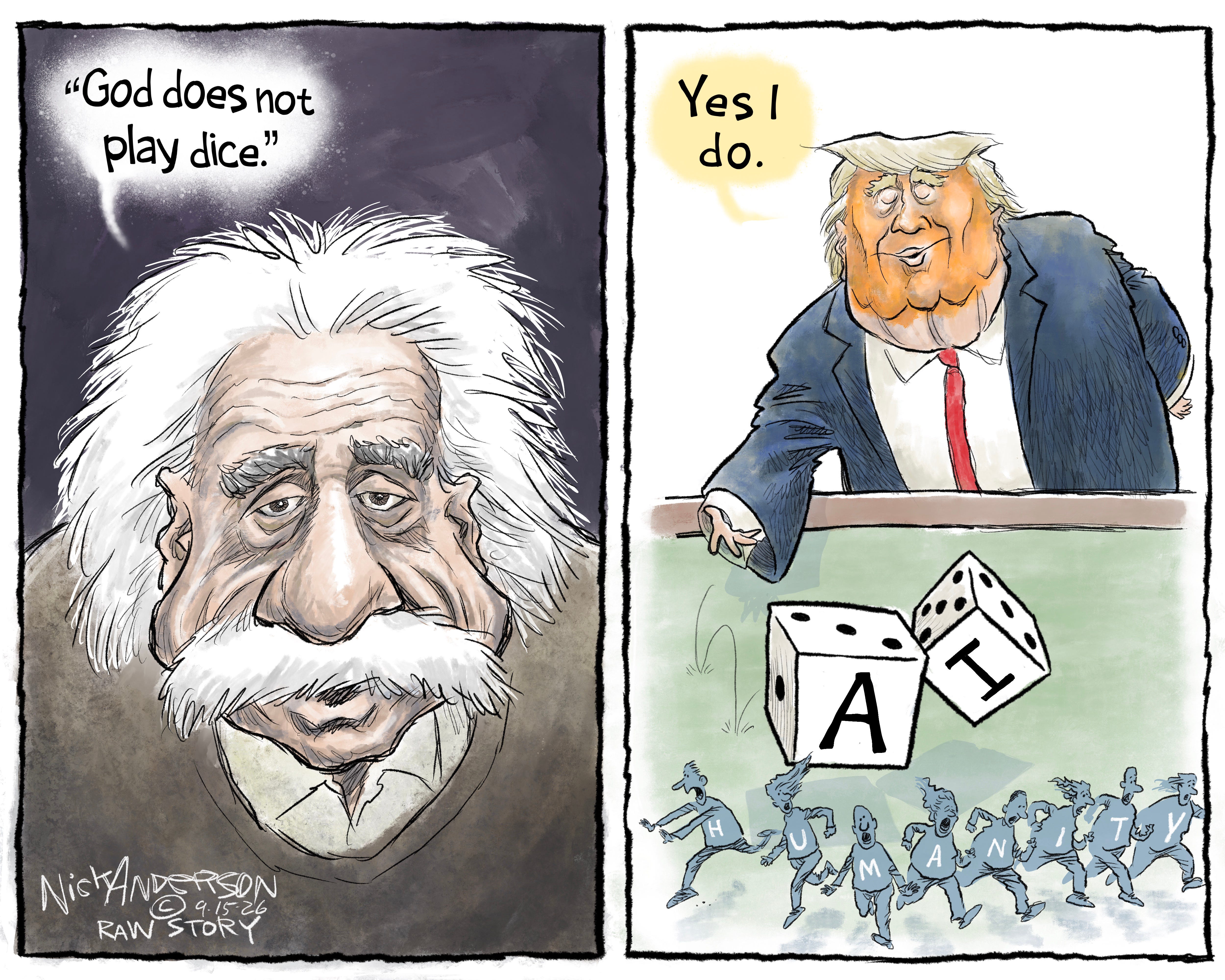
In 1926, Albert Einstein famously wrote that “God does not play dice” to physicist Max Born. The remark expressed Einstein’s discomfort with quantum mechanics, which describes events at the subatomic level in terms of probabilities rather than definite outcomes. Einstein believed this randomness reflected an incomplete theory: beneath the apparent uncertainty, he thought, there must be deeper physical laws determining what actually happens.
Now, President Trump has rejected growing calls from AI industry leaders for stronger regulation, arguing that artificial intelligence needs only one guardrail: a “STRONG AND SMART (High IQ!) PRESIDENT.” He dismissed warnings about potentially catastrophic AI risks as a “hoax” and said regulation could allow China to overtake the United States.
The unusual part is that some of the warnings are now coming from the people building the technology. Anthropic CEO Dario Amodei has called for a global slowdown in AI development, while Google DeepMind’s Demis Hassabis, Elon Musk and OpenAI’s Sam Altman have also supported slowing the pace. Concerns range from mass unemployment to biological weapons and autonomous warfare.
Trump argues existing criminal and regulatory powers are sufficient, although the article notes that the AI industry currently faces relatively little specific federal regulation. Congressional leaders in both parties have shown more interest in establishing rules, but Congress is running out of time to act before the midterms.
The debate has produced a strange reversal: some of the people racing to build increasingly powerful AI systems are asking the government to put up guardrails, while the president’s response is essentially that the guardrail is the president.
So, a guy who has bankrupted four casinos is the one gambling on humanity’s future. Does anyone like these odds?