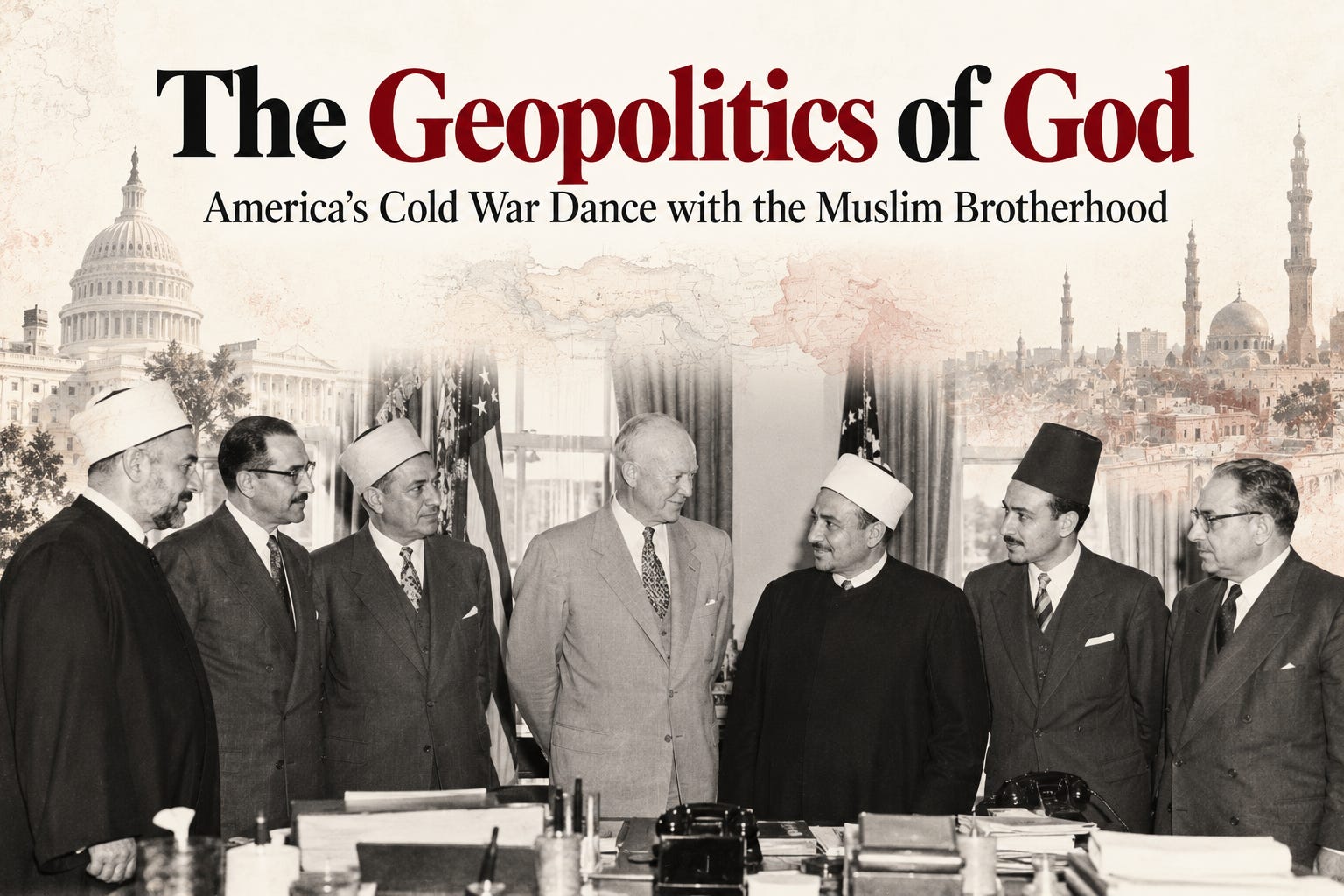
In September 1953, Said Ramadan came to the United States for a conference on Islamic culture at Princeton University. He was 27 years old, Egyptian, and already an important figure in the Muslim Brotherhood. He was also Hassan al-Banna’s son-in-law. Al-Banna had founded the Brotherhood just 25 years earlier.
While Ramadan was here, he and several other Muslim delegates were invited to the White House to meet President Dwight D. Eisenhower. Eisenhower’s appointment book listed the visitors by name and affiliation. Next to Ramadan’s name were four words: “Delegate of the Muslim Brothers.”
I’m a history activist on a mission to document the Jewish story before it’s rewritten or erased. Your paid subscription funds this deep daily research and unlocks every daily briefing, tracking report, and archive.
Subscribe now
The Americans weren’t confused about who Ramadan was. A CIA officer who attended the Princeton conference wrote a report afterward and had plenty to say about him. He described Ramadan as a “Phalangist or Fascist type” who seemed interested in gathering people around him for political power. He also noted that Ramadan’s views were basically those of the Muslim Brotherhood. Whatever concerns the CIA had about him, they hadn’t kept him from meeting the president.
Godless Communism
The problem for Washington in the early 1950s was the Soviet Union. Countries across the Middle East were coming out from under British and French control, and the Soviets were looking for friends there. The Americans were doing the same thing. Somewhere in the middle of all this, religion became part of the calculation.
Make a one-time contribution
American officials had already been talking about it. In 1950, a State Department cable from Moscow discussed the Soviet government’s hostility toward religion and suggested using that in American information campaigns in Muslim countries. It wasn’t a bad argument. The Soviet Union was asking people who took their religion seriously to embrace a system that considered religion something society would eventually leave behind.
Six years later, British Air Chief Marshal Sir William Dickson brought up the same idea in a meeting with Eisenhower. Dickson said there was a base of anticommunism in Islam and the Quran “on which we could build.” Eisenhower agreed that the Americans and the British should work together in the region.
This helps explain why someone like Said Ramadan was worth knowing. The United States didn’t have to agree with the Muslim Brotherhood’s plans for Egypt to notice that the Brotherhood hated communism. During the Cold War, that gave Washington and Ramadan something to talk about.
Read more