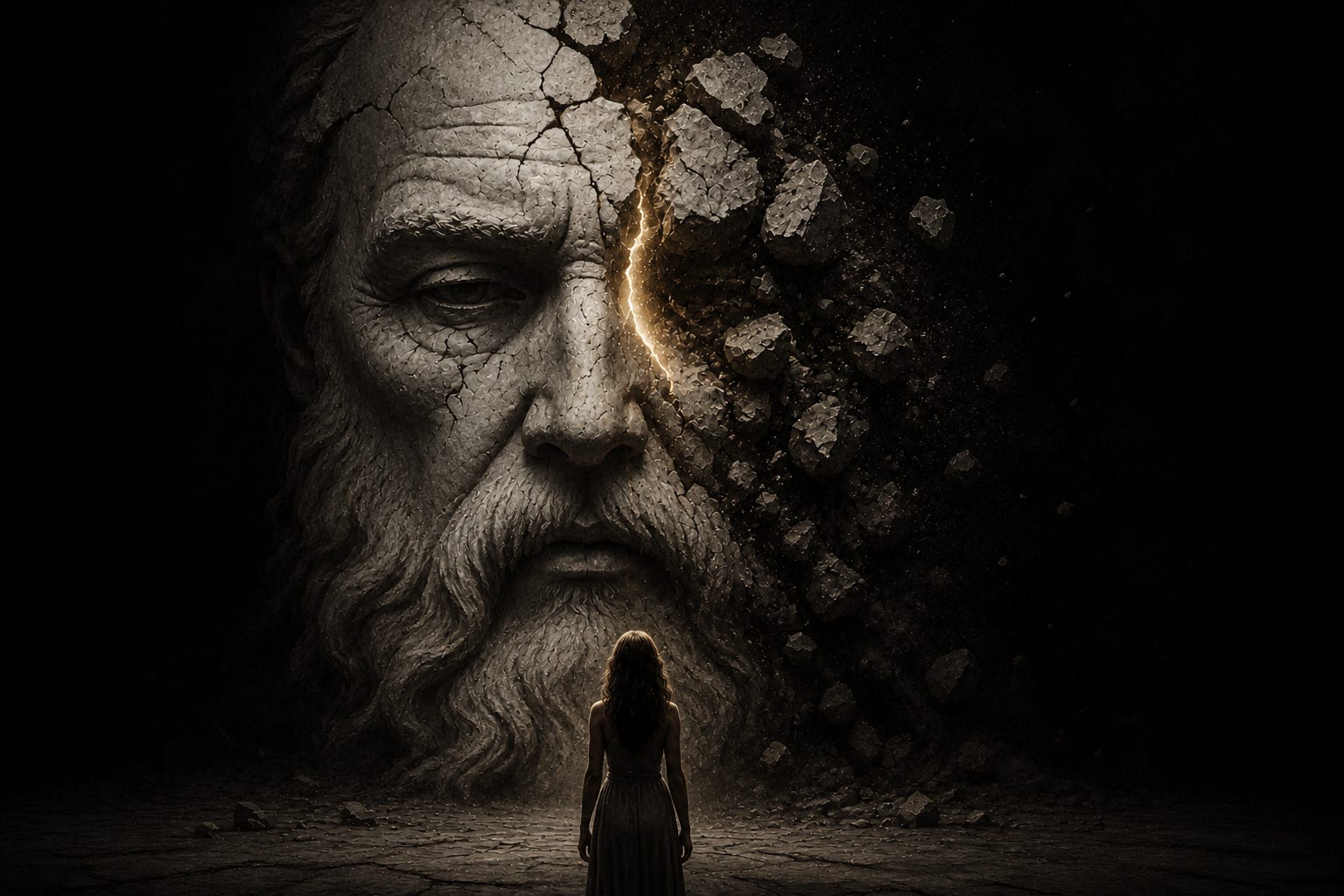
What happens when the God you were taught to worship becomes the greatest obstacle to taking God seriously?
I did not encounter this question as a detached observer of Christianity. I was formed inside its world. I studied theology in seminary, built a ministerial career around Christian belief, preached the biblical story, and helped other people interpret their lives through its categories.
I knew how the parts fit together: God existed above and beyond the universe as its supernatural creator; humanity had become estranged from God through sin; Jesus entered history to repair the breach; salvation restored the relationship; eternal destiny depended upon how one responded to the terms.
For years, this framework possessed the force of reality itself. It named the human problem, explained suffering, organized morality, interpreted history, and offered a final account of what everything meant. To question any part of it placed the whole structure under pressure because the doctrines did not stand independently.
Original sin required atonement. Atonement required a particular interpretation of Jesus. That interpretation required a certain view of Scripture. Scripture required an authorized community of interpreters, even when that community insisted that the text simply spoke for itself. What appeared to be a collection of beliefs functioned as an enclosed interpretive world.
Eventually, that world began to distort more than it disclosed. Its God seemed morally inconsistent with the goodness attributed to him, strangely human despite being described as transcendent, and inseparable from the patriarchal institutions that claimed to represent him. The framework declared an estrangement I could no longer locate in the structure of existence, then offered itself as the exclusive remedy. It made belonging conditional, turned spiritual life into relationship management, and required ancient cosmology to carry forms of authority it could not reasonably bear.
My difficulty extended beyond individual doctrines. The entire theological architecture had become intellectually implausible, morally unstable, and existentially costly. That conclusion did not arrive in a single moment, nor did it leave behind an uncomplicated atheism. The collapse of one conception of God opened a more demanding inquiry: whether traditional Christian theism had mistaken its own image for the mystery to which it was meant to point.
The ten problems that follow are therefore connected. Each reveals a feature of a larger system built around separation, hierarchy, supernatural intervention, and conditional belonging. Together they raise a question more consequential than whether the tradition has gotten some doctrines wrong. They ask whether its dominant construction of God has trained human beings to experience reality, themselves, and one another through a wound that theology itself created.
Because traditional Christian theism overwhelmingly imagines and addresses God as male, I use the pronoun he when describing the deity constructed within that system. The usage reflects the theology under examination rather than my own understanding of ultimate reality.
Traditional Christian theism commonly begins with a categorical division between God and everything that is not divine. The creator is uncreated; the universe is creation. He is self-existent, infinite, and necessary, while everything else is finite, dependent, and contingent. This division was intended to protect divine transcendence. The deity could not be reduced to nature, identified with any object, or contained within the cosmos. Creation depended upon him while he depended upon nothing.
The philosophical seriousness of this account deserves recognition. It safeguards the intuition that ultimate reality exceeds every finite form and resists the temptation to deify nature, nation, ruler, or religious institution. Yet popular Christianity rarely leaves transcendence at that level of subtlety. God becomes a supreme individual located conceptually somewhere beyond the universe: invisible, disembodied, immensely powerful, and equipped with intentions, preferences, emotions, plans, and judgments. However strongly theologians deny that he is one being among other beings, ordinary religious language continually imagines exactly that.
This produces what I call metaphysical exteriority: the assumption that the source and depth of existence stand outside the existence they source and sustain. The divine may be said to be present everywhere, but the governing picture still places him elsewhere. Heaven is above. Revelation arrives from beyond. Meaning is assigned to life from outside life. Human beings look away from the world in order to find the one who supposedly grounds it.
Once metaphysical exteriority becomes the controlling image, reality divides into sacred source and secondary creation. The world can display divine glory, obey its creator, or bear traces of his presence, yet it never fully participates in divinity. Matter becomes spiritually ambiguous. Bodies become lower than souls. Nature becomes scenery, resource, evidence, or stage. The present world is frequently subordinated to another realm imagined as our real home. Even when Christian theology affirms creation as good, its devotional gravity often pulls elsewhere.
The alternative need not be the simplistic claim that every object is God. A richer metaphysical vocabulary includes panentheism, nondual traditions, process thought, the ground of being, sacred naturalism, and forms of Christian mysticism that understand all things as existing within an inexhaustible reality that exceeds them without standing apart from them. These approaches differ substantially, but they refuse to picture transcendence as distance. Ultimate reality can exceed every form while remaining intimate to the being of every form.
That shift changes spiritual orientation. If the word God names the depth, ground, or encompassing mystery of existence, contact with reality does not require escape from the world. Attention becomes spiritually significant. Embodiment is no longer an obstacle to transcendence. Ecological destruction becomes more than the irresponsible use of divine property; it becomes violence within the living whole to which we belong. The sacred ceases to be a distant object of belief and becomes a dimension of participation.
Christian theology has developed many accounts of the human condition, some far more humane than others. The dominant Western narrative nevertheless remains familiar: humanity was created in right relationship with God, fell into sin, became alienated from its creator, and now requires reconciliation. The details vary across traditions. Some emphasize inherited guilt, others inherited corruption, bondage, mortality, or disordered desire. In most versions, a fundamental rupture precedes us. We enter life already implicated in it.
Such a narrative can illuminate genuine features of human experience. We are capable of estrangement from ourselves, one another, the natural world, and the demands of conscience. Human beings inflict harm, rationalize cruelty, betray their values, and participate in systems whose consequences they prefer not to see. Any spirituality that cannot reckon with our capacity for destruction offers sentiment rather than depth.
The theological problem begins when these real forms of estrangement are converted into an ontological verdict. Alienation becomes the deepest truth about the human person. Before an infant has chosen, harmed, understood, or refused anything, the framework has already located that life on the wrong side of a cosmic breach. The person is taught to interpret their existence through inherited spiritual deficit: something essential is missing, corrupted, condemned, or inaccessible until the religious system supplies the remedy.
This structure deserves closer scrutiny because the diagnosis and the cure come from the same institution. Christianity announces that humanity is separated from God, defines the nature of that separation, identifies the event through which it is overcome, and authorizes itself to administer the terms. A system that creates the interpretive wound and monopolizes its treatment acquires extraordinary power. Under its influence, ordinary uncertainty feels like rebellion, bodily desire like corruption, intellectual independence like pride, and departure from the system like departure from reality itself.
The consequences remain even after belief fades. Many people leaving Christianity continue to feel condemned without believing in a condemning God. Their nervous systems retain the threat after their minds reject the doctrine. They may distrust desire, fear their own judgment, or experience autonomy as danger. The theological claim has become an existential posture: I am estranged from the source of life, and my own capacities cannot be trusted to bring me home.
A different starting point would recognize belonging as ontological before it becomes moral, religious, or communal. Violating relationships does not remove us from the web of relationship. Alienation from our own experience does not separate us from the ground of being. Accountability remains necessary because belonging does not confer innocence. It gives accountability somewhere to occur. Repair becomes possible within relationship rather than serving as the price of admission to it.
The difference is profound. Grounded in prior belonging, a person is better able to face harm without collapsing into metaphysical shame. Moral failure calls for truth, restitution, changed behavior, and sometimes consequence. It does not require the belief that one’s essential existence has become repulsive to reality. Traditional Christian theism often confuses moral rupture with ontological exile. Once those are disentangled, human responsibility deepens because it no longer depends upon self-rejection.
Sophisticated Christian theology insists that God transcends biological sex. The divine is spirit, neither anatomically male nor female. Scripture occasionally uses maternal imagery, and theologians point to traditions in which divine wisdom, compassion, or presence carries feminine associations. These qualifications are real. They have not prevented the religious imagination from being organized overwhelmingly around a male deity.
God is Father, Lord, King, Son, Bridegroom, and Judge. The tradition’s definitive incarnation of God is male. The dominant pronoun is he. For much of the tradition’s history, those who interpreted Scripture, defined orthodoxy, presided at altars, governed institutions, and claimed divine authorization were also men. Describing God as metaphorically male does not neutralize the social effects of repeating that metaphor across centuries while concentrating power in male hands.
Religious symbols do more than describe an unseen reality. They distribute legitimacy. When ultimate authority is imagined as male, maleness acquires metaphysical elevation. The hierarchy of heaven becomes available as a template for the hierarchy of earth: God over humanity, Christ over the church, husband over wife, clergy over laity, father over household. Patriarchy can then present itself as participation in cosmic order rather than a historical arrangement serving particular interests.
I call this symbolic authorization: the process by which a religious image lends sacred inevitability to a social structure. No single masculine reference to God causes patriarchy. The mechanism operates cumulatively. Language shapes imagination; imagination establishes what feels natural; what feels natural becomes difficult to identify as political. By the time domination is defended explicitly, the symbol has already trained the community to associate authority, rationality, protection, and divine representation with men.
Expanding divine language is therefore more consequential than adding occasional feminine metaphors to an otherwise masculine system. If God is called Mother while ecclesial authority remains male, reproductive autonomy is controlled by men, women’s testimony is discounted, and gender hierarchy is treated as revelation, the new vocabulary becomes decorative inclusion. The governing distribution of sacred authority remains intact.
An adequate reconstruction must examine the deeper premise that ultimate reality resembles a magnified person at all. The debate over whether God is male often leaves anthropomorphism untouched, as though the solution were a more representative divine individual. Human language will always draw from human experience, and personal metaphors carry genuine relational depth. Trouble begins when metaphor forgets that it is metaphor and returns as cosmic anatomy.
The point reaches beyond gender. Every divine image authorizes a way of organizing human life. A sovereign deity lends legitimacy to authoritarian power. A punitive ruler sanctifies cruelty. A tribal divinity makes exclusion feel righteous. When ultimate reality is imagined as invulnerable perfection, dependency, grief, embodiment, and change appear spiritually inferior. Examining God-language therefore means examining the human order that language protects.
Traditional Christian theism attributes to God a combination of properties that becomes agonizing in the presence of suffering. He is perfectly good, fully powerful, intimately aware of every life, sovereign over history, responsive to prayer, and capable of intervention. Christian communities then tell stories of providence: the tumor disappeared, the accident was avoided, the money arrived, the child came home, the right person called at the right moment. Gratitude turns fortunate circumstance into evidence of divine attention.
The same interpretive system strains when intervention does not come. Another tumor grows. Another child dies. A family prays with equal sincerity and receives no rescue. Genocide unfolds while victims plead for deliverance. Abuse continues inside institutions dedicated to the one who supposedly sees everything. At that point, theology introduces hidden purpose, human freedom, spiritual formation, fallen creation, divine timing, or mystery. Each may address part of the philosophical problem. Collectively, they often protect the doctrine from the evidence rather than helping the sufferer understand what has happened.
The central dissonance lies in selective providence. If the deity can intervene, loves every person, and sometimes alters events in response to prayer, every claimed rescue creates a shadow question about those who were not rescued. The testimony that “God protected me” carries an implication few believers intend: the same protection was available and withheld elsewhere. Appeals to mystery may restrain arrogance, but mystery becomes morally troubling when it preserves praise for divine action in fortunate outcomes while shielding divine inaction from scrutiny in catastrophic ones.
This produces providential asymmetry. God receives agency when events turn out well and exemption when they turn out terribly. Human beings are encouraged to detect divine intention in coincidence, recovery, opportunity, and survival, while apparently meaningless suffering is assigned to causes that leave his goodness untouched. The framework cannot lose. Every outcome confirms it, which also means no possible outcome can test it.
The psychological burden falls heavily on those who suffer. Unanswered prayer can become an investigation of the self. Did I lack faith? Was I asking for the wrong thing? Is he teaching me something? Have I failed to recognize the answer? The believer must often defend divine goodness while absorbing the emotional consequences of divine absence. Grief becomes entangled with theological labor.
Some Christian responses move away from interventionist sovereignty. Process theology…