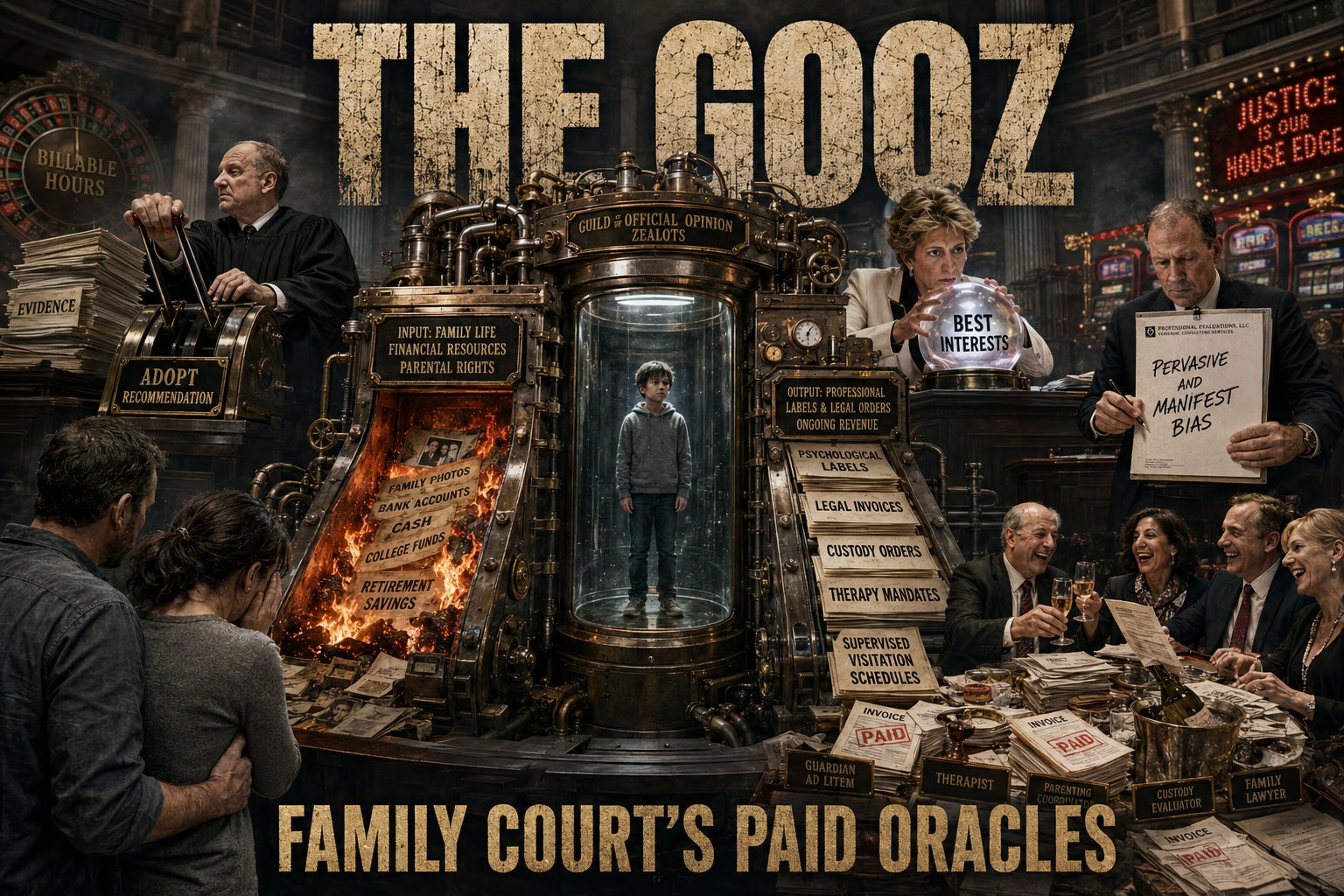
LUTHMANN NOTE: The forensic-evaluator racket survives because it gives everyone inside family court what they want. Judges get a professional blame sponge. Lawyers get depositions, hearings, and rebuttal experts. Therapists and coordinators get compulsory referrals. The evaluator gets another appointment. Only the family loses. APA calls its custody guidelines aspirational. AFCC converted standards into guidelines. Courts still treat the resulting reports like tablets carried down from Mount Sinai. Strip away the credentials and clinical word salad. The GOOZ sell opinions to a captive customer under judicial compulsion. Publish the appointment history, methodology, raw data, communications, and complete invoice. This piece, “The GOOZ,” is written in the “classical style” of The Blog, offence intended. Reader discretion advised.
“Psychologist” sounded too ordinary. Family court needed something grander, colder, and more expensive. Something that smelled like a laboratory, carried the authority of a medical examiner, and frightened desperate parents into believing that resistance was useless. So the custody racket placed “forensic” in front of “psychologist,” wrapped opinion in scientific costume, and introduced the family courthouse to the GOOZ.
The GOOZ are the Guild of Official Opinion Zealots, a professional caste where membership requires a credential, a court appointment, a limitless appetite for billable conflict, and the ability to tell a judge exactly what the judge wanted to hear before ordering the evaluation.
A forensic psychologist is still a psychologist. “Forensic” means the work relates to litigation. It does not confer X-ray vision, establish moral authority, or create an instrument capable of measuring love, honesty, loyalty, parental fitness, or a child’s future happiness. There is no blood test for “best interests.” No microscope reveals which parent should receive Christmas morning. No brain scan tells a judge whether a crying child has been abused, coached, alienated, traumatized, or simply terrified by the courthouse strangers dissecting his family.
The title creates the illusion. The GOOZ collect the check.
The American Psychological Association’s child-custody evaluation guidelines admit that they are aspirational. They are not mandatory, exhaustive,e or definitive. They do not override the evaluator’s professional judgment. The Association of Family and Conciliation Courts performed the same escape act when it replaced “Model Standards” with “Guidelines on Parenting Plan Evaluations”, clarifying that its document provides guidance rather than enforceable rules.
Standards become suggestions. Rules become professional discretion. Accountability evaporates. The invoice remains enforceable.
A family arrives in court wounded, frightened, and financially exposed. Divorce has ripped open old betrayals. Lawyers have converted every argument into evidence. Both parents fear losing the children, and the children fear losing everything. Into this disaster walks a GOOZ carrying questionnaires, diagnostic vocabulary, and the serene confidence of someone who gets paid regardless of which family member leaves the courthouse destroyed.
The evaluator conducts interviews, administers tests, observes carefully staged parent-child interactions, and telephones “collateral sources” selected from the wreckage. Every hour generates a charge. Every accusation demands investigation. Every disputed detail justifies another session. Every new session enlarges the report. The report produces depositions, cross-examination, rebuttal experts, and supplemental opinions.
The evaluation does not end conflict. It industrializes conflict.
Then comes the vocabulary. A mother becomes “enmeshed.” A father becomes “narcissistic.” A child who refuses contact has been “alienated.” A parent who protests is “defensive.” A parent who remains calm is “emotionally detached.” Tears indicate instability. Anger indicates poor regulation. Silence indicates concealment. Detailed answers indicate rehearsal.
The GOOZ creates a closed belief system in which every response confirms the theory selected during the first interview. Psychology becomes courtroom astrology. The evaluator reads the constellation, announces which parent carries darkness, and sends a bill for professional stargazing and court-supervised butchering of the nuclear family.
The scientific literature has warned courts about this carnival for years. A major scholarly assessment described custody evaluation as “limited science and a flawed system”. Its authors found no scientific justification for certain forensic instruments marketed as tools for assessing children’s best interests. Another analysis found the empirical foundation for ultimate custody recommendations “tenuous or non-existent” and demanded clinical humility and judicial vigilance.
Humility is poison to the GOOZ business model. “I don’t know” does not support a custody transfer, justify supervised visitation, or generate six months of compulsory therapy. The industry requires certainty, even when the science supplies none.
A 2021 review of 50 custody evaluations identified cherry-picked evidence, arbitrary factual determinations, speculative inferences, misinterpreted testing, and confirmation bias. Errors within individual reports tended to favor the same parent. Once the evaluator had chosen a hero and a villain, the evidence was sorted accordingly.
That is not science. It is scriptwriting with psychological letterhead. New York’s Appellate Division caught the act in * Matter of Montoya v. Davis*. A court-appointed forensic evaluator recommended taking a child from his longstanding primary caretaker, giving custody to the father and cutting the mother off for at least six months so the child could be “deprogrammed.” The evaluator’s recommendation had changed dramatically without another meeting with the mother and without a convincing explanation.
The appellate court found “pervasive and manifest bias.” It said the evaluator abandoned neutrality and became an “overly zealous advocate” for the father. Family Court recognized her less-than-neutral tone, adopted her findings anyway,y and allowed the hired expert to usurp the judge’s duty.
That is the GOOZ franchise in one reported decision. The court appoints the oracle. The oracle delivers the desired prophecy. The court launders the prophecy into findings of fact. The child changes homes while every participating adult congratulates himself for serving the child’s best interests.
The evaluator remains protected because the family usually cannot afford a fair fight. The GOOZ has the credential, the appointment,nt and access to the judge’s confidence. The parent has an emptied retirement account and an attorney explaining that another expert must be hired to rebut the first expert.
One GOOZ creates demand for another. The rebuttal report generates another deposition. The competing reports generate a hearing. The hearing produces an order requiring therapy, coordination, and monitoring from professionals orbiting the same courthouse economy. Family money enters. Professional money exits. The child remains trapped in the machine.
Children are gifts from God. The GOOZ turn them into billable subject matter. Parenting becomes percentages, visitation grids, psychological profiles, and remedial programs. Family love enters the courthouse as something sacred and emerges as a service plan managed by strangers charging hundreds of dollars per hour.
Peace is the natural enemy of this industry. Cooperation closes the file. Shared parenting eliminates appointments. Reconciliation starves the professional swarm. Conflict keeps the report alive, and the report keeps everyone feeding.
The worst GOOZ do more than loot the family bank. They manufacture the evidentiary foundation for separating children from protective parents, minimizing abuse claims and compelling contact with dangerous adults. A child’s fear becomes evidence of coaching. The protective parent’s alarm becomes pathological anxiety. The accused parent’s rehearsed performance becomes composure. The evaluator’s theory circulates through motions, reports, and orders until repetition transforms opinion into courthouse truth.
Family court seals the report, shields the evaluator, and threatens anyone who publishes the contents. The public cannot inspect the methodology. Journalists cannot examine the raw data. Parents risk contempt for exposing the professional garbage used to take their children.
Dr. Bandy X. Lee has attacked this secrecy and professional arrogance, producing a federal free-speech confrontation over criticism of New Jersey family-court actors. The same machinery appears when ordinary custody litigation expands into a billable production of evaluators, coordinators, lawyers and collateral warfare.
The cure is not another GOOZ committee writing another aspirational guideline. Courts must require the evaluator to identify the scientific basis for every conclusion, disclose contrary evidence, explain the limitations and error rates of each test, produce the raw materials,s and reveal every dollar collected. Appointment histories must be public. Communications with lawyers, guardians, and court personnel must be preserved. Judges must make independent factual findings instead of stuffing psychological word salad into custody orders.
Most importantly, courts must strip “forensic psychologist” of its ceremonial magic. The title is not science. The report is not evidence merely because it is expensive. The recommendation is not wisdom because it arrived bound in plastic.
The GOOZ is not God. It is a court vendor with an opinion, a billing rate, and a dangerous talent for giving black-robed cowards somewhere else to place the blame.