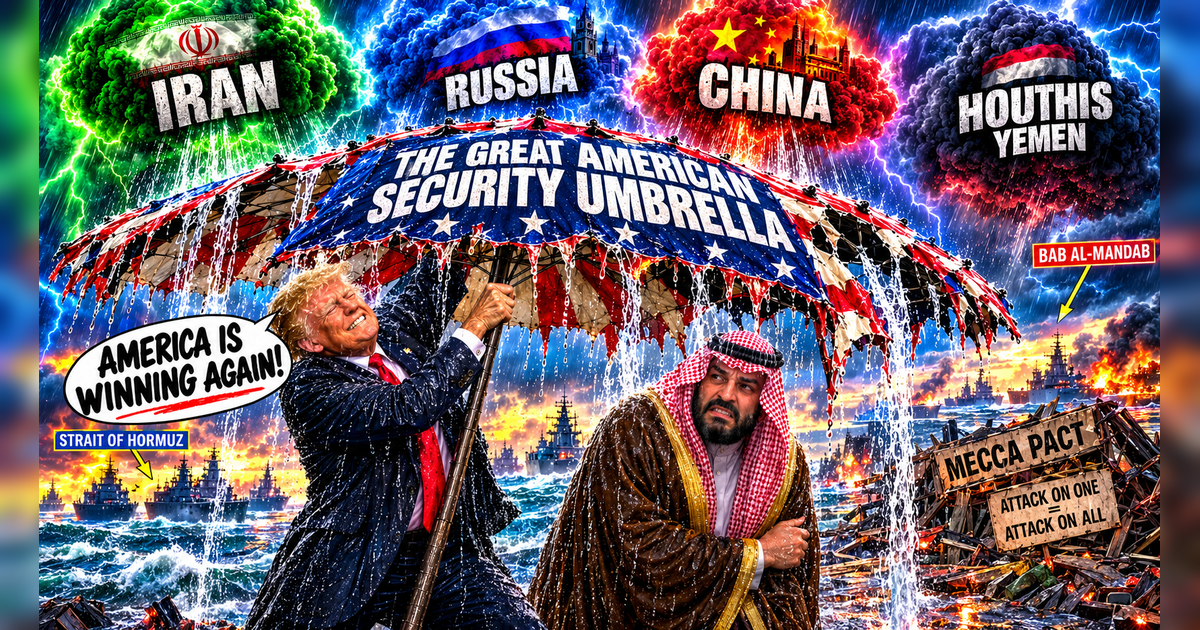
One island. One broken pact. One prince in tears. And the hidden proof that the entire global order is being rewritten in real time.
There are moments in history when an empire doesn’t fall with a bang.
It falls through a series of small, almost boring failures — a phone call that doesn’t get returned, an alliance that isn’t invoked, a promise that quietly stops being kept. Nobody announces the end. Nobody signs a document declaring it over. It simply stops working, one incident at a time, until the world looks up and realizes the ground has already shifted beneath its feet.
That is precisely what is happening right now. And almost nobody watching the mainstream news cycle has connected the dots.
If you follow this chain carefully, you’ll feel something close to a jolt of clarity — the moment where several confusing headlines from the past few months suddenly snap into one coherent, unsettling picture.
Let’s walk through it. Slowly. Completely. Nothing skipped. 🧩
For nearly 80 years, since the end of the Second World War, the modern world has operated on one unspoken assumption: that a single superpower — the United States — sits at the center of the global system, both as its largest economy and, more importantly, as its ultimate security guarantor.
This wasn’t just symbolic. It was structural. Nations built entire national strategies around this assumption. Smaller countries didn’t need to build massive militaries of their own because they trusted that the American security umbrella would open above them if push came to shove. Regional rivals held back from open aggression against U.S.-aligned nations because provoking a protected ally carried real, predictable consequences — economic sanctions, diplomatic isolation, or in the most extreme cases, direct American military involvement.
This arrangement is often called the postwar security order, and it’s genuinely one of the most consequential arrangements in modern history. It has shaped everything from how small nations spend their defense budgets to how confidently they’ve been able to pursue economic development, trusting they wouldn’t need to divert resources into self-defense.
That assumption is now being tested — and it’s failing, publicly, repeatedly, in front of the entire world.
Look closely at how global events are unfolding, not through press releases, but through how nations actually behave under pressure. One thing becomes undeniable: the United States is becoming steadily less dependable, whether you judge it as an economic partner or, far more critically, as a security provider.
This isn’t a hot take. It’s a pattern. And there is no better live case study right now than what’s happening in the Middle East.
For roughly four months, a real, ongoing war has been grinding on in the Middle East — largely underreported, but very real. The two principal antagonists are Iran and the United States.
Here’s what most surface-level coverage completely misses: Iran isn’t fighting this war using only its own uniformed military. Iran learned decades ago that direct confrontation with a superpower is a losing bet — the kind of war that ends in devastating losses even if you occasionally land a symbolic blow. So instead, it built something far more insidious and far harder to counter: a sprawling network of proxy militias scattered strategically across the region.
A proxy militia, in simple terms, is a local armed group that a larger power arms, trains, funds, and directs — without ever officially claiming ownership of its actions. This lets the sponsoring power claim distance and deniability while still projecting real force. Each proxy Iran has cultivated functions like a pressure valve it can open or close at will — inflicting real damage, tying down enemy resources, destabilizing entire regions — all without Iran ever risking its own soldiers or inviting a direct war on its own soil.
This is the genius, and the danger, of proxy warfare. It lets a mid-sized regional power punch dramatically above its actual weight, using other people’s territory and other people’s blood as the battlefield, while keeping its own hands technically clean on the world stage.
And the front line of that war is not in Iran or America. It is in Yemen, on Saudi Arabia’s southern border — where Iran fights through a proxy, and where the United States has quietly refused to fight at all.
One of the most consequential nodes in this entire network is a group most Western and global audiences only vaguely recognize by name: the Houthis.
The Houthis draw their base from Yemen’s Shia Muslim population. Iran — itself the world’s dominant Shia power and the largest Shia-majority nation on Earth — spent years cultivating, arming, and training this community, transforming what could have remained a scattered, powerless minority into a disciplined, battle-hardened militia capable of holding territory and launching sophisticated attacks.
Here’s where geography becomes absolutely critical to understanding everything that follows: Yemen sits directly on Saudi Arabia’s southern border.
Saudi Arabia’s relationship with Yemen has also been strained for a long time, largely because of the Houthi conflict and the continuing security threat emanating from Yemen.
To understand why this matters so much, it helps to understand the broader picture first. Islam has two major branches, Sunni and Shia, and this division dates back roughly 1,400 years to a disagreement over religious succession after the Prophet Muhammad’s death. Today, Saudi Arabia positions itself as a central custodian of Sunni Islam — it’s home to Mecca and Medina, Islam’s two holiest cities — while Iran positions itself as the central power of Shia Islam.** This isn’t merely a theological difference; over centuries, it has become deeply entangled with regional politics, national identity, and competition for influence across the wider Middle East. It is, in effect, the oldest and most consequential geopolitical rivalry in the region, and it shapes nearly every major conflict that erupts there.**
By quietly identifying Yemen’s Shia communities, arming them, training them, and militarizing them, Iran effectively planted a live weapon inside its greatest rival’s own backyard — a small but potent force capable of harassing and bleeding Saudi Arabia continuously, for years, without Iran ever having to cross a border or declare formal war.
This isn’t a new or sudden development. The roots trace back to 2013 and 2014, when a movement called Ansar Allah — the ideological and political backbone of what would become the modern Houthi movement — seized Sana’a, Yemen’s own capital city, and has held it in a firm grip ever since. This wasn’t a fringe uprising; it represented a genuine, sustained takeover of the machinery of a national capital.
Since that takeover, Iranian support hasn’t just continued — it has intensified into extremely aggressive military and logistical backing. And critically, Iran doesn’t do this alone. Multiple intelligence assessments point to Russia and China playing supporting roles in keeping weapons flowing to the Houthis — critically, routed through African territory, using the continent as a logistical blind spot that makes shipments harder to trace and easier to deny internationally.
Step back and absorb what this actually means: a coordinated, multi-power logistical network — Iran, Russia, and China all playing some role — quietly sustaining a militia on the doorstep of one of the world’s most strategically vital nations, a country that sits atop some of the largest oil reserves on the planet. This is not a local skirmish confined to a poor corner of the Arabian Peninsula. This is an engineered geopolitical pressure point with global energy-market implications.
Saudi Arabia is now permanently trapped in a security dilemma, its own national safety hostage to a militia embedded in its own neighborhood, sustained by a coalition of powers it cannot easily counter through diplomacy or force alone.
For years, Saudi Arabia partnered with the United Arab Emirates to run joint military operations against the Houthis inside Yemen. And for years, those operations failed — repeatedly, expensively, and humiliatingly, despite significant resources poured into them.
Why does a wealthy nation with access to some of the most advanced weapons systems on Earth keep failing against what should be, on paper, a far weaker and less resourced opponent?
The answer isn’t about the hardware. Saudi military technology is not inferior in any meaningful technical sense — the vast majority of its arsenal is imported directly from the world’s number-one military supplier, the United States. These are elite, cutting-edge systems, some of the most sophisticated ever built.
The real problem runs much deeper:** Saudi Arabia simply lacks the accumulated institutional expertise of actually fighting sustained, offensive wars — and winning them.**
Here’s a historical detail that reframes the entire picture. Modern Saudi Arabia was founded in 1932 by Ibn Saud, who consolidated the various tribal territories of the Arabian Peninsula into a single kingdom after winning the Battle of Sabilla, fought using his own loyal fighting force, known as the Ikhwan. That battle effectively marked the last major armed conflict the kingdom’s founding generation fought to secure its borders and establish sovereignty.
Since then — across nearly a century — Saudi Arabia has not once successfully prosecuted a sustained offensive campaign to a decisive conclusion. Yemen is the proof: years of operations, no victory.
Think about the sheer weight of that fact.** Nearly one hundred years spent accumulating the most advanced military hardware money can buy, while accumulating almost none of the real-world combat experience needed to deploy that hardware effectively under the chaos and pressure of actual war.**
There’s a second layer to this problem, just as important as the first: even where Saudi Arabia has acquired top-tier American equipment, its forces often simply lack the deep operational familiarity — the years of hands-on training, doctrine development, and combat rehearsal — needed to use that equipment to its full potential in real combat conditions. It’s the equivalent of owning a Formula 1 car but never having driven anything faster than a family sedan. The machine is world-class. The driver isn’t ready for it, and no amount of additional purchasing fixes that gap — only years of hard-won experience does.
This single structural weakness — expensive hardware paired with underdeveloped operational skill and doctrine — explains why Saudi Arabia, despite its enormous wealth and impressive arsenal, has remained stuck in a grinding, seemingly unwinnable conflict against a militia it should, on paper, be able to overwhelm with relative ease.
And there is a third reason, one that military planners rarely say out loud: you cannot bomb an insurgency out of existence.
The Houthis are not a conventional army. They are not a navy, not an air force, not a column of tanks that can be found, targeted, and destroyed. They are fighters embedded in the terrain — in mountains, in villages, in the population itself. They live where they fight. They disappear into the landscape the moment the jets leave. They have no headquarters to level, no fleet to sink, no formations to break.
This is the oldest lesson in the history of warfare, and it is the one Saudi Arabia keeps refusing to learn:** air power can punish, but it cannot occupy. It can destroy buildings, but it cannot hold ground. To actually defeat an entrenched militia, you need infantry — soldiers on the ground, holding territory, block by block, valley by valley, for years.**
Saudi Arabia does not have those soldiers. Its allies will not send them. And so the war continues — not because the Houthis are stronger, but because the only force that could defeat them has never shown up.
Here’s where the story turns genuinely dark — and reveals something most people refuse to believe about how great powers actually operate behind the scenes.
Iran backs the Houthis. Everyone accepts that as a given. But here’s what should genuinely disturb you: the United States — Saudi Arabia’s supposed protector and long-standing security guarantor — also refuses to meaningfully help crush the Houthi threat. And based on the pattern of events, there appear to be two distinct, compounding reasons for this, not one.
Reason one is cold strategic math — and it’s blunter than most casual observers assume. From Washington’s vantage point, Saudi Arabia isn’t simply an ally that’s grown slightly more independent over the years.** In important respects, Saudi Arabia now functions as something closer to a strategic rival to certain American interests **— a country whose oil production decisions, growing economic ties with China, and deepening engagement with other global power blocs increasingly cut against Washington’s preferences.
If an Iran-backed militia is already tying down a country behaving this way, Washington has no urgent incentive to spend a dollar or risk a single soldier keeping that country’s ambitions in check.
Iran, in effect, is doing that containment work for free — and this dynamic serves Washington’s interests quietly, without it ever needing to say so out loud.
Reason two is even less discussed publicly, and arguably even more revealing: Washington has already run a military operation directly against Iran itself in recent months, as part of this same four-month conflict — and that operation, by most accounts, produced no clear or meaningful strategic gains.
Here’s what happened. The United States struck Iran directly — a sustained campaign aimed at degrading specific military capabilities. More than 2,000 targets were hit. American officials spoke of achieving complete and total control of Iranian airspace. The strikes landed. The targets were destroyed.
And then nothing changed.
Within weeks, the strategic picture was exactly where it had been before the operation began — only now with the bill attached. No decisive outcome. No clean victory to point to as justification for the cost. Having just absorbed that expensive, inconclusive experience, the United States understandably has very little appetite for opening a second costly front — this time against Iran’s proxy rather than Iran directly — purely on Saudi Arabia’s behalf. Why repeat a gamble that just failed to pay off the first time?
Put those two reasons together, and the picture becomes brutally clear: America isn’t merely indifferent to Saudi Arabia’s suffering. It has both a quiet strategic incentive to let the situation continue unresolved, and a recent, bitter track record actively discouraging it from intervening again so soon.
This dual explanation resolves something that would otherwise make no sense at all: why, despite Saudi Arabia’s increasingly desperate and repeated diplomatic pleas, the United States has consistently, firmly declined to step in and help neutralize the Houthi threat once and for all.
And the refusal was not passive. It was personal. Crown Prince Mohammed bin Salman called President Trump twice in rapid succession — first to brief him on the deteriorating situation, then again to request direct American strikes on the Houthis. Trump declined. The offer extended:** intelligence and targeting data. Nothing more. A superpower’s answer to a desperate ally: we’ll tell you where to shoot. We won’t shoot for you.**
Faced with this abandonment, Saudi Arabia moved to construct its own alternative safety net. A few months ago, it orchestrated a brand-new defense agreement, publicly branded the Mecca Pact.
But here’s the sharper, more accurate way to describe what this pact actually turned out to be in prac…