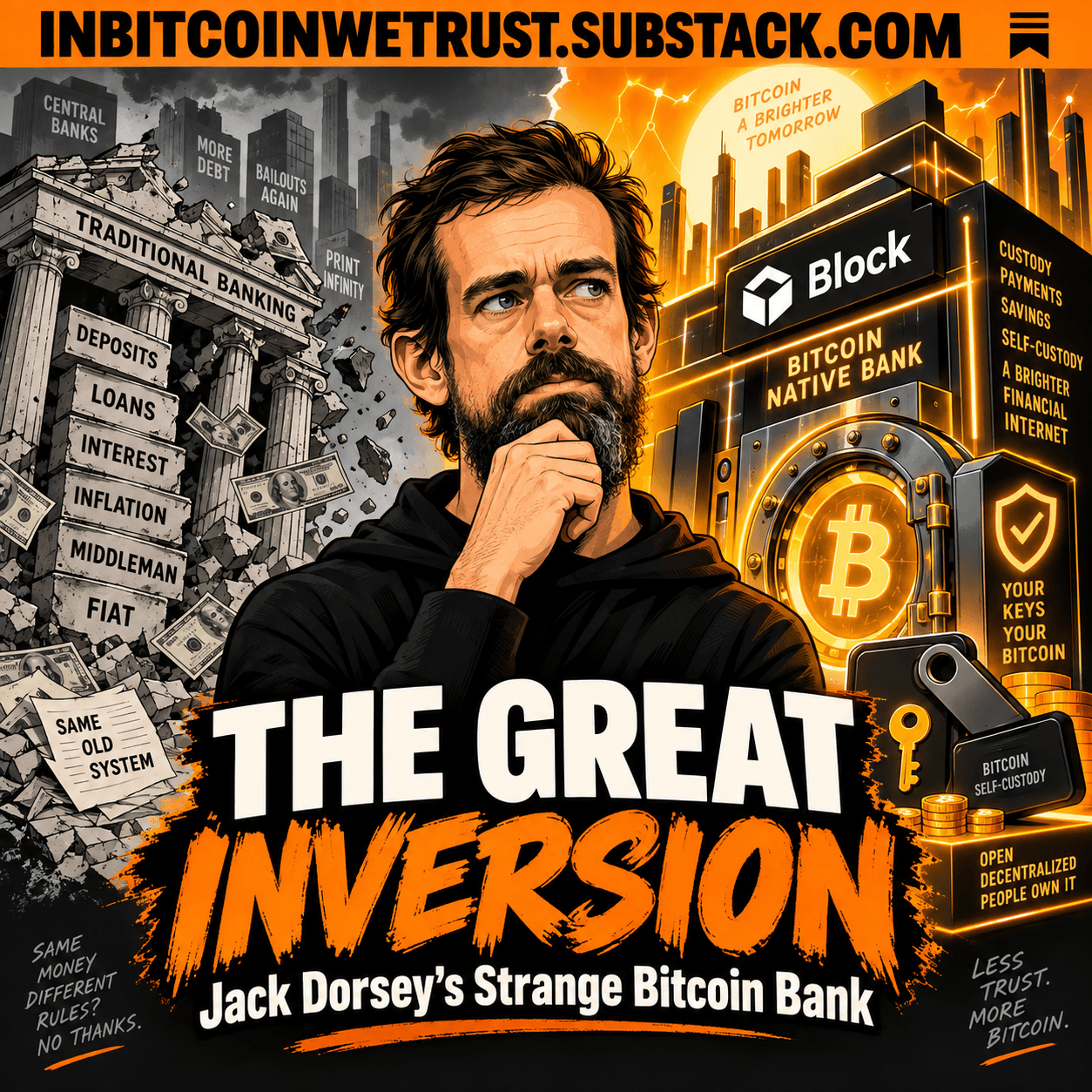
Block spent years building tools to help you escape the banking system. Now, Jack Dorsey is building a federally chartered bank. Here is why this apparent contradiction is actually a Trojan horse for Wall Street.
Jack Dorsey wants to build a bank. A Bitcoin bank.
Coming from almost anyone else in the financial sector, that sentence would barely deserve a headline anymore. Over the past twenty-four months, the assimilation of digital scarcity into the legacy fiat system has been relentless. Coinbase has established itself as the undisputed institutional infrastructure layer. BlackRock, the apex predator of global asset management, launched a Bitcoin ETF that absorbed tens of billions of dollars in record time. Traditional commercial banks and bulge-bracket investment firms are increasingly offering custody, trading, and access to digital assets. Wall Street has spent the past few years absorbing Bitcoin one financial product at a time.
But Jack Dorsey is different. His company, Block, has spent years telling people that Bitcoin offers something the traditional financial system fundamentally cannot provide: the ability to own money without depending on a financial intermediary.
Block built Bitkey specifically around the cypherpunk ethos of self-custody. It built Proto to open up the notoriously opaque and centralized world of Bitcoin mining hardware. It funded open-source Bitcoin and Lightning Network development through Spiral. Cash App integrated Bitcoin and Lightning to make peer-to-peer digital scarcity frictionless for retail users. Square is pushing Bitcoin payments toward everyday merchants. Block itself describes Bitcoin as a monetary technology capable of creating financial access without gatekeepers, without borders, and without discrimination.
And now?
Block has applied to the U.S. Office of the Comptroller of the Currency (OCC) to create Builders Bank & Trust, N.A.
This would be a federally regulated institution designed, among other things, to custody Bitcoin for other people.
At first glance, it looks like a glaring contradiction. The very company building cutting-edge tools to eliminate the trusted custodian now wants permission from the federal government to become one. It feels like a capitulation to the fiat system.
But look closer.
Because this is not a retreat from Bitcoin’s original promise. It may be something much more profound. Bitcoin could be forcing the legacy banking system to permanently split apart, unbundling its core functions. And Builders Bank may be an early, highly calculated preview of the exact institutional architecture that survives the transition to a Bitcoin standard.
Let’s start with the most important and least understood fact about this application: Builders Bank would not be a normal bank.
Block submitted its application on September 8 to create an uninsured national trust bank supervised directly by the OCC. If approved, it would provide custody and related fiduciary services, including specialized services involving Bitcoin and stablecoins.
But here is what Builders Bank would
notdo:
It would not accept customer deposits. It would not make loans.
Stop and think about the macroeconomic implications of that limitation. There would be no checking accounts. No savings accounts. No traditional deposit franchise. No mortgage book. No corporate lending business. No classic fiat model of taking short-term, uncollateralized deposits from retail customers and lending that money out long-term to institutional borrowers.
The two activities most people—and most central bankers—associate with the word “bank” would be entirely missing.
Instead, Builders Bank would concentrate almost exclusively on fiduciary realities: custody, digital-asset execution, and settlement infrastructure. Reporting on the application also indicates that the proposed institution could execute customer digital-asset buy and sell orders on a riskless-principal basis and support stablecoin settlement.
That makes Builders Bank closer to a cryptographically verifiable vault and a financial infrastructure routing layer than the marble-columned bank branch most people imagine. It is a bank stripped of maturity transformation. It is a bank stripped of credit expansion.
And that is exactly why this story matters. Bitcoin is forcing the separation of the concept of a “bank” into its component parts, stripping away the fiat leverage and leaving only the essential services of trust and connectivity.
To understand why a custody-only trust bank is so revolutionary, we have to examine the history of fiat monetary architecture. For generations, traditional banks have bundled a myriad of disparate financial functions together into a single, opaque institutional package.
Under the fiat standard, banks stored your money.
They transferred your money.
They lent money.
They issued credit.
They provided final settlement.
They performed custody.
They verified identity.
They kept the financial records.
They controlled access to the global economy.
All of these services lived inside roughly the same institutional wrapper. And because these functions were bundled, the risks were bundled. When you deposited funds into a traditional commercial bank, you were not actually placing money in a vault; you were legally making an unsecured loan to a highly leveraged entity. The bank took your deposit, fractionally reserved it, and lent the rest out, creating new fiat currency in the process. The ledger was private. The settlement was delayed. The trust was absolute.
Bitcoin completely challenges and dismantles that structure.
You do not need a bank to verify whether Bitcoin exists; the decentralized blockchain ledger does that transparently, every ten minutes.
You do not need a bank to create final settlement between two transacting users; the proof-of-work mining network does that.
You do not need a bank to maintain the monetary ledger; tens of thousands of independent full nodes distributed across the globe do that.
You do not need a bank to tell you whether you own Bitcoin; a cryptographically secure private key mathematically proves your control.
And most radically of all: you do not necessarily need a custodian to store Bitcoin. You can hold the keys yourself.
So, if software and cryptography have subsumed ledger maintenance, settlement, verification, and storage, what exactly is left for the bank to do?
That is the question that Builders Bank makes incredibly interesting. The answer may be: not everything—but still something highly specific.
If you are an individual who owns $5,000, $50,000, or even $500,000 of Bitcoin personally, self-custody can be relatively straightforward. You buy a high-quality hardware wallet. You secure your seed phrase backup on steel plates. You educate yourself on UTXO management. Maybe you graduate to a multisignature (multisig) setup if your holdings grow to represent a significant portion of your net worth.
The Bitcoin network does not care whether you are an individual cypherpunk running a node over Tor, a macro hedge fund in Mayfair, or a Fortune 500 company in Silicon Valley. The protocol is entirely blind to the identity of the transacting entity.
But the legal system is not blind.
An institution cannot simply operate like a cypherpunk. When billions of dollars of third-party capital are at stake, a corporation cannot tell its shareholders, “Dave from the Treasury department has the hardware wallet in his desk drawer, and he wrote the seed phrase on a piece of paper in the company safe.”
A registered investment adviser (RIA) has strict fiduciary obligations under the Investment Advisers Act of 1940. A publicly traded corporation needs internal controls mandated by Sarbanes-Oxley. An asset manager needs SOC 1 and SOC 2 compliance audits. Corporate boards need multi-layered governance procedures to prevent embezzlement or accidental loss. Insurers underwriting corporate policies need rigidly defined operational processes. Compliance departments need irrefutable transaction records. External auditors need cryptographic and legal evidence of reserves. Regulators need accountable legal entities to supervise.
*If a rogue employee disappears with a 24-word seed phrase, or if a CEO dies without passing on the multisig quorum, shareholders and regulators will not accept the mantra: *** “Not your keys, not your coins.” They will ask why the company had no enterprise-grade control framework in place, and they will litigate.
This is exactly where institutional Bitcoin custody enters the equation. It is not because the Bitcoin protocol requires a custodian. It is because human legal institutions require institutions. That difference matters enormously, and it explains the dual reality Block is trying to build.
This regulatory and legal reality is why Block’s overarching strategy is much more coherent than it initially appears to the hardcore Bitcoin maximalist.
On one side of the corporate ledger, you have Bitkey.