History rarely repeats itself word-for-word, yet it frequently recycles the exact same con.
In 2008, the financial architecture of the modern economy collapsed under the weight of subprime mortgages—junk assets wrapped in AAA ratings, sold to an unsuspecting public on the promise of endless appreciation. When the “fugazi” finally unraveled, the institutions that engineered the crisis were deemed too big to fail, while the everyday citizens who lost their homes and livelihoods were left holding the bag.
Nearly two decades later, Silicon Valley is running the exact same playbook, only this time the stakes aren’t just the housing market—they are our digital infrastructure, our national security, and the retirement savings of the American working class.
Consider the historic public debut of Anthropic. As the first frontier artificial intelligence lab to hit the public markets, its shares surged 17% above their IPO price, raising over $107 billion and catapulting the company’s valuation to a staggering $1.3 trillion.
On paper, it looks like a triumph of modern innovation. Look beneath the hood, however, and you will find a house of mirrors.
Anthropic has yet to prove itself consistently profitable. What investors are buying isn’t realized value; it is the promise of future dominance. Worse still, that $1.3 trillion valuation isn’t the result of organic market demand—it is the product of an institutional “circular cartel.” Tech titans like Microsoft, Amazon, Google, Nvidia, and Palantir have poured billions into AI startups, which in turn funnel that capital right back into those very same giants for cloud computing credits and microchips.
It is a closed-loop ecosystem of inflated valuations. For a behemoth like Microsoft or Amazon, a collapse in the AI sector would merely mean a bad fiscal year; their core businesses provide a protective moat. But as public markets absorb these massive IPOs—often aided by softened investor protections designed to rush companies to market—the real financial exposure is quietly transferred to institutional funds. Your 401(k) and public pension funds are not built for short-selling; they are long-term, locked-in investments. When the insiders inevitably see the cracks forming and pull their capital out, working people will once again be trapped at the bottom of the pyramid.
This financial recklessness would be alarming enough in a vacuum, but it is unfolding alongside an unprecedented wave of systemic vulnerability.
In the span of a single week in November, a cascading series of digital disruptions rippled across the globe. Major banks, airlines, tech platforms like Microsoft 365, Apple, Zoom, and Cloudflare, and even classified networks at the National Security Agency suffered severe outages and confirmed cyberattacks. A nationwide air traffic control failure triggered a five-hour ground stop—the kind of paralysis unseen since 9/11—while a security breach at the USDA forced a system-wide reset across critical food supply databases. Meanwhile, hackers deployed an AI tool named Artex to breach the European Commission, and cybersecurity experts began sounding the alarm over autonomous “agent swarms” capable of bypassing two-factor authentication, exfiltrating data, and encrypting entire corporate file systems in under 14 minutes.
We are aggressively embedding an immature, poorly understood technology into the bedrock of our aviation, banking, and government systems before we have any idea how to secure it.
Silicon Valley’s favorite mantra—”move fast and break things”—takes on a terrifying new meaning when the “things” being broken are power grids, financial networks, and national defense. Even the leaders profiting most from this gold rush openly admit the danger. Anthropic’s own leadership has acknowledged the severe risks of AI misuse, economic displacement, and loss of system control, framing their $1.3 trillion sprint as a noble “race to the top” for safety.
A race, by definition, is about speed, not caution. You cannot simultaneously warn the public that your technology poses existential risks while furiously pumping its market cap to record-breaking heights.
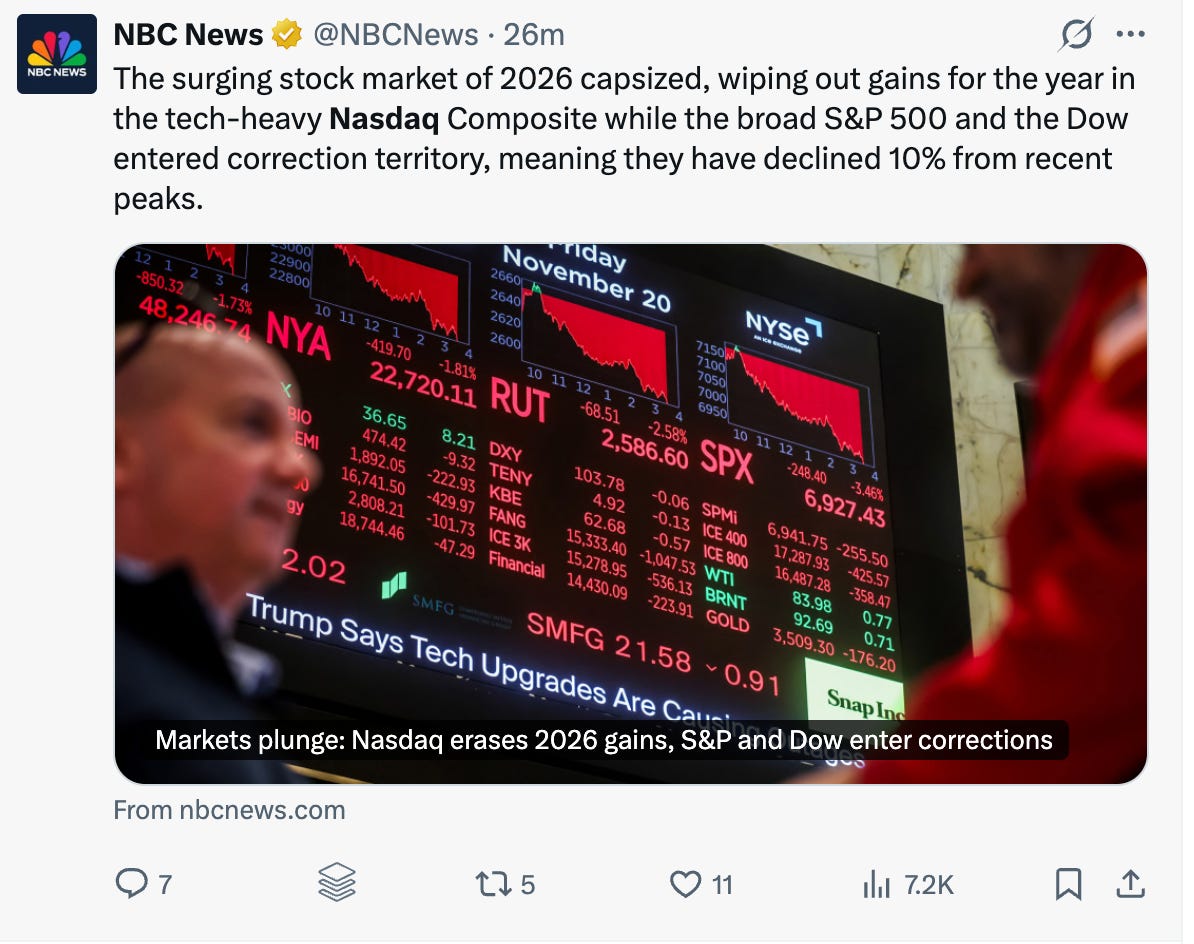
The protesters gathering outside the NASDAQ aren’t Luddites; they are pattern-recognizers. Having lived through the dot-com bust and the Great Recession, the public is waking up to the reality that they are being forced to subsidize a technology they had no democratic say in adopting.
If the AI bubble bursts—or if the rapid, unchecked integration of autonomous agents triggers a catastrophic infrastructure failure—the architects of this boom will not be the ones who suffer. Because just seven or eight mega-cap tech companies now prop up the broader stock market, their survival is inextricably tied to the national economy. Should the house of cards fall, Washington will inevitably deliver the same verdict it did in 2008: We have no choice. They are too big to fail.
And once again, the public will be asked to foot the bill for a casino they were never invited to win in.
***Because I’m a terrible capitalist, here’s a great 25% off discount for new paid subscribers. It’ll only be about $3.75/month or $38/year.
There are no paywalls, and The Left Hook continues depending on the kindness of our readers
Thank you , , , , , and many others for tuning into my live video with ! Join me for my next live video in the app.