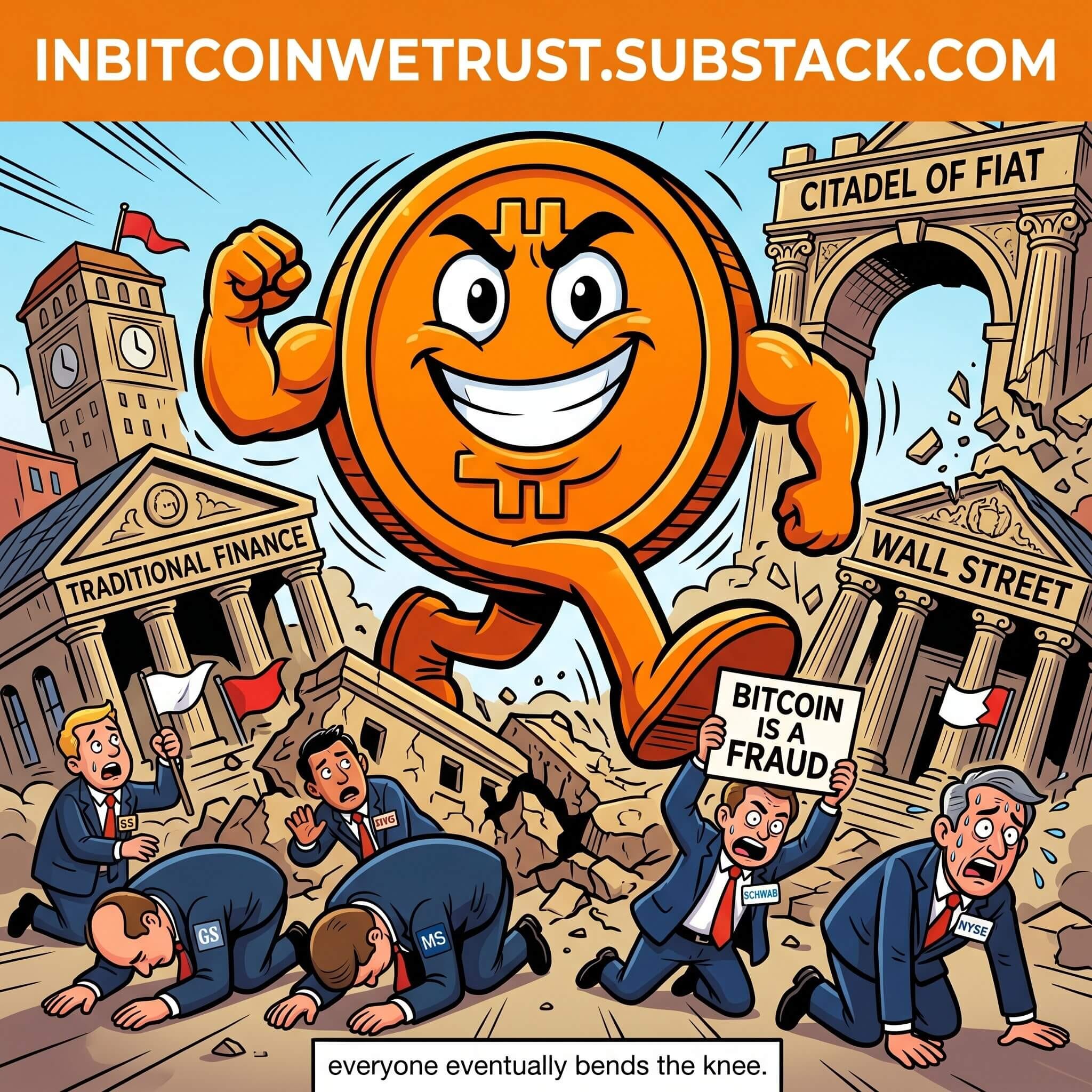
Ladies and gentlemen, over the course of the last few days, the financial world has fundamentally shifted on its axis. We have just borne witness to what can only be described as the fastest, most dizzying, and utterly shameless moral pivot in recorded human history. Wall Street, the impenetrable fortress of traditional finance, the ivory tower of fiat currency, has officially raised the white flag.
They didn’t just surrender; they scrambled over each other to be the first to hand the victor his crown.
For fifteen years, the titans of traditional finance told anyone who would listen that Bitcoin was a joke. It was a Ponzi scheme, a bubble, a vehicle for illicit activity, digital tulip mania, and a fad engineered by basement-dwelling cypherpunks. They laughed at it. Then they fought it. Now? They are desperate to own it.
Let us examine the casualty list of institutional pride that has fallen over the last few days.
Yes, that Goldman Sachs. The towering behemoth of global investment banking. The “vampire squid wrapped around the face of humanity,” as rolling stone famously dubbed it, has found a new, digital asset to wrap its tentacles around.
For years, the executive leadership at Goldman Sachs took every available opportunity to pour scorn on the very concept of decentralized currency. We all remember the interviews, the smug dismissals on financial television, the polished executives adjusting their ties while assuring the public that Bitcoin had no intrinsic value. Their CEO once famously and loudly proclaimed Bitcoin to be a “vehicle for fraud.” It was a narrative crafted to keep wealth locked within their gated community, where they could extract their customary tolls.
Yet, henceforth, the tune has violently changed. Goldman Sachs is now rolling out a Bitcoin Exchange Traded Fund (ETF). The absolute hypocrisy is as breathtaking as it is predictable. The institution that warned you away from the “fraud” is now charging you a management fee to hold it for you.
Why the sudden change of heart? Because Wall Street has no permanent morals, only permanent interests. When their high-net-worth clients began threatening to move their capital elsewhere—demanding exposure to the best-performing asset of the decade—the moral objections evaporated overnight. The fraud suddenly became an “innovative alternative asset class.” Goldman Sachs didn’t see the light; they felt the heat.
If Goldman’s reversal is a comedy, Morgan Stanley’s is a masterclass in historical irony. Once upon a time, not so long ago in the grand scheme of financial history, Morgan Stanley was so violently opposed to the digital asset revolution that they reportedly banned the word “crypto” from being used in internal corporate emails. It was Voldemort—the asset class that shall not be named. They treated it as a contagion, a toxic virus that could infect their pristine, heavily regulated mahogany boardrooms.
Fast forward to the present reality. In the last few days, Morgan Stanley has overseen the largest ETF debut in the entire storied history of their firm.
And what was the underlying asset of this record-breaking, monumental financial product? You guessed it: Bitcoin.
The very asset they tried to scrub from their corporate lexicon has now become the crown jewel of their modern product offerings. The advisors who were once forbidden from typing the word are now dialing up their wealthiest clients, pitching them on the necessity of having 1% to 5% of their portfolio in digital gold. The cognitive dissonance is staggering, but the institutional FOMO (Fear Of Missing Out) is louder than any past prohibition. They realized that you cannot ban the future, but you can certainly try to slap a ticker symbol on it and sell it to the masses.
While the investment banks play the ETF game, Charles Schwab has taken an even more direct route, deciding to offer direct spot crypto trading to its gargantuan retail client base.
Schwab represents the everyday investor. They are the gatekeepers to middle-class wealth, retirement accounts, and Main Street portfolios. For years, they kept their clients cordoned off in the safe, predictable world of mutual funds, legacy stocks, and municipal bonds. If you wanted Bitcoin, you had to leave the Schwab ecosystem, brave the wild west of crypto exchanges, and manage your own keys.
No longer. By integrating direct spot crypto trading, Schwab has essentially admitted that a portfolio without Bitcoin is an incomplete portfolio. This isn’t just about offering an ETF—a derivative proxy for the real thing—this is about allowing millions of everyday investors to acquire the actual underlying asset through their trusted brokerage interface.
This move normalizes Bitcoin in a way that is hard to overstate. It places the decentralized orange coin right next to Apple, Amazon, and the S&P 500 on the dashboard of the average American investor. It removes the friction, it removes the stigma, and it opens a floodgate of capital that has been waiting on the sidelines, hungry for access but hesitant of the medium.
And then there is the beating heart of traditional finance itself: the New York Stock Exchange (NYSE). The hallowed halls where traders once screamed over slips of paper are now quietly, efficiently powering up dedicated crypto infrastructure.
The NYSE isn’t just facilitating trades; they are laying the plumbing. The infrastructure is live, integrated, and “purring like a cat on a warm laptop.” When the foundational layer of global equities decides to build the rails for digital assets, the debate is officially over.
The NYSE does not build infrastructure for fads. They do not invest millions in technological integration for Ponzi schemes. They build infrastructure for permanence. By integrating crypto at the exchange level, the legacy system is officially hard-wiring itself to the new digital paradigm. They are acknowledging that the future of value transfer, settlement, and asset ownership will run, at least in part, on cryptographic networks.
Trading the Assembly Line for the Front Line: How a $1.5 Trillion Mandate is Turning America’s Automakers Back into Engines of War.
To understand this monumental 24-hour shift, we have to look past the surface-level announcements and delve into the underlying psychology and economics of Wall Street.
“First they ignore you, then they laugh at you, then they fight you, then you win.”
This quote, often misattributed to Gandhi but universally true in the context of disruptive innovation, perfectly maps onto the trajectory of Bitcoin vs. Traditional Finance.
In the early days, Wall Street didn’t care. Bitcoin was a sandbox for cryptographers and libertarians. When it began to gain traction, the laughter started. It was dismissed as “Monopoly money.” The idea that a decentralized, leaderless network with a hard-capped supply of 21 million could ever compete with the sovereign currency of the United States was treated as high comedy at Davos and Wall Street cocktail parties.
As Bitcoin survived crash after crash, rising like a phoenix from the ashes of every bear market, the laughter turned to fear. The narrative shifted to hostility. This is when the Jamie Dimons of the world threatened to fire any trader stupid enough to buy it. This is when the SEC launched its relentless crusades. This is when the media ran endless obituaries, declaring Bitcoin dead hundreds of times. They fought it because it represented an existential threat to their business model. Traditional banking relies on gatekeeping, intermediaries, and fractional reserve alchemy. Bitcoin requires none of those. It is peer-to-peer, self-custodial, and mathematically transparent. It terrified them.
So, what happens when you spend 15 years trying to kill an idea, and the idea simply refuses to die? What happens when that idea grows into a trillion-dollar asset class completely outside of your control?
You capitulate.
Wall Street’s pivot is not born of a sudden intellectual awakening. They didn’t read the Bitcoin Whitepaper last night and suddenly understand the genius of Satoshi Nakamoto’s proof-of-work consensus mechanism.
No, they capitulated because Wall Street is ultimately a machine designed to extract fees. For over a decade, a massive, historic wealth transfer was happening entirely outside of their ecosystem. Crypto-native exchanges were printing billions in revenue while legacy banks stood on the sidelines, bound by their own stubborn pride and regulatory red tape.
Eventually, the math became undeniable. The opportunity cost of ignoring Bitcoin became too high. They realized the ultimate truth of this new era: If you cannot kill it, you must bill it.
They decided that if people are going to buy Bitcoin, they might as well buy it through a Goldman Sachs ETF so Goldman can collect a 0.25% expense ratio. If they are going to trade it, they might as well do it on Schwab. Wall Street hasn’t embraced the ethos of Bitcoin; they have simply recognized its inevitability and are maneuvering to capture the yield.
There is a profound poetic justice in this sequence of events.
Traditional finance relies on trust. You must trust the central bank not to debase the currency. You must trust the commercial bank not to gamble away your deposits. You must trust the clearinghouse to settle the trade. And as history has shown us time and time again—from the 2008 financial crisis to the rampant inflation of the 2020s—that trust is routinely abused.
Bitcoin relies on math. It relies on open-source code, cryptographic hashing, and a decentralized network of nodes enforcing a rigid set of rules. It doesn’t care about your pedigree, your zip code, or your firm’s AUM (Assets Under Management). It simply produces a block every ten minutes. Tick tock, next block.
It was this relentless, unyielding consistency that ultimately broke the back of the institutional resistance. Wall Street realized they were trying to fight gravity. You cannot legislate away mathematics. You cannot PR your way out of absolute digital scarcity.
As the fiat system continues to creak under the weight of astronomical sovereign debt, endless money printing, and geopolitical instability, Bitcoin stands in stark contrast. It is a pristine, un-manipulatable ledger in a world drowning in financial fiction. The smart money eventually recognized this. They realized that Bitcoin is not a hedge against the legacy system; it is the life raft.
Let these last few days be recorded in the annals of financial history as the Great Capitulation.
It is a vindication for the early adopters. The cypherpunks, the retail investors, the believers who held on through 80% drawdowns, the people who were mocked by their families at Thanksgiving dinners, and the visionaries who saw the future before the institutions did. They were right. The suits were wrong.
And now, the suits are forced to buy the asset from the very people they ridiculed, at a price that reflects their years of ignorance.
Goldman Sachs is bending the knee.
Morgan Stanley is bending the knee.
Charles Schwab is bending the knee.
The New York Stock Exchange is bending the knee.
They are doing it because they have no other choice. The financial architecture of the 21st century is being rewritten, and it is being built on decentralized protocols.
The narrative has flipped entirely. It is no longer considered a risk to own Bitcoin. The ultimate career risk in traditional finance today is not having an allocation to Bitcoin. The institutions have realized that the train has left the station, and they are currently sprinting down the platform, throwing their briefcases on board, hoping they aren’t too late to claim a seat.
We have moved past the era of adoption and into the era of assimilation. But make no mistake: Wall Street did not assimilate Bitcoin. Bitcoin assimilated Wall Street.
The virus has successfully infected the host. The Trojan horse is inside the gates, and the soldiers are pouring out. The infrastructure is lit, the ETFs are trading, the spot markets are open, and the legacy gatekeepers have surrendered their pride for a piece of the action.
Bitcoin cannot be stopped. It could never be stopped. It is an idea whose time has come, backed by the most powerful computing network in human history.
So, to the titans of Wall Street, welcome to the revolution. You’re late, you’re hypocritical, and you’re charging too many fees. But we’ll let you in anyway. Just remember who bends the knee to whom.