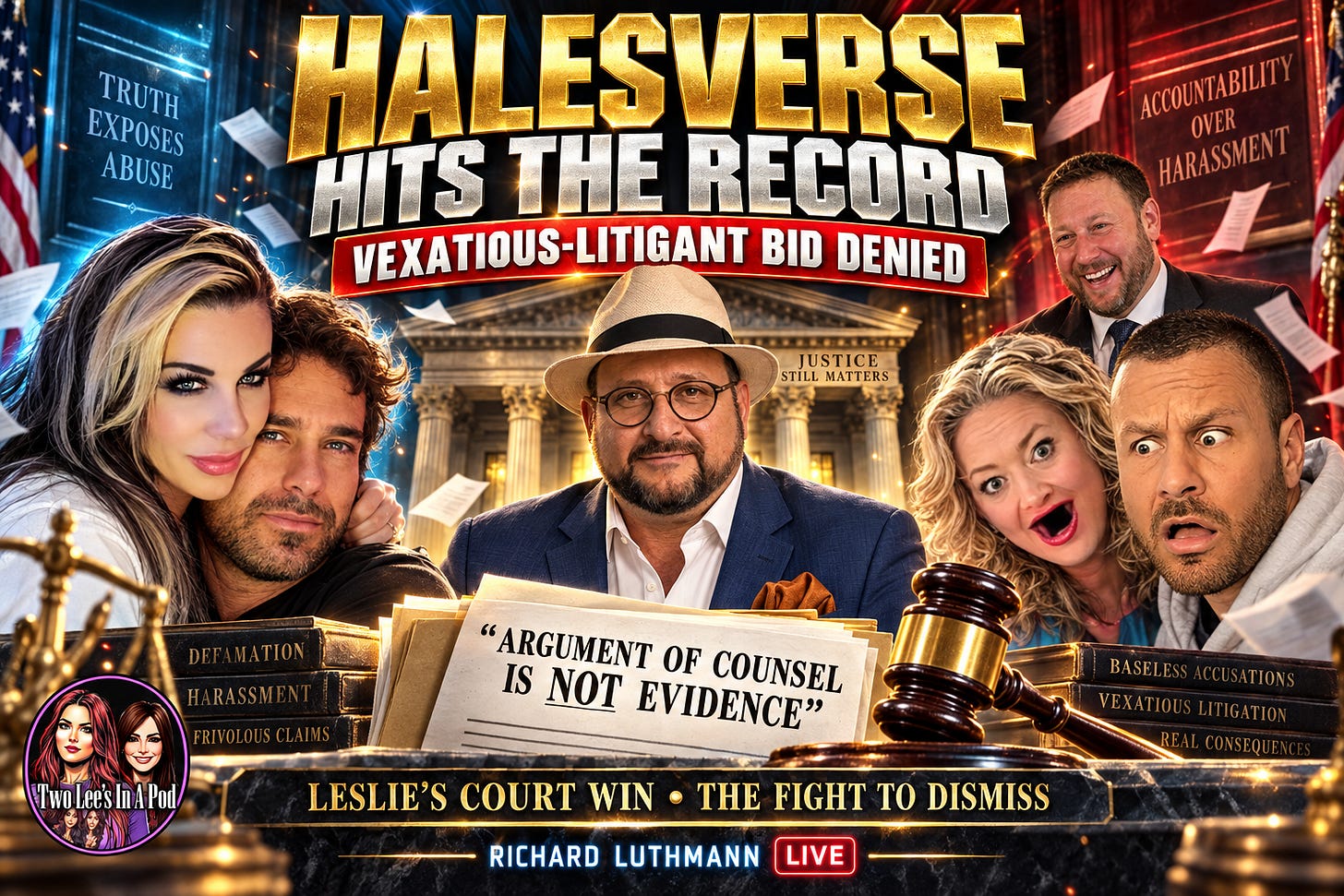
LUTHMANN NOTE: I see this case as another test of whether an online grievance can lead to courtroom punishment. Hales and his allies asked a judge to brand Leslie Ferderigos vexatious. The judge denied that request. That result deserves the same attention their accusations received. I believe the defense filings expose serious weaknesses in the claims and deserve a prompt ruling. The court must decide dismissal, and I will report the order when it does. Until then, my position remains straightforward: show the filings, show the defense, and stop selling an audience the fantasy that an accusation arrives with a judicial endorsement.
The Halesverse has a court order to confront—and Leslie Ferderigos wants viewers to read it.
Richard Luthmann joins Lisa Lee and Leslie Ferderigos for a blunt examination of the Orange County lawsuit brought by Jeremy Hales, Elephant Shoe LLC, Martha George Rizk, Megan M. Fox, and Matthew Lewis, known online as That Umbrella Guy. At issue are accusations of malicious prosecution and abuse of process, a failed attempt to have Leslie declared a vexatious litigant, and the defense’s demand that the court dismiss the remaining claims.
The broadcast brings the pleadings into a controversy that has generated livestreams, personal attacks, and competing accounts of what happened. Luthmann’s position is straightforward: viewers who have heard the accusations should also see the documents challenging them.
Judge Tanya Davis Wilson delivered a concrete setback to the plaintiffs in her September 3, 2026 order denying their attempt to declare Leslie a vexatious litigant. The judge found the record insufficient to support the requested designation and declined to impose sanctions under the court’s inherent authority.
One sentence cuts through the noise: “Argument of counsel is not evidence.”
That sentence becomes a central theme of the discussion. A lawyer can make an accusation. A livestream can repeat it. An audience can embrace it. The court still needs a sufficient record to grant the requested relief.
Leslie and Michael Ferderigos are now pressing for dismissal of the separate damages claims in Case No. 2025-CA-006868-O. Luthmann examines the original September 2, 2025 dismissal motion, the plaintiffs’ September 4, 2026 opposition, and the defendants’ September 12 reply, correspondence, and request for judicial notice.
The distinction matters throughout: Leslie defeated the vexatious-litigant motion. The supplied materials do not contain an order dismissing the malicious-prosecution and abuse-of-process claims.
Behind the filings are people who say the public spectacle has become deeply personal.
Lisa challenges the relationship between Hales and his audience. She argues that mocking someone’s appearance, age,e or personal circumstances can also demean supporters who share those characteristics. Her question is uncomfortable: what happens when the people applauding the humiliation could just as easily become its targets?
In Lisa’s telling, the problem extends beyond any individual insult. It is the contradiction between asking people for loyalty and building entertainment around contempt for people like them.
Leslie then turns the scrutiny on herself. She acknowledges that anger at people she says have targeted her has spilled into insults of her own.
“I shouldn’t replicate the same meanness,” she says.
That admission gives the conversation a different weight. Leslie is describing both her resentment and the temptation to answer cruelty with more cruelty. She argues that some viewers come to these online communities looking for connection, only to find themselves participating in somebody else’s profitable conflict.
The need to belong, she contends, can become a source of income for the person directing the outrage.
The questions about influence and accountability also run through Luthmann’s reporting on Megan Fox, Susan Bassi, disputed correspondence, and the backlash to his interviews. His recurring demand is that accusations come with something readers can examine.
In this case, that means identifying the allegedly wrongful act, explaining the legal theory, and showing how the claimed injury follows.
The Ferderigoses argue that the plaintiffs’ complaint falls short. They challenge the allegations of favorable termination, the claimed misuse of judicial process, and the asserted damages. They also argue that Fox and Lewis were never served in the underlying action and defend Michael’s conduct as Leslie’s attorney.
The plaintiffs disagree. Their opposition, filed through Randall Shochet, maintains that the amended complaint adequately states its claims and that the defense is trying to resolve factual disputes at the pleading stage. They ask the court to deny dismissal or permit another amendment.
Luthmann’s discussion becomes profane as he examines probable cause, advocacy ,and the uncertainty of litigation. His central point is that advancing a claim does not require certainty of victory. A lawsuit’s eventual withdrawal or failure does not, by itself, answer every question about whether it had an adequate basis when filed.
The parties dispute that basis here. Luthmann argues forcefully for the defense position; the pending motion asks the judge to decide whether the plaintiffs have sufficiently pleaded their claims.
The conversation takes a more personal turn when Leslie describes an interaction with Shochet that she says left her feeling threatened.
According to Leslie, Shochet referred to knowing her parents and their home and business, proposed an off-the-record meeting, and wanted to inspect communications on her phone involving defendants in the separate federal litigation. She says the proposed arrangement linked her cooperation to avoiding further action against her.
Leslie describes the interaction as feeling like a “shady drug deal.” She connects that account to her broader allegations about pressure and the exposure of private information, explaining that she withdrew her earlier lawsuit because she wanted the situation to stop.
Her explanation bears directly on the competing accounts of why the underlying case ended. It remains her account of the conversation and her reasons for withdrawal. The supplied materials do not establish a criminal finding against Shochet.
Luthmann then returns to Judge Wilson’s order and delivers his strongest prediction about the damages case.
He focuses on the order’s treatment of the earlier voluntary dismissal and argues that the plaintiffs’ position has suffered a devastating blow. His assessment is emphatic: he believes the defense has the answer to the lawsuit.
The order’s actual reach is more limited. It addressed the requirements for declaring Leslie a vexatious litigant. Whether the earlier withdrawal satisfies the favorable-termination element of malicious prosecution remains a separate, contested question. The court’s denial of the vexatious-litigant motion does not itself dispose of the damages claims.
Readers following the separate federal litigation will recognize the importance of distinguishing a favorable development from a final disposition. In his reporting on the recommendation to dismiss Hales’s sexual-cyberharassment claim, Luthmann examines Magistrate Judge Zachary Bolitho’s September 2 analysis of the challenged video. That article explains that the recommendation requires action by the district judge.
The Orange County litigation involves different claims and requires its own rulings. Each development must be measured against what the relevant judge actually decided.
The panel also examines the Ferderigoses’ request for Judge Wilson to rule on the papers. Their September 12 correspondence describes difficulty securing a hearing date and asks for a decision without oral argument. Leslie recounts the scheduling dispute and objects to efforts she believes go beyond scheduling and into contested legal questions through communications with the judicial assistant.
Lisa separately discusses uncertainty surrounding her bankruptcy-hearing situation, bringing another example of the practical pressures that accompany litigation: preparing to appear while trying to establish what will be heard and when.
The final stretch turns to the media disputes surrounding Luthmann and Michael Volpe’s Jay Collins interview about Disney, AI power costs and Florida business policy. Luthmann argues that attacks on the interviewers distract from the substance of the questions they asked.
His account of the ensuing Fox and Bassi controversy provides additional background on the posts, correspondence, and editorial disputes discussed in the broadcast.
Leslie answers part of that controversy through satire. She describes Karen Con, a fictional character inspired by her criticism of Megan Fox: someone who invokes free speech while trying to shout down everyone else.
The comedy escalates until even losing her voice cannot stop the character’s tirade. Leslie uses the caricature to ridicule what she sees as selective tolerance for speech—demanding room for your own attacks while treating criticism of yourself as unacceptable.
The episode makes a direct demand of its audience: examine the defense record with the same attention given to the accusations.
Read the order. Read the opposition. Read the reply. Listen to the competing accounts. Distinguish the panel’s predictions from the relief the court has actually granted.
The documents establish a defeat for the plaintiffs’ vexatious-litigant motion. The next fight is over whether their damages claims survive.
Follow Richard Luthmann’s continuing reporting on Substack, his coverage at Florida Gulf News, and the related investigations at Michael Volpe Investigates.
EDITORIAL DISCLOSURE: Richard Luthmann is a litigant in separate Hales-related litigation. The broadcast contains adversarial commentary, disputed allegations, profanity, and satire. The supplied filings establish the denial of the vexatious-litigant motion; they contain no order granting the pending dismissal request or awarding the Ferderigos’ attorney fees.
#JeremyHales #WhatTheHales #RichardLuthmann #LuthmannNews #LeslieFerderigos #MichaelFerderigos #LisaLee #MeganFox #ThatUmbrellaGuy #RandallShochet #Halesverse #FloridaCourts #FreeSpeech #Lawfare
00:00 Opening discussion of Hales’ livestream03:20 Lisa Lee discusses the bankruptcy hearing and possible continuance06:49 Introducing the filings; Luthmann denies authoring the motions19:40 Michael Volpe’s coverage of Megan Fox and Susan Bassi32:59 The September 2025 motion to dismiss38:30 The underlying lawsuit and the sealing dispute50:51 Leslie explains why she withdrew her earlier lawsuit58:36 Pleading standards, probable cause and litigation privilege1:08:43 Reading the plaintiffs’ September 4 opposition1:23:45 The Ferderigoses’ September 12 reply1:30:29 Fox, That Umbrella Guy and the service argument1:42:20 The favorable-termination dispute1:48:38 The request for judicial notice1:52:09 Reading the order denying vexatious-litigant status1:56:33 Hearing scheduling and Leslie’s account of the default dispute2:00:49 The request to rule on the papers2:08:00 Discussion of correspondence with the judicial assistant2:23:20 Leslie discusses her Karen Con satire series
Thank you to everyone who tuned into my live video! Join me for my next live video in the app.