Innovation is moving at unprecedented speed. Over the last few days, the signal worth paying attention to was not another isolated capability jump. It was the growing pile of evidence that model labor is getting cheaper faster than organizational coordination is getting easier.
That is the shift I would watch. Once you can launch multiple agents, let them run for hours, and connect them to real workflows, the expensive part is no longer producing tokens. The expensive part is deciding who can act, what gets handed off, which artifacts matter, and when a human has to step in.
The free section makes one claim: coordination, not intelligence, is becoming the hidden tax on AI adoption. The paid section, Going Deeper, turns that claim into a coordination-compression memo you can use this week.
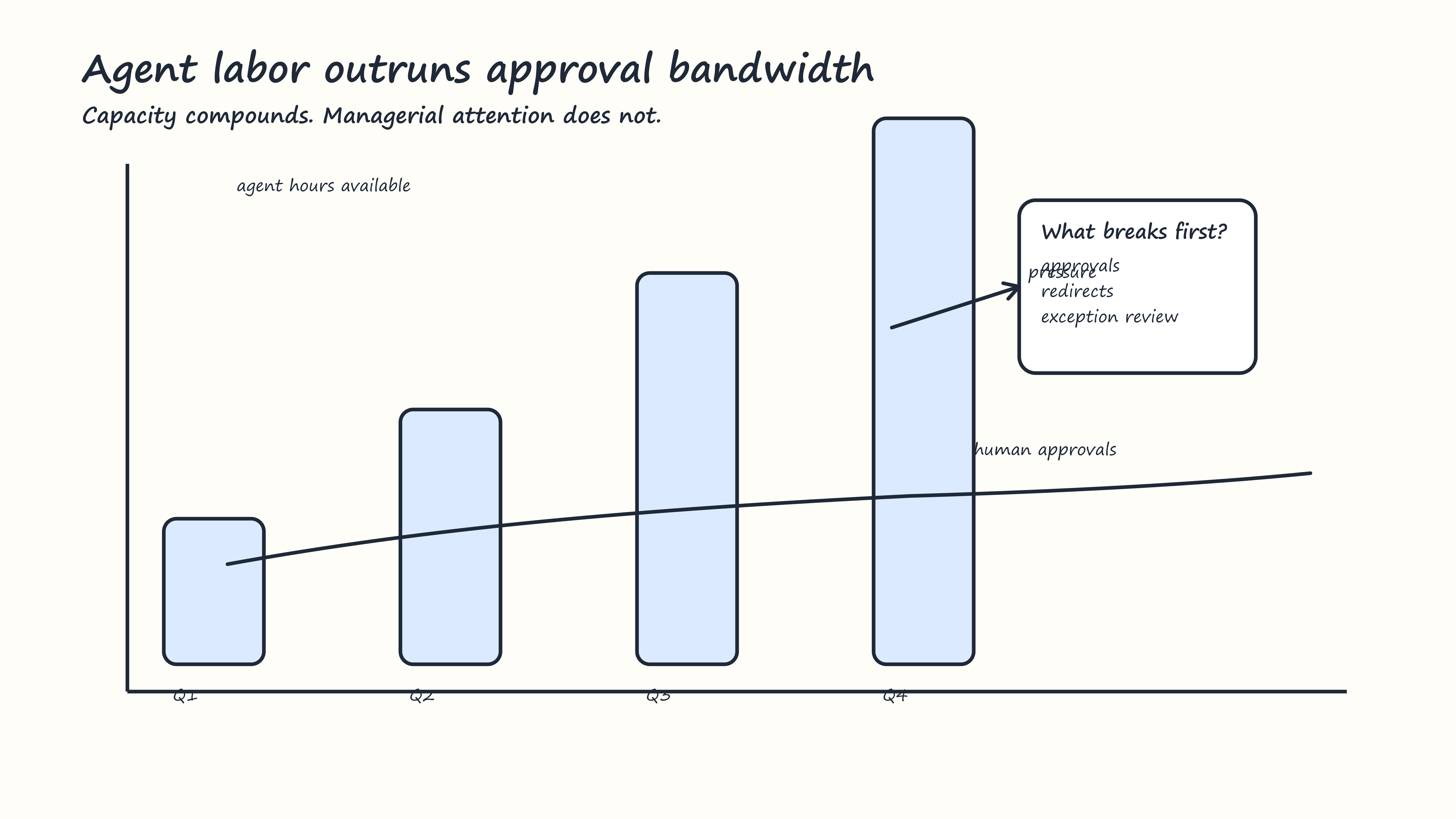
Figure 1 shows why this shift is happening now: agent capacity is rising almost vertically, while human approval bandwidth grows slowly and irregularly.
Figure 1: Agent labor outruns approval bandwidth
For a while, AI strategy was mostly about getting better answers. The question was whether the model could draft, summarize, code, or reason well enough to justify the subscription or the API bill.
That is not the main question anymore.
Now the more interesting systems can run for hours, split work across parallel branches, keep context alive across steps, and move through real tasks instead of one-shot prompts. That sounds like a pure win, but it creates a very specific new bottleneck.
You can generate more machine work in one afternoon than one person can casually supervise.
That changes the operating math. If one person can trigger ten parallel workstreams, the constraint is no longer how fast the model can think. The constraint is how fast the team can review, approve, redirect, and absorb the output without turning the whole workflow into transcript archaeology.
This is why so many teams feel a strange mismatch right now. Capability is improving, but the day still feels more chaotic. More drafts, more branches, more tickets, more traces, more logs, more proposed actions, more review requests.
The agent did not remove management. It multiplied it.
Figure 2 shows what happens when one user goes from asking for one answer to supervising a fan-out of semi-independent work.
Figure 2: Parallel agents create an approval queue
This is the second shift worth watching.
Once agents are allowed to call tools, message other agents, move across apps, or pass work from one stage to another, handoffs stop being an implementation detail. They become part of the product surface.
A weak handoff creates hidden coordination tax in at least four ways.
First, it drops context. The next step receives output without the assumptions, constraints, or uncertainty that produced it.
Second, it inflates review cost. A human has to reconstruct what happened because the packet was too thin.
Third, it increases retries. The next step gets the wrong artifact, the wrong scope, or the wrong instruction, then burns more expensive intelligence cleaning up avoidable confusion.
Fourth, it widens risk. A bad handoff can move stale state, sensitive material, or ambiguous authority into a place where action is easier than audit.
That means the real design unit is no longer just the prompt. It is the handoff packet.
What job is being delegated?
What authority level does the next step have?
What evidence must survive the transition?
What state can be modified, and what only observed?
What forces escalation instead of silent continuation?
Those questions sound operational, but they increasingly determine whether the workflow feels magical or untrustworthy.
Figure 3 lays out the minimum packet I think every serious agent handoff now needs.
Figure 3: The handoff packet is the new product unit
A lot of AI discussion still treats output as if it were one clean answer.
That is outdated.
Modern agent workflows produce a trail: drafts, diffs, screenshots, citations, traces, plans, temporary files, evaluation notes, messages to other agents, and half-finished artifacts that may or may not deserve to survive. The cost is not just storage. The cost is deciding what counts.
This matters because artifact volume compounds faster than judgment.
If the system creates five candidate plans, three generated assets, one patch, two retries, and one human escalation packet, someone still has to know which of those objects is the one that should move forward.
When that decision is unclear, teams pay three taxes at once.
They pay a cognitive tax because people waste time finding the authoritative version.
They pay a technical tax because stale or duplicate artifacts get reused later.
They pay a political tax because nobody wants to widen autonomy until they trust the evidence trail.
The artifact glut is where many promising AI rollouts quietly lose momentum. Not because the model failed, but because the workflow began manufacturing ambiguity faster than the team could resolve it.
Figure 4 shows how quickly a simple task can turn into an artifact explosion if the system has no clear contract for what should persist.
Figure 4: Artifact volume grows faster than judgment
It is tempting to think the answer is just cheaper models.
Cheaper models matter. They are not enough.
Once AI starts doing more real work, the total cost curve widens around the model.
You have inference cost, obviously.
Then you have orchestration cost: routing, retries, evaluation, and context packaging.
Then you have infrastructure cost: storage, network traffic, compute bursts, and long-running sessions.
Then you have human cost: approvals, exception handling, code review, policy review, and decision latency.
Then you have rework cost: the price of discovering too late that the workflow took the wrong branch with convincing confidence.
This is why some teams are surprised that more capable AI can still feel economically messy. The model got better, but the coordination tax expanded around it.
If you do not measure that tax explicitly, it hides in salaries, waiting time, branch churn, cloud bills, and organizational hesitation.
Figure 5 turns that into a single cost picture: the visible token bill is often the smallest part of the real operating burden.
Figure 5: The real AI bill sits outside inference
This is the thesis I would not miss.
The next durable advantage in AI may not belong to the team with the most raw intelligence. It may belong to the team that can compress coordination faster than everyone else.
Compression does not mean removing humans from the loop at all costs. It means making each human touchpoint more intentional and less reconstructive.
It means shorter approval paths because authority is explicit.
It means fewer retries because handoff packets are complete.
It means less rework because artifact contracts are clear.
It means lower infrastructure waste because the workflow knows what should persist and what should evaporate.
It means wider rollout because the organization can tell the difference between autonomy and drift.
This is also why the most important AI product decisions are starting to look more like operating-system decisions. The system that wins is the one that can route, checkpoint, surface evidence, and narrow ambiguity before it becomes expensive.
Figure 6 shows the operating loop behind that advantage: not more intelligence for its own sake, but a tighter cycle for turning intelligence into accountable progress.
Figure 6: Coordination compression becomes the operating loop
If you are building in this market now, I would watch for one question above all the others:
Is this workflow getting smarter, or is it just generating more work for the people around it?
That is the dividing line.
Cheap intelligence is no longer the full story.
The hidden tax on AI is coordination.
For paid subscribers: the practical operating memo starts below.
Everything above this line is the thesis and analysis. The Going Deeper section turns it into a coordination-compression memo and weekly checklist you can use with one live workflow this week.