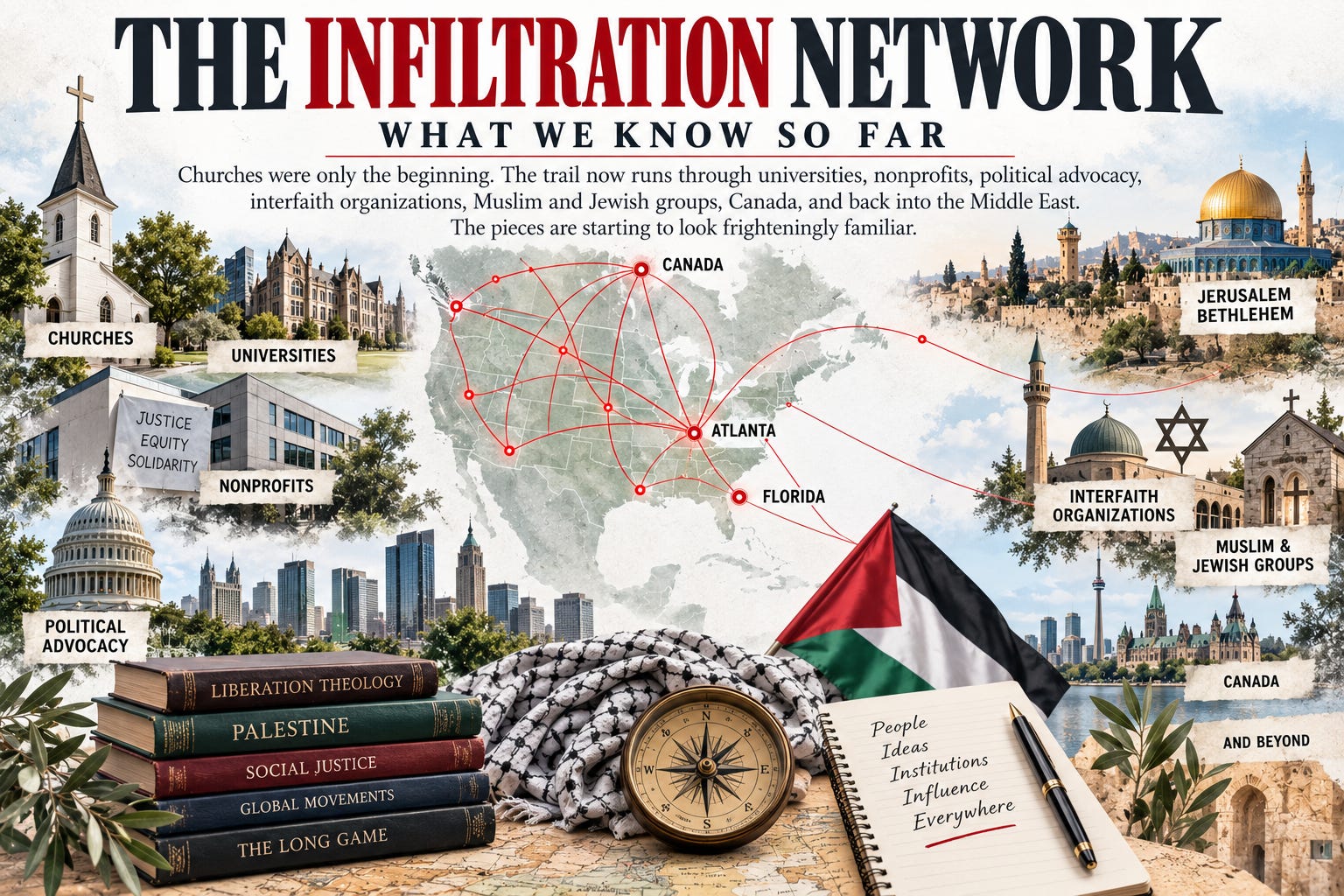
If you’ve been following my Notes or Facebook posts, you already have a general idea of what I’ve been digging into. Many of us had bits and pieces of information, and you wonderful folks started sending me what you knew. Names, organizations, old events, church programs, people I needed to look at, financial records, and connections I hadn’t seen yet. Every time I thought I had a handle on one branch, somebody sent me something that opened another.
There is now a growing number of people helping me dig and the amount of information coming in is overwhelming. What you're about to read is the tip of the iceberg. I couldn't possibly include every person, organization, event, partnership, conference, financial record, or connection uncovered without turning this into a book. This is a summary of much of what I have so far. Hopefully it's enough to give you an idea of just how pervasive this has become. And it goes way beyond the couple of states I’ll talk about in here. I’m not sure I will turn it into a formal series because there are too many moving pieces but I'll keep sharing the important pieces as they surface.
A friend sent me something about an alarming situation in Atlanta. I started pulling at it because I knew it would go deeper. This insanity always does. I was looking at Palestinian Christian organizations working inside American churches, teaching about Israel and Zionism, bringing speakers into congregations, producing study materials, organizing trips, pushing divestment, and challenging Christian Zionism from inside Christianity.
It spread far beyond the churches very quickly. The trails ran through seminaries, universities, nonprofits, Muslim organizations, Jewish organizations, political advocacy groups, activist coalitions, interfaith programs, and the arts. Florida connected to Atlanta. Atlanta connected to national organizations. Those organizations connected to Canada, and Canada connected right back into the United States. Jerusalem and Bethlehem kept appearing upstream.
People who seemed completely unrelated when I first found their names turned up again through an entirely different trail. Someone involved with a Presbyterian network appeared in FOSNA. Someone at a university appeared in a Palestine organization. Palestinian Christian groups appeared in coalitions with Muslim and Jewish organizations. A Canadian organization shared leadership with an American organization. Speakers moved from city to city through the same organizational circles.
If you didn’t believe we were being infiltrated, I understand. Despite how much I already knew, I didn’t want to believe it either. After spending days buried in these organizations and their records, I believe we are. The United States. Canada. And…I haven’t even headed into Europe yet, and I wouldn’t be shocked if some of these same networks have made their way into Israeli institutions too.
I’m NOT an investigative reporter; I wish I was. But what gets me is how easy it is to find so much of this. Organizations publish their partners. Universities publish biographies. Churches advertise speakers. Coalitions announce themselves. Nonprofits file tax returns. Conferences publish speaker lists. People put their board positions in their bios. Organizations describe their goals and strategies on their websites. Much of this has been sitting in public view for years.
If a growing group of us sitting at home with laptops can find this much, imagine what the governments of the United States, Israel, and Canada know. They have intelligence agencies, law enforcement, financial records, tax authorities, and access to information we’ll never see. They know far more than we do, which leaves me with a question I can’t answer: why aren’t they stopping this?
For now, here’s what’s been discovered.
Last month I wrote The Long Game: Decoding the Muslim Brotherhood, a deep dive into the Brotherhood’s history and the strategy it developed for building influence over generations. What stayed with me was the patience of it: build people, families, communities, organizations, institutions, alliances, and eventually political influence. Think beyond the next election and work through institutions people already trust.
Now I’m finding churches, universities, seminaries, nonprofits, advocacy organizations, interfaith groups, political organizations, arts and cultural institutions, community organizations, national networks, and coalitions bringing several of those worlds together.
The organizations we’re following repeatedly cooperate. People move between them. They host one another’s speakers, organize events together, join the same coalitions, share institutional spaces, and carry their advocacy into different communities.
That’s the long game I wrote about, and I am certain we’re looking at pieces of it here.
One of the clearest trails begins with the Sabeel Ecumenical Liberation Theology Center in Jerusalem. And I mean Jerusalem literally. Sabeel's headquarters is at 108 Shuafat Road in Jerusalem. Its own publications also document a Sabeel office in Nazareth, Israel, so this movement has roots on the ground inside Israel as well as connections throughout the West Bank and Gaza. Its current programs include theological education, advocacy, conferences, visiting delegations, community programs, and interfaith work with Muslims and Jews.
Sabeel grew around the work of Palestinian Anglican priest Naim Ateek and what became known as Palestinian Liberation Theology. The Israeli-Palestinian conflict is interpreted through Christian theology: scripture, covenant, land, oppression, justice, Jesus, and Zionism. Those ideas didn’t remain in Jerusalem.
Friends of Sabeel North America, better known as FOSNA, describes itself as “A Christian Voice for Palestine.” It says it promotes the vision of Sabeel Jerusalem and works with churches, communities, and civic leaders through education, advocacy, and nonviolent action.
FOSNA says it has more than 40 hubs across the United States. Some are FOSNA chapters. Others are independent regional organizations formally affiliated with it. FOSNA puts both under what it calls “one organizing umbrella,” with the hubs serving as local bases for education, advocacy, and direct action.
Its organizing materials give a much better sense of the reach. FOSNA lists Joining Hands for Justice in Georgia and Partners for Palestine in Florida among its regional affiliates. Its national partners and allies include American Muslims for Palestine, CAIR, Jewish Voice for Peace, Churches for Middle East Peace, Hindus for Human Rights, IfNotNow, and the U.S. Campaign for Palestinian Rights.
The denominational list is just as extensive. Baptist, Lutheran, Episcopal, Presbyterian, Mennonite, Catholic, Quaker, Methodist, United Church of Christ, and other Palestine-focused church networks appear in FOSNA’s organizing materials. Canada has its own denominational networks, while Canadian Friends of Sabeel appears alongside FOSNA within the international Sabeel movement.
The organization even encourages supporters to connect with existing coalitions, establish new regional networks, assist student activists, form student or faculty groups, fundraise for Palestinian organizations, and work with other movements.
The church network I’d been following suddenly had a structure.
I started finding pieces closer to home. Rev. Jeff DeYoe spent years at Covenant Presbyterian Church in Fort Myers and became a national leader in the Presbyterian Church (USA)’s Israel/Palestine Mission Network. He advocated for divestment from Israel, defended the controversial church curriculum Zionism Unsettled, led solidarity trips, and later served on FOSNA’s Clergy and Seminary Action Council. DeYoe died in 2023, but Covenant still lists Palestinian Missions among its ministries.
The Lutheran trail was just as interesting. In 2024 the Florida-Bahamas Synod of the Evangelical Lutheran Church in America passed a resolution called “Palestinian Advocacy and Dismantling Christian Zionism in our Churches.” Congregations were encouraged to spend at least three hours educating members using Palestinian advocacy resources.
Palestinian Christian programming in Southwest Florida goes back decades. Palestinian Melkite Archbishop Elias Chacour spoke at First Presbyterian Church in Bonita Springs in 2003 before a reported crowd of about 1,300 people. More recently, the Holy Land Christian Solidarity Cooperative has traveled through American churches selling olive-wood religious goods made by Christian families in the Holy Land and sharing the Palestinian Christian story. I’ve independently documented one of its visits at St. Finbarr Catholic Church in Naples in 2024.
Orlando gave me another branch. Partners for Palestine is a Florida nonprofit that grew out of St. Luke’s United Methodist Church in Orlando. It hosts speakers, panels, advocacy programs, and church events. In March 2025 St. Luke’s hosted a Churches for Middle East Peace program called “Bewilderment to Empowerment,” and Partners for Palestine encouraged people to bring speakers into their congregations.
Partners for Palestine also hosted Palestinian Christian pastor Alex Awad in 2023. His name will come up again.
FOSNA lists Partners for Palestine among its regional affiliates. Florida had already become part of the national structure I was finding elsewhere.
Joining Hands for Justice in Palestine and Israel is based in Georgia and works directly with churches. Its leadership became one of those browser tabs I never seemed to close because nearly every biography gave me another person or organization to research.
Rev. Dr. Fahed Abu-Akel brings decades of Presbyterian leadership into Joining Hands, including service as moderator of the Presbyterian Church (USA)’s General Assembly. Kevin Moran has been involved with FOSNA, the Palestine Mission Network of the Presbyterian Church (USA), and the Presbytery of Greater Atlanta.
Dee Roberts works at Pitts Theology Library at Emory University and has also been involved with the Palestine Justice Network of the Presbyterian Church (USA), the Hosanna Preaching Project, the Institute for the Study of Christian Zionism, Faculty and Staff for Justice in Palestine–Georgia, and Christians for a Free Palestine. Mary Peterson connects to the Evangelical Lutheran Church in America through Sumud and is an ambassador for Bright Stars of Bethlehem.
The organizational overlap gets even bigger through events. Joining Hands has documented programming involving FOSNA, CAIR-Georgia, Jewish Voice for Peace Atlanta, the Institute for the Study of Christian Zionism, the Atlanta Multifaith Coalition for Palestine, Bright Stars of Bethlehem, and other organizations.
A September 2025 event called Theology After Gaza brought several of those worlds onto the same program. Its co-sponsors included Joining Hands, CAIR-Georgia, FOSNA, Jewish Voice for Peace Atlanta, Bright Stars of Bethlehem, the Institute for the Study of Christian Zionism, Beacon Hill Black Alliance for Human Rights, Charis Books, and the Refaat Mobile Library.
In August 2026 another public action brought Joining Hands together with CAIR-Georgia, the Atlanta Multifaith Coalition for Palestine, Georgia for Palestine, and faith leaders after members of a delegation traveling to meet Palestinian Christians were denied entry to Israel.
The Atlanta branch had moved from Palestinian Christian church advocacy into a coalition crossing Christian, Muslim, Jewish, academic, activist, and community organizations.
Christian Zionism appears throughout this network. FOSNA has developed materials devoted to challenging it. The Institute for the Study of Christian Zionism appears in the same Atlanta circles. The ELCA Florida-Bahamas Synod resolution used “Dismantling Christian Zionism in our Churches” in its title. Palestinian Christian conferences and speakers repeatedly address it.
This is what originally bothered me about what I was finding inside churches.
Zionism is the Jewish movement for national self-determination in the Jewish ancestral homeland. Christians are being taught about it through organizations committed to opposing it, sometimes inside denominations and congregations with longstanding relationships with Jewish communities.
Convince enough Christians that Zionism is incompatible with Christianity and something changes between Christians and Jews. That’s the wedge I’ve been following from the beginning.
Jonathan Kuttab is the executive director of FOSNA and one of the founders of Sabeel. He’s also a co-founder of Al-Haq and Nonviolence International, serves on the board of Bethlehem Bible College, is president of the board of Holy Land Trust, and is a co-founder and board member of Just Peace Advocates in Canada.
One person connects organizations in Jerusalem, Bethlehem, the United States, and Canada.
Those relationships extend beyond board positions. In 2023 Nonviolence International announced that it, Holy Land Trust, Just Peace Advocates, and FOSNA had formed an “ad-hoc coalition” supporting Kuttab’s work. The announcement said the groups wanted to help change both the conversation and policy.
Canada was now firmly connected to the same organizational world.
On September 16, 2026 Matthew Taub, founder and executive director of Unapologetically Jewish, stood in the Parliamentary Press Gallery in Ottawa and released the results of a seven-month investigation into Canadian charities, advocacy organizations, funding, and campaigns targeting Israel and Jewish institutions.
I didn’t even know he was doing this investigation. He didn’t know what I was digging into either. We were working independently, in two different countries, starting from completely different places.
A major focus of Taub’s investigation is Just Peace Advocates, the Canadian organization connected to Jonathan Kuttab. Taub said his team examined its campaigns against Canadian charities and found that 108 of 143 organizations caught up in those efforts were Jewish institutions, including synagogues, Jewish schools, summer camps, charities, foundations, and other parts of Jewish communal life. Those figures come from Taub’s investigation, but the names he was finding were already sitting all over my research.
Taub also followed Just Peace Advocates’ relationship with the U.S.-based Nonviolence International, which JPA identifies as its fiscal sponsor. Kuttab connects to both organizations and was also a co-founder of Al-Haq. Taub highlighted a Nonviolence International tax filing reporting about $1.3 million paid to foreign recipients whose names weren’t identified in the material he presented. That’s one of the financial trails I’m working through separately because I want to know where the money actually went.
The part that floored me was how the two investigations met. I started with Palestinian Christian activism inside American churches and ended up moving through Florida, Atlanta, FOSNA, Bethlehem, Jonathan Kuttab, and Canada. Taub started with campaigns against Canadian Jewish institutions and moved through Just Peace Advocates, Kuttab, Nonviolence International, Al-Haq, funding, and eventually the United States.
We didn’t get these connections from each other. We found them independently from opposite sides of the border. Matthew and I are now in contact, and we’re comparing what we’ve found.
His full September 16 press conference runs about an hour and a half, and it’s worth watching because Taub presents his investigation in his own words rather than in someone else’s account.
Watch Matthew Taub’s full press conference on CPAC
Canadian Friends of Sabeel operates within the international Sabeel movement alongside FOSNA. Canadian church networks…