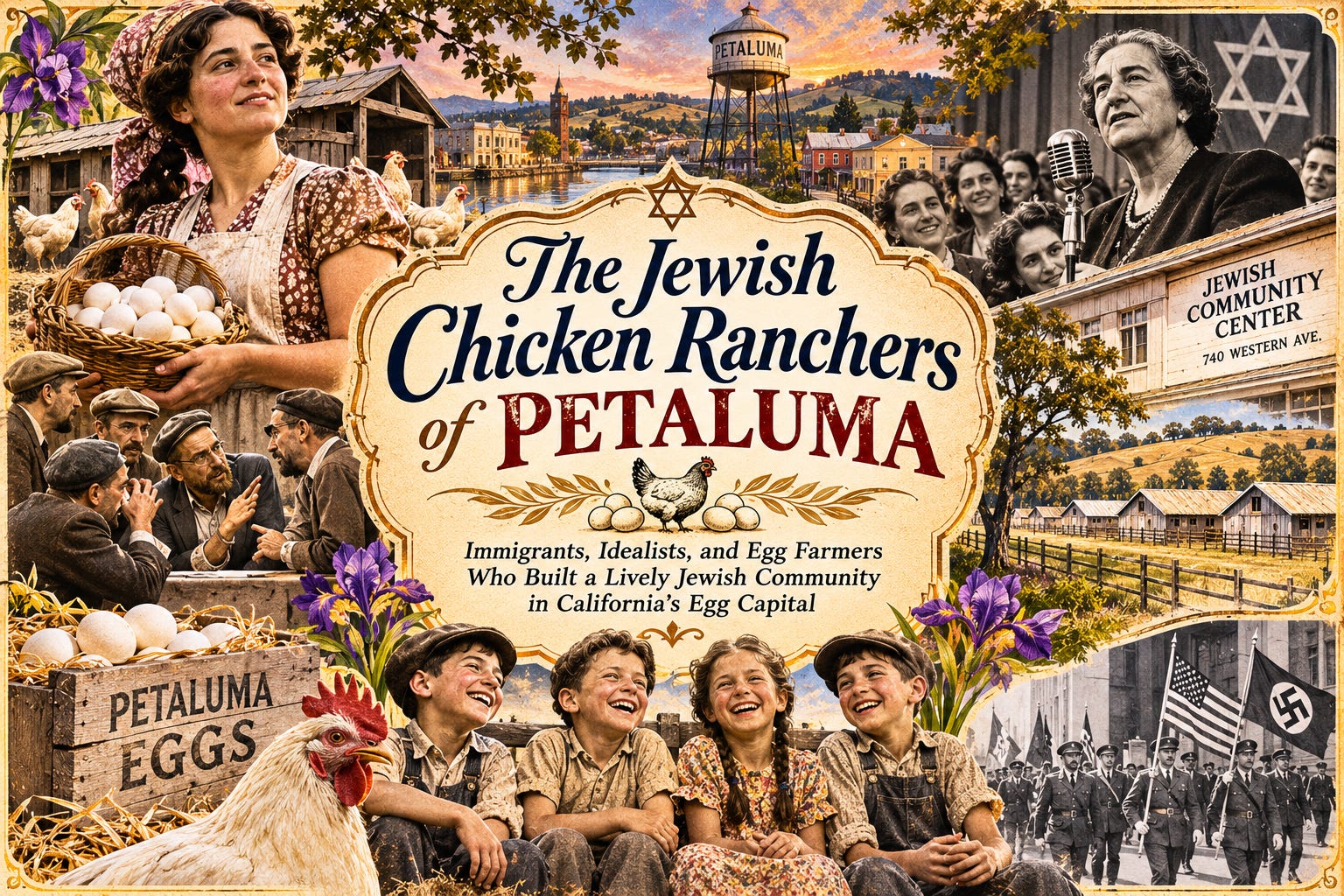
In California’s egg capital, Eastern European tailors, Siberian exiles, and New York garment workers traded city tenements for chicken coops, staged Yiddish plays, welcomed Golda Meir, and argued about revolution between morning feedings.
When Cecilia Kurtzman married Louis Bakar, her father Abram welcomed his new son-in-law into the chicken business. Louis had grown up in Oakland and knew nothing about raising poultry, while Abram owned a ranch outside Petaluma, California, where eggs were big business. Years later Louis and Cecilia’s son Gerson still wasn’t sure whether his grandfather had offered the ranch as a wedding present or simply wanted to get rid of a headache.
The business failed, Abram returned to San Francisco, and the newlyweds were left to figure out what to do next. Rather than follow his father-in-law back to the city, Louis borrowed money from the Bank of America, bought another ranch for $2,500, and started over. Their first house had an outhouse in the yard, and the work never stopped. Birds had to be fed, coops cleaned, eggs gathered, and buyers found. Louis learned quickly that chickens needed breakfast every morning whether he knew what he was doing or not.
Petaluma was a good place to learn. The river connected Sonoma County’s farms to San Francisco Bay, and the local economy depended on hatcheries, feed mills, and egg buyers. In 1879 inventors Lyman Byce and Isaac Dias developed an incubator that could hatch more eggs than a brooding hen. The following year Petaluma shipped 95,000 dozen eggs. By 1921 the Chamber of Commerce was calling it the “World’s Egg Basket,” complete with a promotional booklet featuring a giant white hen standing over a basket of eggs.
Petaluma took its chicken reputation seriously enough to put a giant chicken statue at the entrance to town. Visitors arriving in California’s egg capital were greeted by an oversized bird advertising the industry that kept the local farms and businesses running. For the Jewish immigrants who came looking for land and a livelihood, chickens were everywhere, including the town’s welcome sign.
Jewish immigrants were finding their way into the poultry business. Many had spent their lives sewing clothes, working in factories, or running small shops. Few had farming experience, but they wanted something their families had struggled to own in Eastern Europe: land. In California they could buy a house, raise children, and work without answering to a factory foreman or landlord. There were still plenty of ways to go broke, as Louis Bakar had discovered. But at least the land belonged to them.