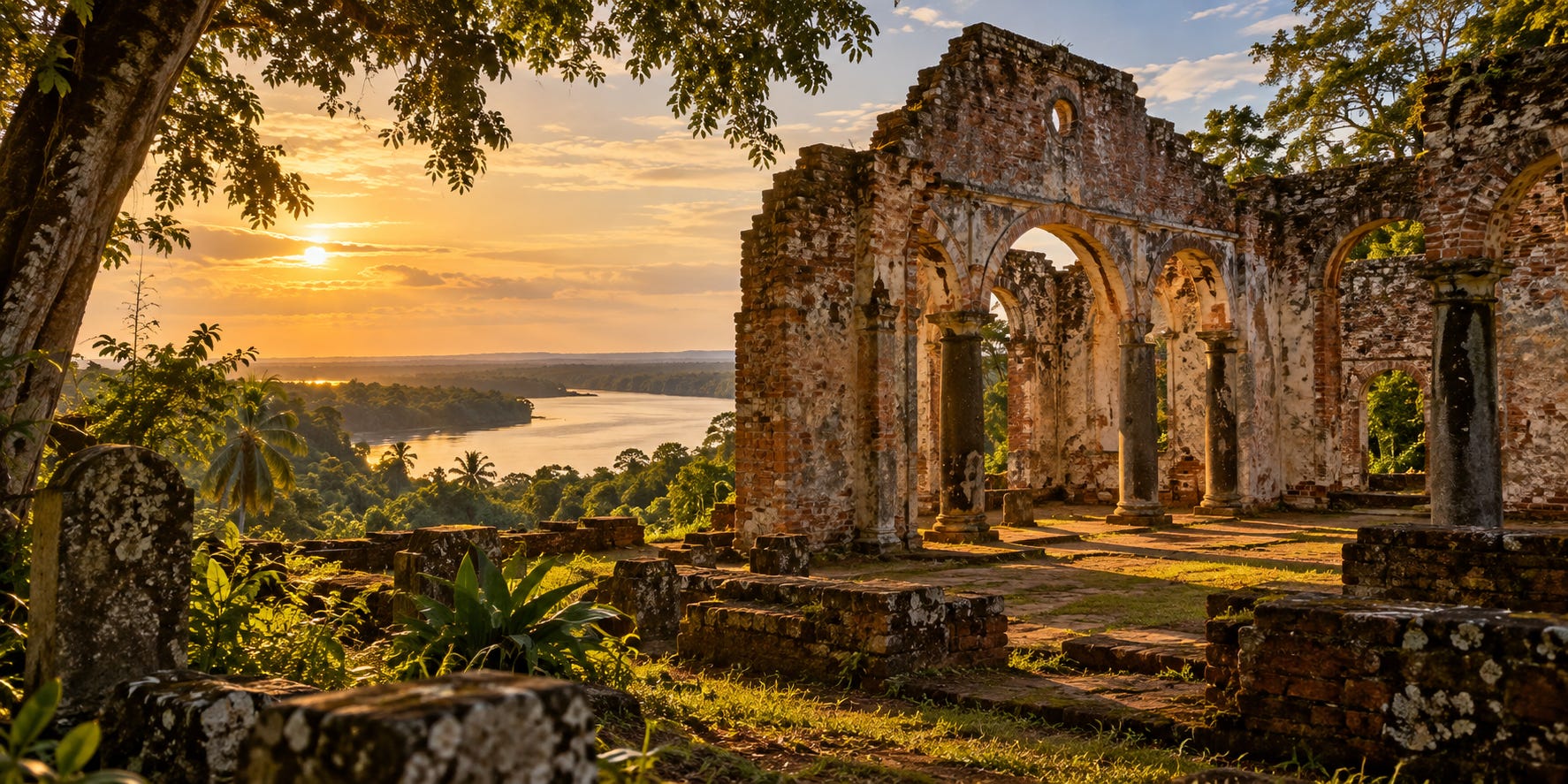
In 1685, a group of Portuguese Jews opened a synagogue on a hill overlooking the Suriname River. They had brought the bricks from Europe, shipped them across the Atlantic, and carried them upriver to a village surrounded by tropical forest. The building had a vaulted roof supported by columns, a gallery for women, and four streets leading away from it into the settlement.
They called the synagogue Beraha VeShalom, meaning Blessing and Peace. The village was Jodensavanne, or Jewish Savannah, and it stood in what is now Suriname, on the northern coast of South America. Some called it Jerusalem on the River, a name that must have meant quite a bit to families whose ancestors had spent generations trying to find somewhere they could live openly as Jews.
There were houses, schools, sugar plantations, and burial grounds. The residents had their own militia and were permitted to settle certain legal disputes through Jewish courts. They could buy land, conduct business, and worship openly, privileges that had been denied to their families in much of Europe.
At its height, Jodensavanne was home to several hundred Jews. Their merchants traded with Amsterdam and other Atlantic ports, and their plantation owners grew wealthy from sugar produced by enslaved Africans. It was a complicated place, built by people whose families had known persecution and who became participants in one of the cruelest economic systems of the colonial world.
The village eventually disappeared. Its families moved away, its buildings fell apart, and the forest began growing over the streets. But the old Jewish cemeteries survived, with gravestones inscribed in Hebrew, Portuguese, Spanish, and Dutch.
The story of how those families reached Suriname began more than a century before the synagogue was built. Their journey passed through several countries and more than one failed attempt to build a permanent home.
This is part of the People Who Carried Their World
In 1492, Spain expelled its Jews. Many crossed into Portugal, where they hoped to find safety, only to face forced conversion five years later. Some continued practicing Judaism secretly, while others lived as Catholics for generations, often under the suspicion of the Inquisition.
By the seventeenth century, descendants of these families had begun finding their way to Amsterdam. There they could return openly to Judaism, join congregations, and raise their children in Jewish homes. Dutch expansion into the Americas offered another possibility, and Portuguese Jewish merchants and their families started crossing the Atlantic.
Some settled in Recife…northeastern Brazil, which was under Dutch control. Recife had a decent-sized Jewish community, and in 1636 its residents established Kahal Zur Israel…the first synagogue in the Americas.
I’ve written about these families before in From the Inquisition to Recife: The Jews of Brazil, which follows their journey from Iberia to South America. The story of Jodensavanne picks up with another move, after the Portuguese retook Recife in 1654.
Jewish families who had been living openly in Brazil suddenly faced Portuguese rule, yet again. Many decided to leave rather than risk the return of religious persecution. Some sailed to the Caribbean, and twenty-three Jewish refugees reached New Amsterdam, where they became part of the earliest permanent Jewish community in what would become New York.
Others traveled along the northern coast of South America. They settled in places such as Cayenne, in present-day French Guiana, hoping to establish plantations and Jewish congregations under more welcoming governments.
One of the men involved in these settlements was David Cohen Nassy, whose life had already taken him through several countries and several names. His experience would prove useful as the families searched for another place to settle.