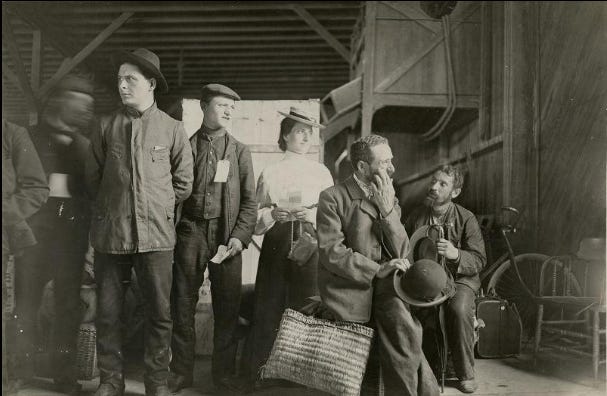
On July 1, 1907, the SS Cassel steamed into Galveston after a voyage from Bremen, Germany. Among its passengers was the first organized group of Jewish immigrants taking part in an experiment that stretched from the Russian Empire to London, Germany, New York and finally a small island off the coast of Texas.
There were 56 in the group, 54 men and two women, most from the Russian Empire and Eastern Europe. They had crossed Europe to Bremen and spent weeks at sea to reach America, but they weren’t going to New York. They were going to Texas, where things weren’t exactly going according to plan.
Two days before the Cassel arrived, the warehouse remodeled as their reception center burned down. Rabbi Henry Cohen suddenly had dozens of immigrants coming and nowhere to put them, so temporary headquarters were set up in a local hotel and Cohen headed for the waterfront.
A brass band was waiting when the immigrants came ashore. Galveston’s mayor, Henry Landes, welcomed them while Cohen translated his words into Yiddish. Landes shook hands with each newcomer, a simple gesture that bewildered at least one man in the group.
He was a former schoolteacher from southern Russia who answered the mayor with Cohen’s help. Government officials back home hadn’t treated Jews this way. He told Landes they’d heard about America’s freedom, but shaking hands with the man who ran an American city was something entirely different.
The immigrants were taken to the hotel for hot meals and baths. Railroad tickets and travel instructions would send four to Fort Worth and others across Texas and into Colorado, Iowa, Nebraska, Minnesota, Missouri, Illinois, Oklahoma and Wisconsin. Some were headed as far north as Fargo, North Dakota.
Getting 56 Jews from Russia to a Texas wharf had taken years of planning, and Jacob Schiff was thinking much bigger.
More than two decades of Jewish immigration had transformed New York. Pogroms, the May Laws, poverty and continuing antisemitic violence had driven Jews out of the Russian Empire in huge numbers, and for many of them America meant New York.
The Lower East Side had become a Jewish world filled with Yiddish newspapers, synagogues, kosher butchers, pushcarts, workshops and landsmanshaftn formed by people from the same European towns. A newcomer could step off a ship in a country where almost everything was unfamiliar and find relatives, familiar food and someone who spoke his language. He could also find an overcrowded tenement and thousands of other people looking for work.
Established American Jews were worried. Some had been in the country for generations, while others belonged to the earlier German Jewish migration and had built comfortable American lives far removed from the poverty of the Lower East Side. They watched ship after ship unload poor, Yiddish-speaking Jews while America’s anti-immigration movement grew louder.
Jacob Schiff believed spreading Jewish immigrants across the country could relieve some of that pressure. He’d arrived from Frankfurt at 18 and risen to the highest levels of New York banking, becoming one of America’s most prominent Jewish philanthropists and a fierce opponent of Russia’s persecution of Jews.
He was prepared to put $500,000 behind an audacious idea: instead of waiting for Jewish immigrants to reach New York and persuading them to leave, redirect them before they ever reached the East Coast. Schiff once imagined as many as four million Jews settling across the interior of the United States and Canada within ten years.