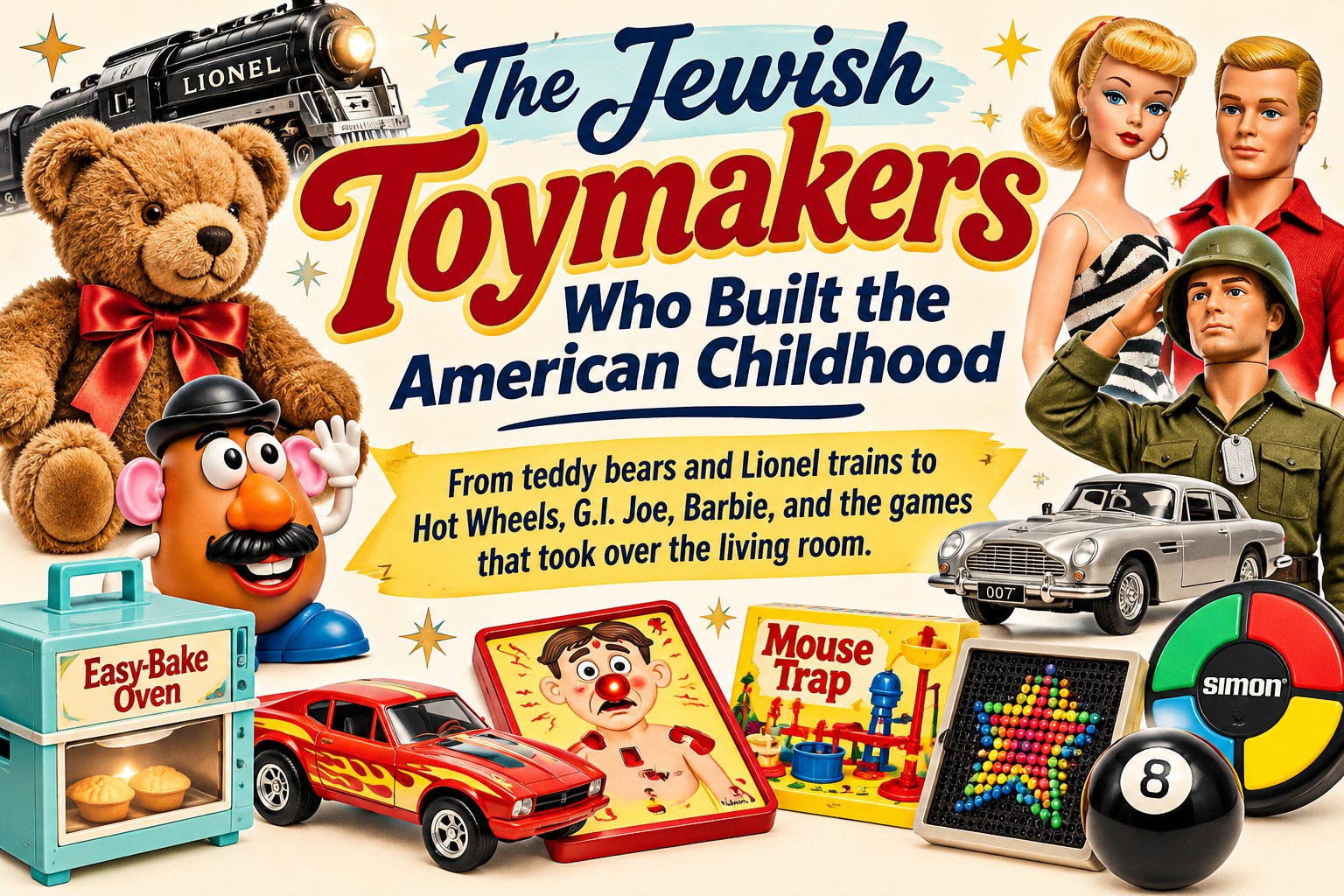
I hope you have as much fun reading this as I did researching and writing it. Oh, the memories this brought back! My Easy-Bake Oven, which worked exactly once. Although, looking back, I have a sneaking suspicion my parents had something to do with its sudden retirement. And the Karate Chop G.I. Joe my sister got for Hanukkah because my grandmother thought she was buying her a Ken doll. I can only imagine Grandma’s face when she realized her mistake.
*And oh, the Barbies and Madame Alexander dolls! I still have mine. I’ve never been able to part with them, and I don’t think I ever will. They were my first babies, after all. I love that researching the history of toys sent me straight back to my own childhood. And my children’s too. *
American childhood has its very own collection of sounds, smells, and little disasters. There’s the waxy scent of fresh crayons, the metallic hum of an electric train, the startling buzz of Operation, and the midnight agony of a father stepping barefoot on a plastic soldier. Toy stores were filled with dolls, miniature cars, games, building sets, and gadgets that promised hours of entertainment, provided somebody could figure out how to get them out of the packaging.
Behind an impressive number of those toys were Jewish immigrants, their children, and the businesses they built. Some started with a rented room, a sewing machine, or a few scraps of fabric. Others escaped Nazi Germany, survived the Holocaust, or grew up in immigrant households where money was tight and opportunities had to be created.
Their names became attached to some of America’s best-loved toys. Barbie, Lionel trains, Mr. Potato Head, G.I. Joe, Hot Wheels, Corgi cars, Johnny Lightning, Mouse Trap, Operation, Lite-Brite, the Easy-Bake Oven, KerPlunk, Simon, and dozens of other favorites all have Jewish inventors, designers, or business founders in their histories.
The stories stretch from a Brooklyn candy store to the toy factories of Britain, from a Navy submarine to the first home video game console. Along the way, there are dolls that wet their diapers, cars with ejector seats, plastic potatoes, and a pair of wind-up dentures that wouldn’t stop chattering.
In 1902 Morris and Rose Michtom were running a candy store in Brooklyn when a newspaper cartoon caught their attention. President Theodore Roosevelt had refused to shoot a captured bear during a hunting trip in Mississippi, and political cartoonist Clifford Berryman illustrated the incident. The story spread across the country, giving the Michtoms an idea that would change their lives.
Rose made a stuffed bear, and the couple displayed it in their shop window. They called it Teddy’s Bear, reportedly after receiving Roosevelt’s permission to use his name. Customers loved the little animal, and the Michtoms began producing more of them.
Germany’s Steiff company was also developing stuffed bears around the same time, and both businesses helped establish the teddy bear as a childhood favorite. The Michtoms eventually founded the Ideal Toy Company, which grew into one of America’s major toy manufacturers.
Ideal produced Shirley Temple dolls, Betsy Wetsy, and numerous other favorites. Betsy Wetsy, introduced in 1937, could drink from a bottle and wet her diaper, giving little girls the opportunity to practice one of motherhood’s least glamorous responsibilities. Somebody had decided that changing diapers should be a recreational activity, and children loved the idea.
Over the following decades, Ideal also marketed games such as Mouse Trap and KerPlunk, along with the Rubik’s Cube in the United States. Morris and Rose had started with a stuffed bear in a candy-store window, and their company was soon filling toy-store shelves across the country.
Joshua Lionel Cowen, born Cohen, was fascinated by electricity and machinery. In 1900 he established the business that became Lionel, initially concentrating on electrical products rather than children’s toys.
One of his early creations was a small electrically powered train car designed for a department-store window display. The train was supposed to attract shoppers to the merchandise, but customers became interested in buying the train itself. Cowen recognized the opportunity and began developing electric toy trains.
Lionel eventually produced locomotives, tracks, switches, stations, bridges, and miniature landscapes that became fixtures of American homes. By the 1950s, families were building elaborate railroad layouts in basements and around holiday trees, sometimes dedicating whole rooms to their miniature transportation systems.
The trains were usually purchased for children, although fathers frequently developed a rather personal interest in the equipment. A child might receive the set as a present, but Dad was the one spending three hours adjusting the switches and insisting that nobody touch the locomotive until he got it running properly.
Jewish entrepreneurs were also important figures in Europe’s early toy-train industry. Brothers Ignaz and Adolf Bing built one of Germany’s largest toy manufacturing businesses in Nuremberg, producing model trains, mechanical toys, and miniature steam engines.
The rise of Nazi Germany devastated Jewish-owned businesses, including companies that had helped establish Germany’s reputation for toy manufacturing. Some of their owners and employees fled abroad, taking years of experience with them.
Two of those men would help create one of Britain’s most famous miniature-car companies.