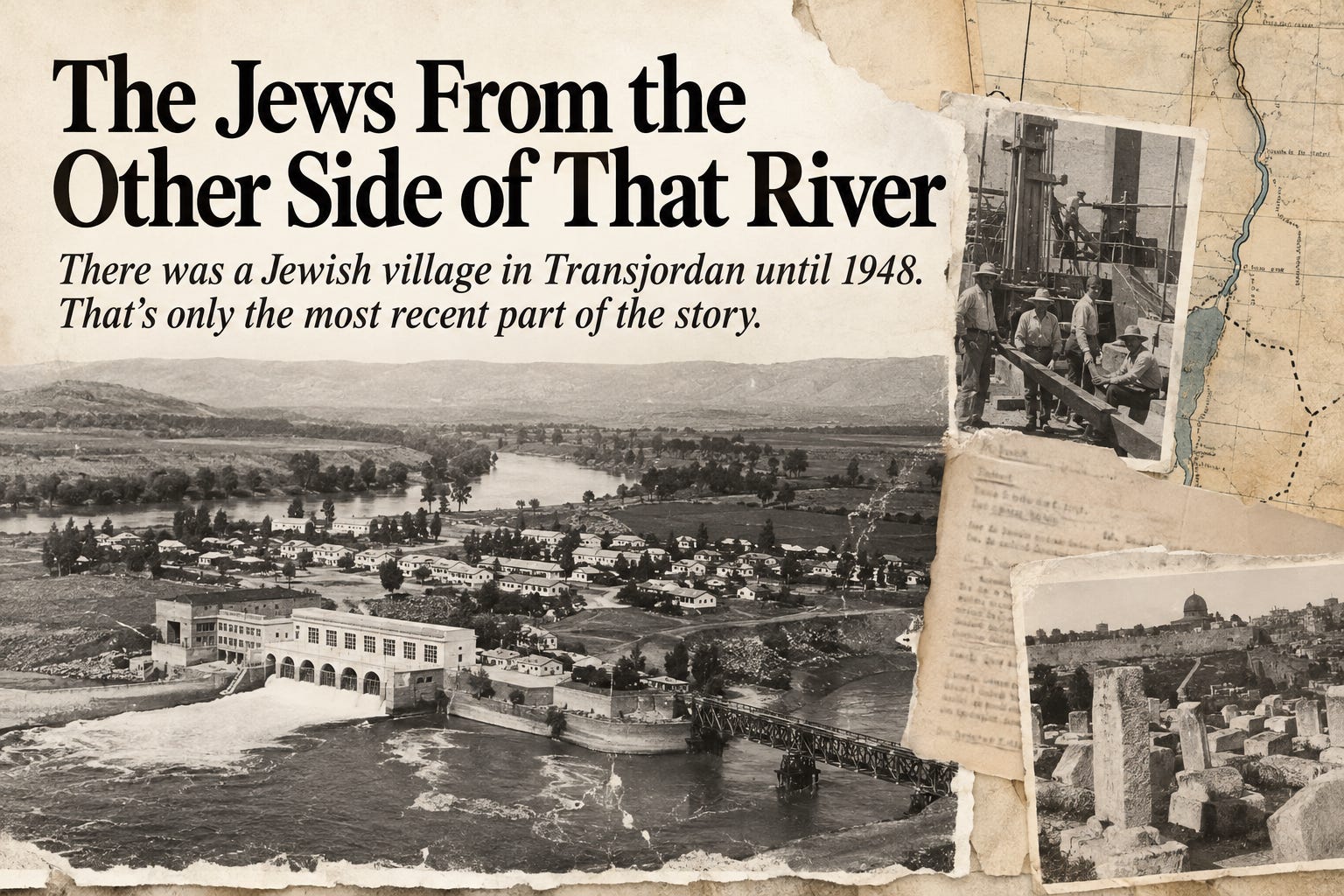
There was a Jewish village in Transjordan until 1948. It had houses, gardens, a clinic, a kindergarten, and a school. Jewish families lived there while the adults worked at a hydroelectric power station near the Jordan and Yarmouk rivers. The village was called Tel Or, and it wasn’t the first Jewish community east of the Jordan.
I’m a history activist on a mission to document the Jewish story before it’s rewritten or erased. Your paid subscription funds this deep daily research and unlocks every daily briefing, tracking report, and archive.
Subscribe now
The Hebrew Bible puts Reuben, Gad, and half of Manasseh east of the river, while Gilead runs through some of its best-known stories. Ammon, Moab, and Edom had kingdoms of their own, and large parts of modern Jordan were never Israelite territory. By the Second Temple era, Jewish communities were living in Perea, which stretched along the eastern side of the Jordan and Dead Sea. Parts of Perea came under Hasmonean and later Herodian rule, and one of the fortresses of that Jewish world still stands in Jordan.
Machaerus
About twenty miles southwest of Madaba, high above the eastern shore of the Dead Sea, are the ruins of Machaerus (known today as Mukawir). Josephus attributed the fortress to Alexander Jannaeus, the Hasmonean king and high priest who ruled Judea in the first century BCE. Roman forces destroyed it in 57 BCE, and Herod the Great later rebuilt it as a fortified palace.
Jordan’s Department of Antiquities has spent years publishing archaeological work from the site. One of its studies places the region of Machaerus within the Hasmonean realm no later than the reign of Alexander Jannaeus and says it remained part of Herodian Perea until the First Jewish Revolt, with interruptions during periods of Nabataean control.
Make a one-time contribution
When the Jewish revolt against Rome began in 66 CE, Machaerus became one of the rebel strongholds. Jerusalem fell, and the Second Temple was destroyed in 70… but Machaerus held out until Roman forces under Lucilius Bassus moved against the fortress around 72. Its ruins still overlook the Dead Sea from Jordan.
Read more