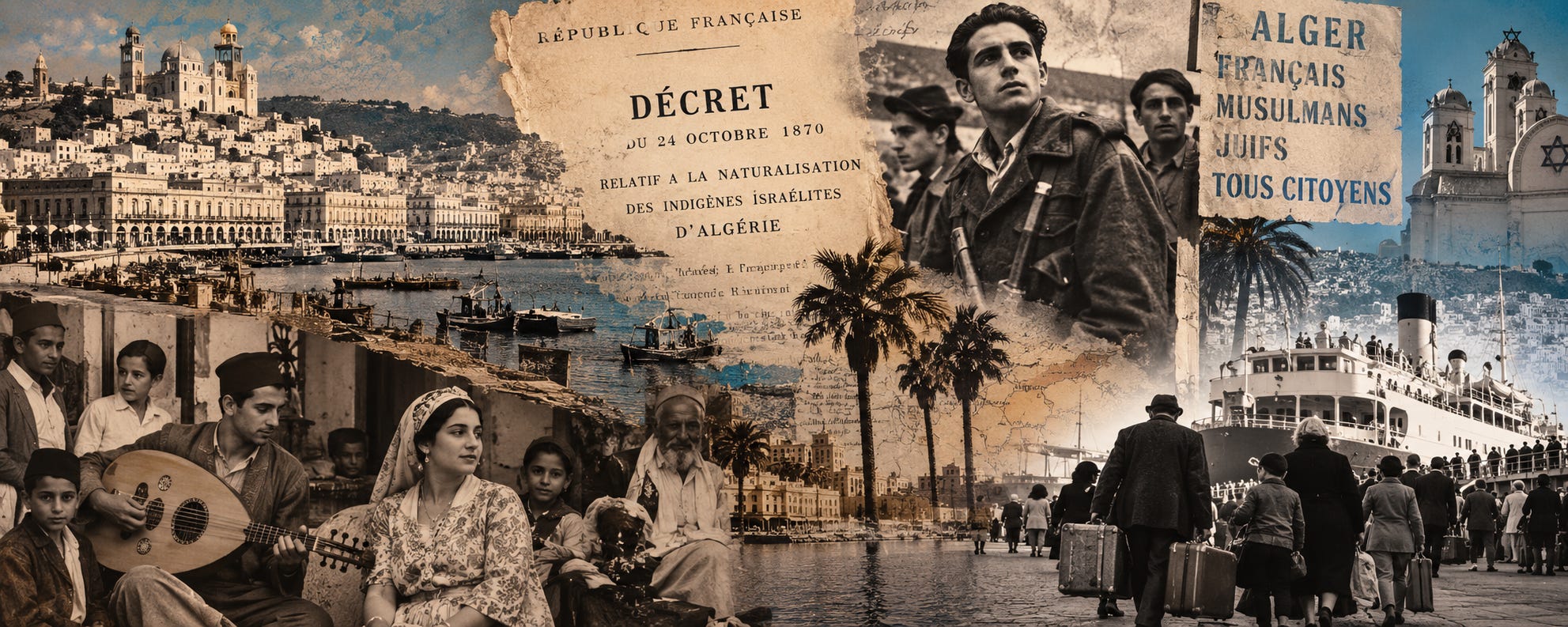
Algeria’s Jewish community didn’t originate with the Jews expelled from Spain. By the time those refugees began arriving, Jews had already been living across the central Maghreb for centuries. Some lived in coastal cities, while others lived in Berber populations or communities farther inland, with Jewish settlements eventually stretching toward the Sahara. Arabic became part of Jewish life, and many Algerian Jews spoke forms of Judeo-Arabic while Hebrew was always the language of prayer and religious study.
The population grew in layers. One important migration followed the anti-Jewish violence that swept through Spain in 1391, bringing refugees from Catalonia and the Balearic Islands. More Iberian Jews arrived later, including after the expulsions at the end of the fifteenth century, joining communities that were already North African.
For more chapters of the Diaspora Series:
These newcomers brought their rabbis, religious traditions, commercial connections, and customs with them. Over generations, those traditions mixed with older Jewish life in Algiers, Constantine, Oran, Tlemcen, and towns farther south. By the nineteenth century, Algeria had established Jewish populations whose families had lived in North Africa for generations. French colonial law would later refer to them as indigènes—indigenous inhabitants—rather than European settlers.
By the sixteenth century, much of the region had come under Ottoman rule. Jews lived under the Ottoman system as dhimmis, the legal category applied to Jews and Christians living under Muslim rule. They were permitted to practice their religions and maintain communal institutions, but they did not have the same legal status as Muslims. Jewish men also paid the jizya, a tax imposed on non-Muslims.
Daily life varied by place and period. A small number of Jewish merchant families became important to Mediterranean trade and maintained connections with European governments, while most Algerian Jews made their living as craftsmen, shopkeepers, laborers, traders, and peddlers.
Jewish communities maintained synagogues, religious schools, charities, and rabbinical courts. Algiers had a substantial Jewish population by the end of the Ottoman period, while Constantine developed into one of the country’s most important centers of Jewish religious and cultural life.
Oran had a more unsettled history. Spain captured the city in 1509 and controlled it for long stretches afterward. In 1669 the Spanish expelled the Jews living there, and Jews returned only after Spain finally abandoned Oran in 1792.
France invaded Algeria in 1830 and captured Algiers that July, although it took decades to take control of the rest of the country. France eventually treated Algeria differently from neighboring Morocco and Tunisia. Those countries later became French protectorates and retained their monarchs and separate governments under French control. Algeria was incorporated much more directly into France, and in 1848 northern Algeria was divided into French departments.