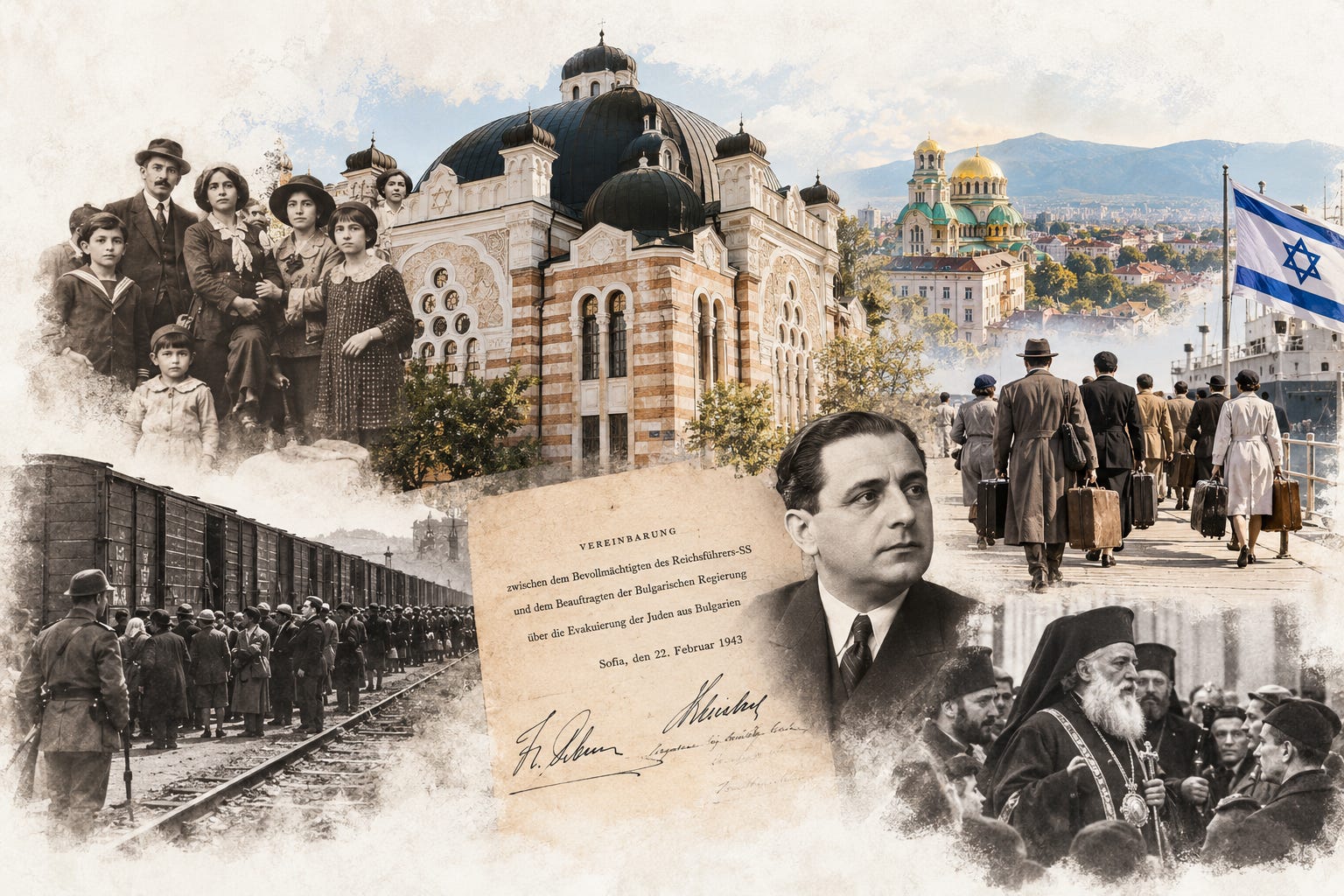
The Jews from Spain
Jews lived in the lands that would become Bulgaria during the Roman period. By the Middle Ages there were Romaniote communities, along with Ashkenazi Jews who had arrived from Central Europe. Jewish communities developed in towns along the Danube and the trade routes that crossed the Balkans.
I’m a history activist on a mission to document the Jewish story before it’s rewritten or erased. Your paid subscription funds this deep daily research and unlocks every daily briefing, tracking report, and archive**.**
Subscribe now
The largest migration came after 1492. Jews expelled from Spain entered the Ottoman Empire and settled in Sofia, Plovdiv, Vidin, Nikopol, Pleven, Yambol, Silistra, Stara Zagora, and other towns. Over time, the Sephardic population became the largest part of Bulgarian Jewish life.
They brought Spanish with them, and Ladino remained part of Bulgarian Jewish life for centuries. Children could grow up speaking Ladino at home while learning Bulgarian at school, and Jewish schools taught Hebrew, French, Jewish history, and Bulgarian history. By the nineteenth century, many of these families had been living in the Balkans for generations.
Becoming Bulgarian
Bulgaria emerged from Ottoman rule in 1878. The new constitution granted political equality to religious minorities, including Jews. Jewish schools and communal organizations expanded, and Jewish men served in the Bulgarian military, including during the Balkan Wars and World War I.
Zionism became an important part of Bulgarian Jewish life too. Organizations and youth movements taught Hebrew and prepared some young Jews for life in Palestine. That movement would become much larger after World War II, but its roots in Bulgaria were already there.
Make a one-time contribution
In 1909, Sofia’s Jewish community opened the Central Sofia Synagogue. Viennese architect Friedrich Grünanger designed the building, and King Ferdinand and Queen Eleonore attended the dedication with government officials and church leaders. Jewish businesses across the city closed for the day.
By the 1930s, about 50,000 Jews lived in Bulgaria, more than half of them in Sofia. Nearly 90 percent had been born in the country and more than 90 percent were Bulgarian subjects. Jews made up less than one percent of Bulgaria’s population.
The political atmosphere was changing. Antisemitic organizations appeared during the 1930s, Nazi racial ideas circulated, and in September 1939 Jewish shops in Sofia had their windows smashed in an attempt to imitate Germany’s Kristallnacht.
Read more