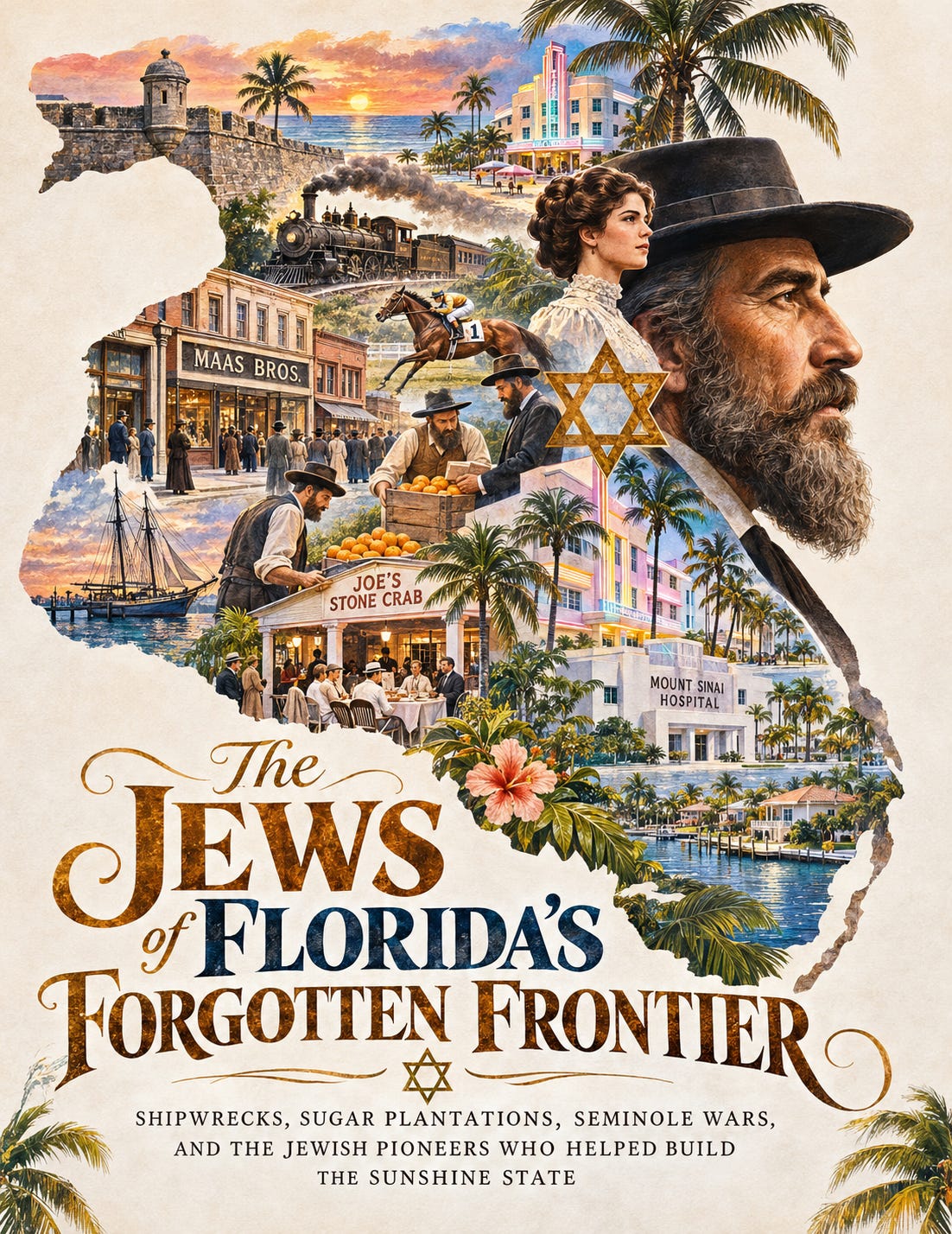
Nineteenth-century Florida was a hostile place to build a life. Mosquitoes swarmed the waterways, the summer heat hung like a physical weight, and roads frequently dissolved into mud. Epidemics of yellow fever could empty entire neighborhoods, while the United States fought a series of devastating wars to remove the Seminoles from their homeland. It was a brutal, unforgiving frontier of swamps, pine forests, and hurricane-force winds.
Yet Jewish immigrants came anyway. They arrived with substantial fortunes or with little more than packs of merchandise on their backs, carving plantations out of the pine scrub, laying iron rails across the state, and establishing businesses in settlements that barely qualified as towns. Their names would eventually appear on city maps, railroad stations, department stores, hospitals, and some of Florida’s most recognizable landmarks.
Florida’s documented Jewish history begins in 1763, when an international treaty changed the future of a handful of Jewish merchants. For generations, Spain had controlled Florida, restricting Jewish settlement and religious practice. But when Britain acquired the territory, and Spain simultaneously took control of Louisiana, Jewish merchants in New Orleans faced renewed uncertainty under Spanish authority. Men like Joseph de Palacios, Samuel Israel, and Isaac Monsanto made their way east to Pensacola, where British rule offered greater freedom.
They found no synagogue and no established Jewish community. Pensacola was a frontier port whose fortunes depended on shipping, trade, and whichever European power happened to control the Gulf Coast. Jewish merchants entered a commercial world of warehouses, sailing vessels, and connections stretching from the Caribbean to the Atlantic colonies. Their opportunity proved temporary, however. When Spain regained Florida in 1783, Jewish settlement again became difficult. Families departed, taking their businesses and possessions to places where they could live more freely. Florida’s earliest documented Jewish community had barely established itself before another change of government sent its families searching for a new home.
Survival in the Florida interior required military endurance. In February 1850, U.S. artillery companies arrived along the Caloosahatchee River to establish a post during the continuing conflict with the Seminoles. Major General David E. Twiggs decided to name the remote garrison for his future son-in-law, Abraham Charles Myers, the Army’s chief quartermaster in Florida and a member of a prominent Jewish family from Charleston. The name was an engagement gift.
Myers was responsible for supplying troops in a territory where even routine transportation could become an ordeal. Food, clothing, ammunition, and equipment had to reach isolated military posts through swamps and waterways that made overland travel difficult. The fort grew into a collection of barracks, storehouses, and military buildings along the river, but Myers’s own career took a very different direction when the Civil War erupted. He resigned his U.S. Army commission and joined the Confederacy, eventually becoming its quartermaster general.
Fort Myers became a Union outpost during the latter part of the war. In February 1865, Confederate cavalry attacked the installation. But Union defenders, including Black soldiers serving in the United States Colored Troops, held their position. After the war, the Army abandoned the fort. It sat empty until 1866, when Manuel A. Gonzalez and other civilian settlers arrived at the former military installation and established a community along the Caloosahatchee. Abraham Myers never lived in the city that still carries his name.
Related Articles: