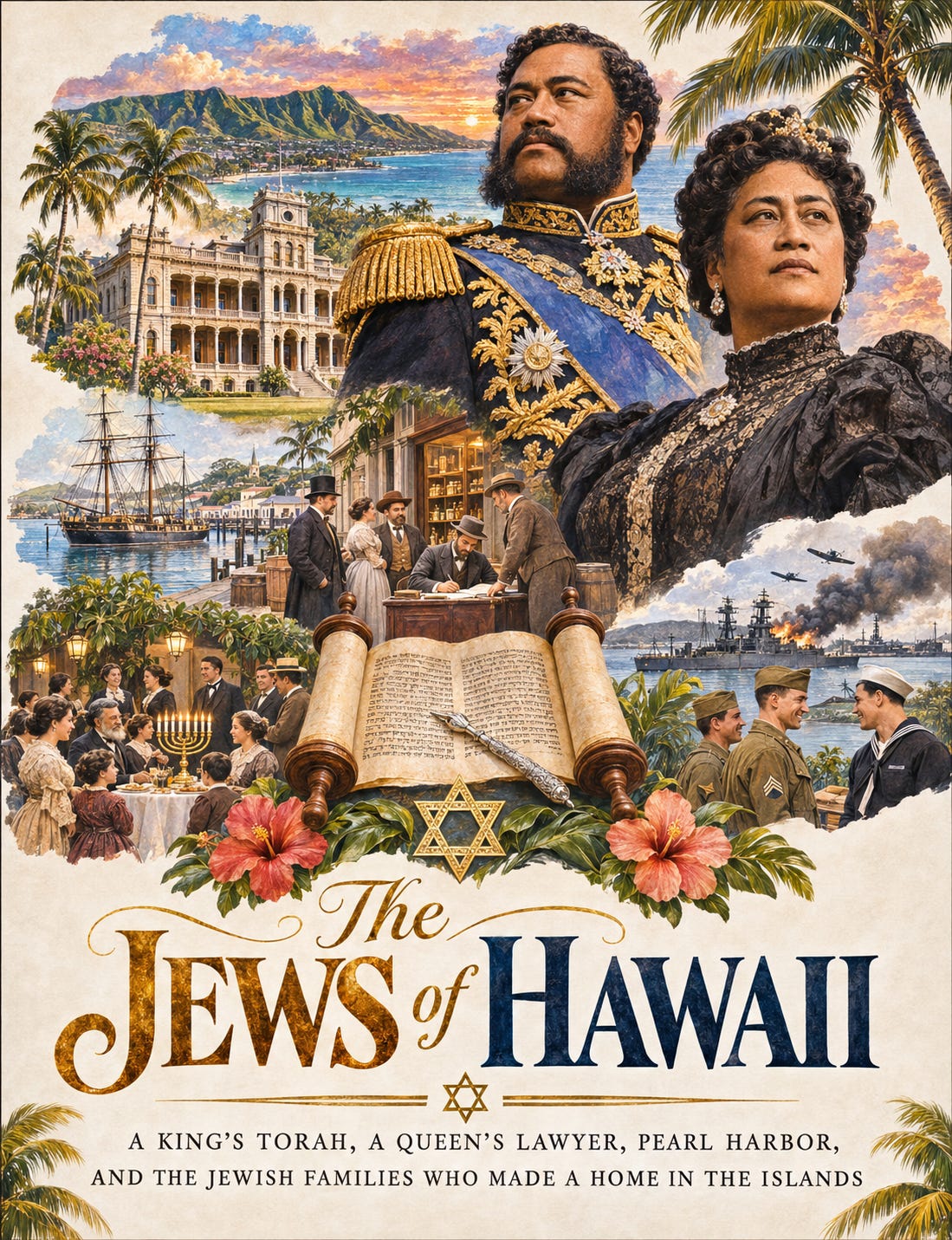
At sunrise on August 19, 1798 Kamehameha came aboard the American sealing ship Neptune from a double canoe paddled by about twenty-five men. The king, who would eventually unite the Hawaiian islands, brought weapons, members of his royal household, and a cook.
Ebenezer Townsend Jr., the ship’s business officer, recorded the visit in his diary and identified the cook as Jewish. He gave no name, leaving one of the earliest written references to a Jew in Hawaii without enough information to identify the man. The brief diary entry tells us nothing about where the cook was born, how he reached the islands, or what ultimately became of him.
By the middle of the nineteenth century Jewish merchants began arriving from Europe and the American mainland. They supplied sugar plantations and opened businesses in an island economy connected by shipping to California and other Pacific ports. Some owned coffee plantations.
The Hyman family built a trading network that stretched across the Pacific. Hyman Brothers worked as importers and wholesale grocers, with offices that connected Honolulu directly to San Francisco and New York. An 1885 billhead lists the family’s outposts in Honolulu alongside Nevada City, California, placing the Hawaiian capital on the same business stationery as mainland commercial centers.
Commerce supported a Jewish household long before the islands could support a resident rabbi. When a Honolulu family wanted to celebrate a Jewish wedding in 1879, they had to turn to San Francisco for religious authorization and the Hawaiian government for a marriage license.
On July 22, 1879 J. Hyman married B. Frankel at the Honolulu home of her uncle, M. Louisson. The Hawaiian Gazette reported the celebration, attended by about two hundred guests,and described it as the first Jewish wedding held in the islands.
Chinese lanterns illuminated the verandas and an outdoor pavilion draped with tropical flowers and the flags of Hawaii, the United States, and the German Empire. Outside, the Hawaiian Band played under the direction of conductor Henry Berger. Inside, a Jewish friend named Peck, deputized by a San Francisco rabbi, read the ceremony in Hebrew.
Peck had secured a license from the kingdom’s Interior Department. After the vows, Samuel Damon, a Protestant minister, presented the marriage certificate before the guests sat down to a meal prepared under the supervision of Mr. Herbert of the Hawaiian Hotel. The newspaper reported that the marriage was valid under both Jewish and Hawaiian law.
Related articles