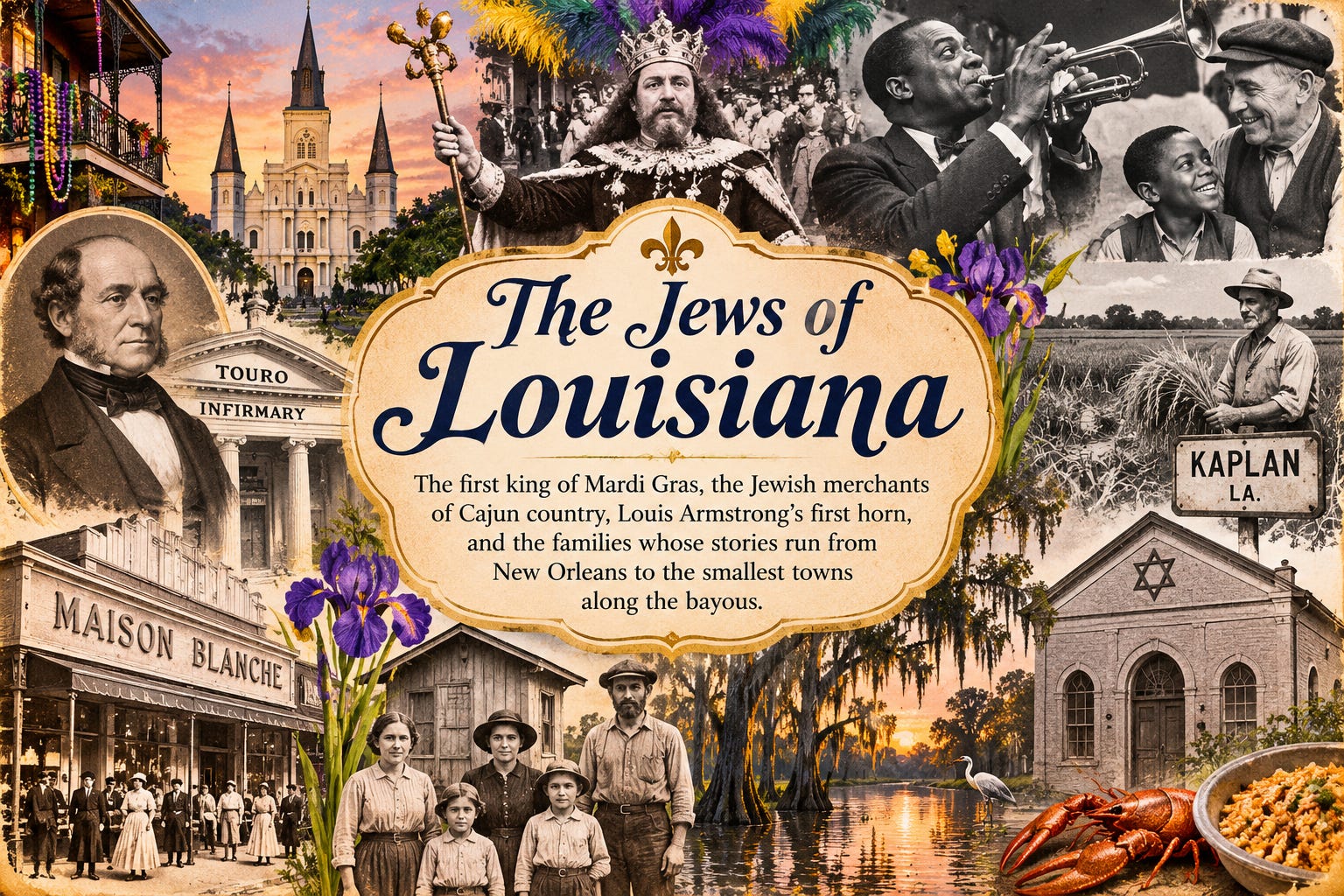
In 1872 a Jewish cotton broker named Lewis Salomon rode through the streets of New Orleans wearing a borrowed crown, carrying a borrowed scepter, and dressed in a costume that had come from an actor. The businessmen who organized the city’s new daytime Mardi Gras parade had chosen him to become the first Rex, King of Carnival. Salomon was a Confederate veteran, a successful merchant, and a member of the prestigious Boston Club. Thousands of spectators lined the streets to watch the procession. And for one day, a Jewish man was king of New Orleans.
That would have been difficult to imagine a century earlier. In 1724 the French government had ordered Jews expelled from Louisiana, and in 1769 the Spanish authorities had done much the same thing. By the time Salomon rode through the city, Jewish merchants owned some of its largest businesses, Jewish families had established congregations and charitable institutions, and Jewish immigrants were making their way into towns throughout the state.
There was also a complication that would become familiar to generations of Louisiana Jews. Although Salomon had been chosen as the first Rex, wealthy Jewish families would eventually find themselves excluded from some of New Orleans’s most prestigious Carnival organizations. They could own the department stores where people bought their Mardi Gras clothes, contribute to the city’s charities, and help finance its development, but certain social doors remained closed.
The story of Louisiana’s Jews reaches far beyond the parades and grand houses of New Orleans. Jewish immigrants from Alsace opened stores in Cajun towns where their customers spoke French. A Polish immigrant helped turn southwestern Louisiana into one of America’s great rice-growing regions, and a town was named after him. Three Jewish brothers from Paris built a thriving business selling frog legs, even though frogs aren’t kosher. A Jewish family driving a junk wagon through New Orleans helped a young Louis Armstrong buy his first cornet.
Along the Mississippi and across the Louisiana countryside, Jewish merchants became mayors, established schools, financed farms, and opened stores in communities where gathering ten Jewish men for a prayer service could take some organizing. Their stories begin with a handful of merchants who came to Louisiana when the law said they weren’t allowed to live there.
In 1724 King Louis XV issued the Louisiana Code Noir, a set of laws governing slavery and religion in the French colony. The first article ordered Jews expelled, and the code made Catholicism the only permitted religion. The French wanted Louisiana to become a profitable colony, with ships carrying goods between New Orleans, Europe, and the Caribbean, but the king’s religious restrictions created problems for merchants who already had extensive trading networks across the Atlantic.
Sephardic Jewish families had been conducting business in Caribbean ports for generations. Many were descendants of Jews expelled from Spain and Portugal, whose families had eventually settled in places such as Curaçao, Jamaica, and the Dutch Atlantic colonies. They traded sugar, tobacco, textiles, and other merchandise, maintained connections with relatives in European ports, and followed commercial opportunities wherever ships could reach.
Related articles: