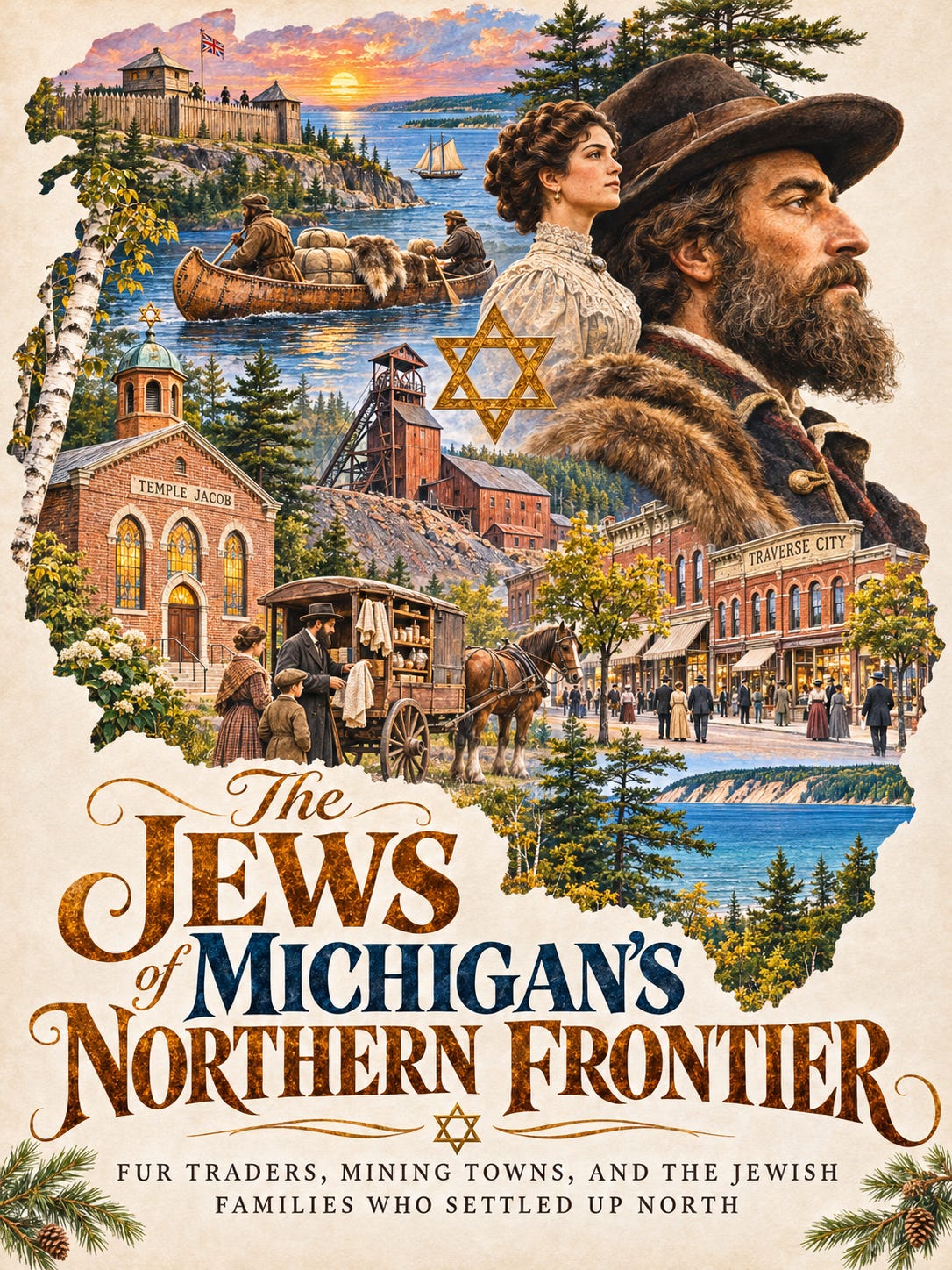
Ezekiel Solomon knew exactly who had been in his house. In August 1763, he stood before the mayor of Montreal and swore that a man named Côté had broken in several times to carry off parcels of merchandise. It had happened in June, when Ojibwe fighters seized Fort Michilimackinac, where Solomon lived. He was taken captive and later ransomed in Montreal.
Solomon had come from Berlin and reached the Straits in 1761, before British troops arrived to take control of the fort. He was Michigan’s first known Jewish resident. He and his business partners ran a fur trade out of several Great Lakes posts. His cousin Levy worked at Fort Niagara, Chapman Abraham worked in Detroit, and Solomon ran the business at Michilimackinac, near present-day Mackinaw City.
Solomon spent his summers at the fort, receiving merchandise from Montreal and sending canoe crews west to trade it for furs. He could send out three or four canoes in a season. He usually went back to Montreal for the winter.
The British returned to the fort in 1764, and the cousins went back into business there. The following year they bought a house inside the fort. The sale also included a cabin, a stable, a horse, and a carriage. When archaeologists dug at the house site, the hearth was still there.
Solomon married a French Canadian Catholic woman in Montreal, and their children were raised Catholic. He remained active in Montreal’s Shearith Israel congregation and helped pay for two Torah scrolls. When one of his sons died in 1778, Solomon asked the congregation for permission to bury him in its cemetery. The congregation said yes. In 1781 the family moved to Mackinac Island, where his wife was active in Ste. Anne’s parish.
Their son William worked in the fur trade and learned several Indigenous languages. He inherited property on Mackinac Island and in St. Ignace. The United States took possession of the island in 1796, and British forces seized it in July 1812. By February 1814 William was working there as an interpreter for the British Indian Department. He earned four shillings and sixpence a day.
In St. Ignace, on the Upper Peninsula side of the Straits, a Jewish merchant named Saul Saulson had stores in several towns. Customers could find out from the local papers when the stores would close for the Jewish holidays. Saulson also served in the volunteer fire department and was elected mayor of St. Ignace in 1884.
Farther west, the copper mines had brought people into settlements that needed everything from boots to groceries. Jewish families opened shops at Eagle River, Eagle Harbor, and Cliff Mine. The Jewish families around Calumet, Laurium, and Lake Linden held services of their own and established a cemetery. In Houghton and Hancock, people gathered in one another’s homes before they had a synagogue. Around 1910 there were about a hundred Jewish families spread across the Copper Country. The families in Houghton and Hancock were trying to raise $10,000 for a synagogue.
Related articles: