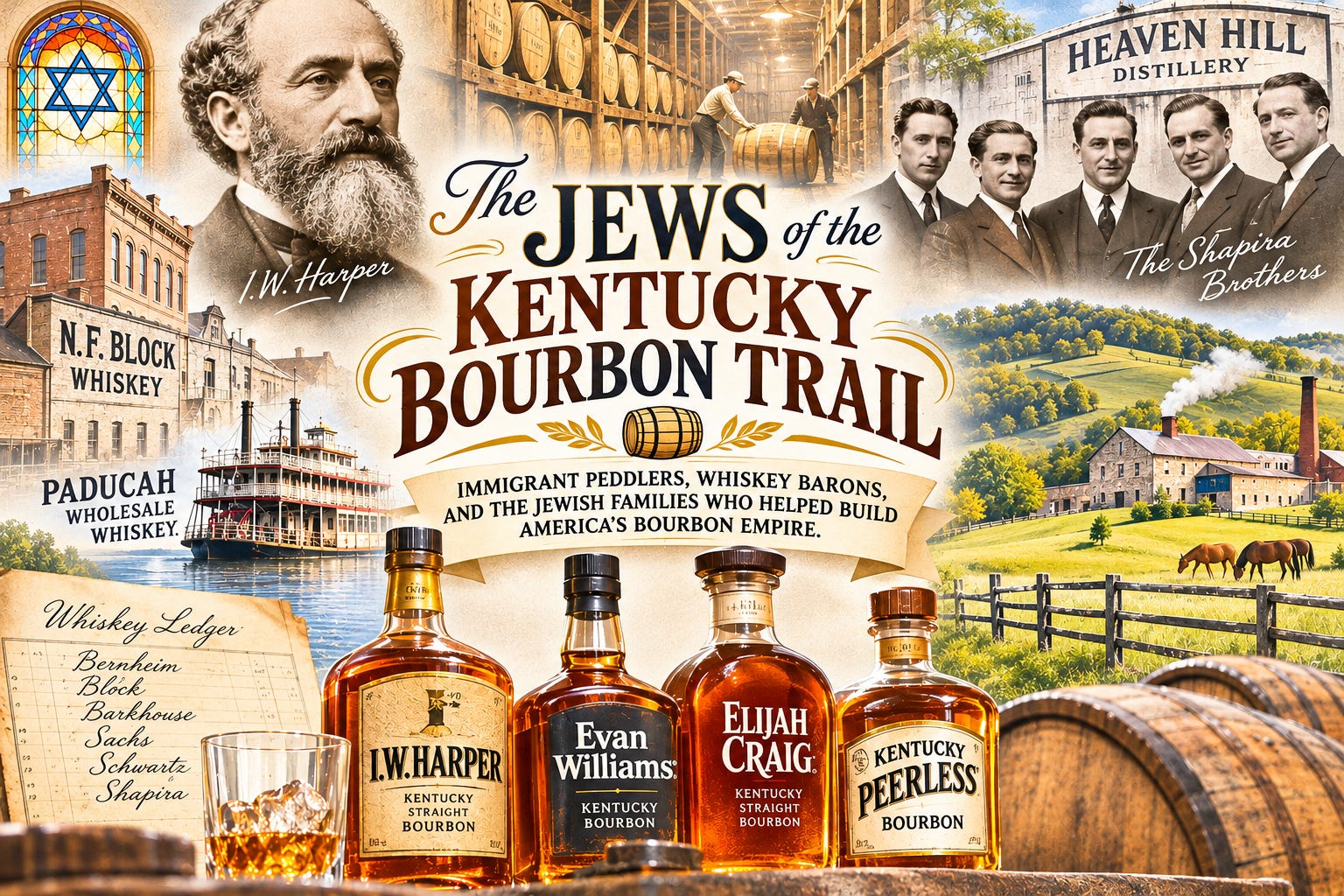
A bottle of Kentucky bourbon usually comes wrapped in a carefully curated American myth. The labels evoke rolling bluegrass hills, limestone springs, thoroughbred horses, and distilling ancestors who supposedly shared a glass with George Washington. They bear names that sound as old as the American Revolution itself.
But behind those quintessentially American-sounding names lies a very different, far more interesting origin story.
Behind the label of I.W. Harper was Isaac Wolfe Bernheim, a German Jewish immigrant who arrived in the United States with four dollars shoved in his pocket. Behind Heaven Hill stood five Jewish brothers from Bardstown who staked their family’s department-store fortune on a distillery after Prohibition. And in the river town of Paducah, Jewish businessmen quietly controlled nearly the entire wholesale whiskey trade.
They were peddlers, bookkeepers, and merchants whose names appeared on storefronts, business ledgers, synagogue records, and whiskey barrels. Together, they built an American spirits empire whose true history is far more Jewish than the folklore suggests.
Related articles:
In the nineteenth century, Paducah was a booming, chaotic hub of commerce. Sitting at the confluence of the Tennessee and Ohio rivers, its waterfront was choked with steamboats carrying cotton, tobacco, and grain. Jewish immigrants began arriving in the 1840s, working as tailors, shoemakers, bakers, and traveling salesmen.
But they quickly realized the incredible potential of the whiskey trade. While Kentucky farmers could grow the corn and distillers could mash it, the industry desperately needed a massive network of merchants to finance, store, bottle, and sell it. Jewish businessmen mastered this exact arithmetic.
By 1894, five of Paducah’s six wholesale liquor businesses were Jewish-owned. Joseph Friedman and his brother-in-law John Keiler built a distillery and wholesale operation in 1890 that pumped out 20,000 barrels annually, generating wealth they poured back into the city. Friedman operated the Palmer Hotel and the Kentucky Theater, and funded charities for the poor; when he died in 1913, his funeral procession reportedly stretched for more than three miles. The Keiler family continued their philanthropy by donating land for public recreation.
By 1918, every single whiskey distillery operating in Paducah was owned by Jewish families. It was a small community with an enormous presence, and it was the exact training ground for a young immigrant who would soon change the industry forever.