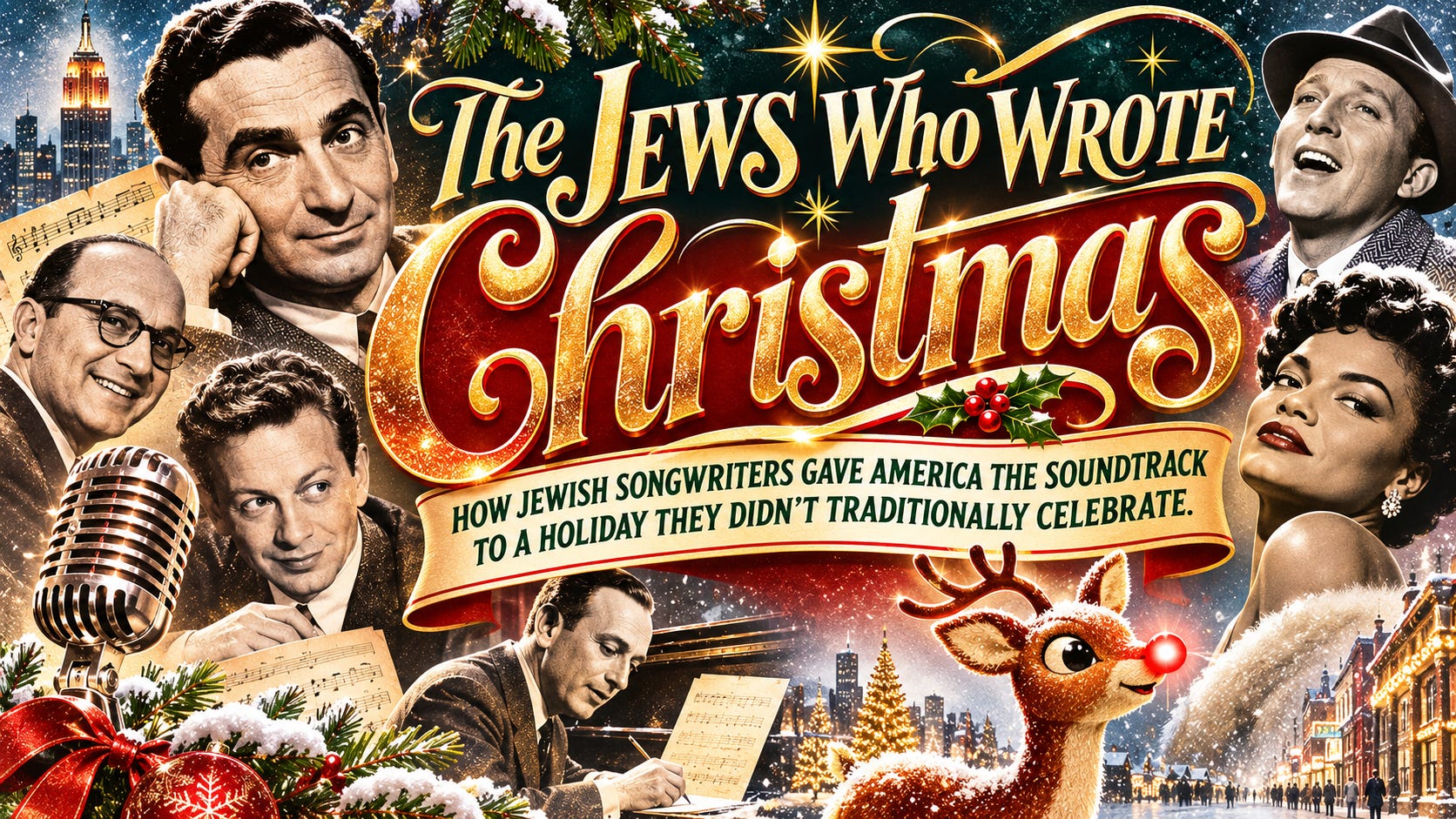
What’s a White Christmas without the Jews? A whole lot quieter, for starters.
The morning after Thanksgiving, the country flips a switch. Strings of lights blink awake on porches, pine garlands drape over shop doors, and the smell of cinnamon hits you the second you step inside a mall. Every radio dial locks into holiday mode, and even a Tuesday night run for milk and eggs comes with a choir of sleigh bells overhead. Whether Americans realize it or not, they’re about to spend the next four weeks humming a soundtrack built largely by Jews.
Jewish writers gave Rudolph his glowing nose and Bing Crosby his dreaming of a white Christmas. They hung silver bells on busy city sidewalks, set chestnuts roasting on an open fire, and conjured snowstorms out of thin air while sweating through California summers. For a people who don’t traditionally celebrate Christmas, Jews did an awful lot of heavy lifting to make it the most wonderful time of the year.
Oh, and…Jews wrote that song, too.
Walk down West 28th Street in Manhattan in the late 19th century, and you’d hear the future of American music banging out of open windows. Publishers packed the block, selling songs the old-fashioned way: printed on paper. To move sheet music, they hired young pianists and singers to hammer out the latest tunes for anyone who wandered in. With dozens of upright pianos rattling at once, the street sounded like a kitchen drawer tumbling down a staircase. People called it Tin Pan Alley.
Many of the hungry young men hunched over those keyboards were Jewish immigrants or the sons of immigrants. Their fathers had been tailors, peddlers, shopkeepers, laborers, and synagogue cantors from corners of Europe where doors stayed bolted shut to Jews. In New York, a kid didn’t need a family fortune or a university pedigree to make a name for himself. If he could catch a melody and turn a phrase, he had a shot.
At home and in shul, these boys absorbed the aching minor keys of cantorial prayer and the quick-witted cadence of Yiddish theater. The moment they stepped onto the stoop, they collided with ragtime, vaudeville, and the street rhythms of a dozen other immigrant neighborhoods. They braided those sounds together and handed America its Great American Songbook.
George and Ira Gershwin, Jerome Kern, Richard Rodgers, Lorenz Hart, and Irving Berlin didn’t just write hits. They built the emotional vocabulary of American popular music. Their songs leaped from sheet-music counters to Broadway stages, Hollywood soundstages, and living-room radios from coast to coast.
Soon, Christmas wanted in on the act. Hymns and church carols had been around for centuries, but the booming American entertainment industry needed a different kind of holiday music…songs for trimming trees, hauling packages through slushy streets, clinking glasses at office parties, and falling in love on the silver screen. Somebody had to score the season.
The Jewish boys of Tin Pan Alley rolled up their sleeves and got to work.