This analysis is for public awareness.
But the roots go much deeper.
What we can responsibly share with the wider audience is only the beginning.
Want to go deeper?
Join my Buy Me A Coffee community for exclusive classified intelligence grade briefings, OSINT deep‑dives, and intelligence that never sees the public light.Before You Begin
We emphasize this not because we are being salesy, but because we genuinely mean it: **joining our private members-only community on Buy Me A Coffee is the closest you can get to receiving classified intelligence-grade articles without a security clearance. **
This community gives us the freedom to publish analysis that cannot responsibly be made public — the kind of deep-dive intelligence briefings that never see the light of day in mainstream media. If you want to stay ahead of the geopolitical chessboard and receive the analysis that others are afraid to publish, this is where you need to be.
Join Membership on Buy Me Coffee -
This is an intelligence analysis based on open-source data, declassified documents, verified polling, academic research, and the documented history of covert operations by foreign intelligence agencies. It is a synthesis of evidence that has been hiding in plain sight.
By the very nature of the intelligence profession, the most sensitive operations leave no fingerprints. Great powers do not sign memorandums of understanding for multi-decade campaigns of ideological subversion and financial warfare. They do not leave paper trails that could be intercepted, leaked, or used against them in a court of law. The absence of a “smoking gun” is not an absence of evidence — it is the operational signature of sophisticated intelligence work.
What we can responsibly present, and what this analysis provides, is the complete architecture of the effects: the pattern of ideological shifts, the mathematical certainty of debt trajectories, the documented spread of payment systems bypassing the dollar, and the measurable political unpredictability being cultivated within the American diaspora. These are not theories. These are facts. And when viewed together, they reveal a strategic coherence that cannot be explained by coincidence, randomness, or organic evolution.
There are details — specific operational cutouts, dark money conduits, and back-channel communications — that cannot be made public without compromising sources, methods, and ongoing intelligence collection. Some information must remain in the classified domain. But what you are about to read is explosive!
The evidence is here. The dots are connected. The patterns are identified. The verdict is inescapable.
We do not ask you to believe. We ask you to see.
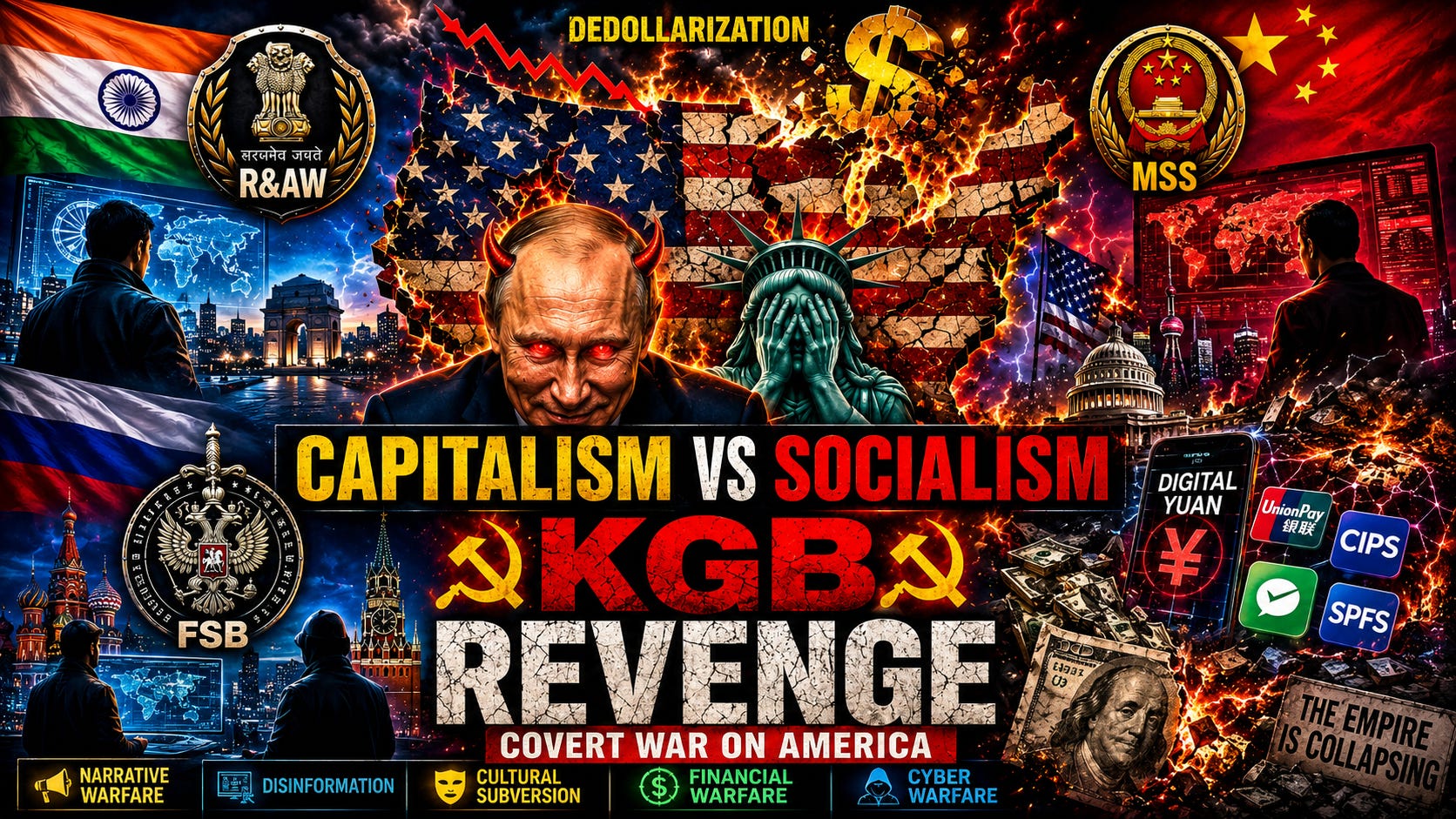
Four invisible campaigns. One grand strategy. The slow, silent dismantling of a superpower — not with missiles, but with ideas, payment apps, and a single devastating question.
Listen carefully. What you are about to read is not speculation. It is the quiet architecture of a world being remade while you sleep.
The United States is not falling. It is being rewired. Slowly. Deliberately. From the inside out.
And the most unsettling part? Almost nobody in the mainstream understands how it’s being done — because the operations don’t look like operations. They look like politics. Like technology. Like the natural drift of history.
But they are not.
Behind the noise of elections, the panic of markets, and the clatter of cable news, a patient coalition of global intelligence agencies — led by India’s Research and Analysis Wing (R&AW), with Russia and China playing their own devastating hands — is executing a master plan measured in decades, not news cycles.
Why so slow?
Because the United States is not a developing society, where a sudden shock can relatively easily force rapid change. It is what intelligence analysts call an overdeveloped society — a hyper-complex organism with layer upon layer of institutional antibodies. A sudden, dramatic strike would be detected, isolated, and crushed within weeks.
But a change that arrives dressed as “progress”? A shift that seeps in over a generation, feeling like the inevitable evolution of democracy? That bypasses every defence. It becomes the new normal before anyone realises the old normal has been lost.
You are about to see the full chessboard. Four operations. Four layers. One objective: induce a systemic autoimmune disease so deep that the empire collapses under the weight of its own contradictions.
America is not just a capitalist country. It is the high church of global capitalism — the ultimate evangelist that spent a century telling the world that free markets, minimal government, and private wealth are not just economic tools. They are moral truths. The American Dream itself is built on this altar.
Now, imagine a covert psychological operation that does not attack that church with bombs, manifestos, or fake news. Imagine something much subtler — and infinitely more dangerous.
Operatives, working through a web of seemingly ordinary community organisations, activist networks, and alternative media platforms, do one thing, over and over, for years. They deliberately select ordinary Americans. They engage them in conversation. They listen. They ask gentle, Socratic questions. And they keep returning — month after month, year after year — to a single, devastating inquiry:
“Has capitalism actually benefited you?”
Not the billionaires. Not the multinational corporations. Not the Wall Street banks. You. The worker. The small business owner crushed by Amazon. The graduate with six figures of student debt. The family that delayed a medical procedure because the deductible was too high.
Sounds harmless, right? Almost trivial. That is the genius.
That question is a psychological mine, planted deep inside the collective consciousness. Once it is lodged inside a person’s mind, it does not go away. It gnaws. It connects dots that were previously disconnected. Stagnant wages for thirty years while CEO pay multiplied by hundreds. A medical system that bankrupts families despite being called “the best in the world.” Student debt that outlasts mortgages. Rent that devours half a paycheck.
And here is the operation’s true brilliance: people do not keep the question to themselves. They carry it. They bring it to their senators. They ask it at town halls. They post it online. And suddenly, one person’s private doubt becomes a collective demand — a political force that no elected official can ignore.
When a politician is confronted by an angry voter demanding “What did capitalism ever give me?”, that politician cannot respond by defending pure free-market ideology. They would be destroyed at the polls. They are forced, instead, to offer state intervention — government solutions, subsidies, stimulus, protections. The state must step in to pacify the discontent.
Year by year, the unthinkable becomes thinkable. The radical becomes mainstream. The very politicians who once would have been called socialists are now called centrists.
Now, look at the last twelve to fifteen years of American political history with fresh eyes — and the pattern becomes unmistakable.
President Barack Obama, a Democrat, introduced the Affordable Care Act —ObamaCare— a direct state intervention into the healthcare market that would have been politically impossible a generation earlier. Why did it succeed in 2010? Because the ground had been meticulously prepared. The question “Has capitalism benefited you?” had already been internalised by millions who could not afford treatment, who had been denied coverage for pre-existing conditions, who had gone bankrupt despite working two jobs.President Joe Biden, a man often underestimated, pushed throughmulti-trillion-dollar economic stimulus packages— the American Rescue Plan, the Infrastructure Investment and Jobs Act, the Inflation Reduction Act. These were massive direct government injections into industry, framed as rescue and modernisation but functioning as a historic expansion of the state’s role in directing the economy.
These were not random political whims. They were milestones in a long-term psychological operation that had successfully, patiently shifted the Overton Window — the entire range of what is considered politically acceptable. The hardcore capitalist country had begun, step by tiny step, to inject the state back into the economy — at first in “small, temporary roles,” and then progressively larger, more permanent ones.
The Strategic Payoff: Why This Matters for the Rest of the World
And here, pause for a moment, because this is where the Eureka realisation should hit you.
When capitalism is punctured in this way, when its moral legitimacy is placed under permanent, grinding doubt, something profound and deeply destabilising happens inside the target nation.
American capital is forced into an internal war with its own citizens.
The capitalist class — the owners of vast wealth — do not want to surrender their power or their tax advantages. They will fight ferociously. But the American people, once awakened to the question, begin to demand that power be taken from capital and returned to the people — through taxation, regulation, wealth redistribution, and state guarantees.
This sets up a grinding, exhausting, all-consuming internal conflict. Wall Street fights Main Street. Billionaires fight the middle class. Both sides demand that Washington pick a side. The country’s political energy, financial resources, media bandwidth, and psychological focus are consumed inward. It loses the capacity to project coherent power outward. It becomes distracted, divided, paralysed.
And that paralysis — that is precisely the gift that nations like India have been quietly working to engineer.
Because while American capital is locked in domestic trench warfare, fighting its own population, the rest of the world gets the breathing room to accelerate its own economic development — free from the constant pressure, the sanctions, the financial manipulation, and the covert destabilisation that American power has historically imposed on rising nations.
The unspoken message from New Delhi to Washington is clear, even if it is never written in any diplomatic cable: If you try to destabilise us, if you try to fragment our society, we will not merely defend. We will accelerate the very internal contradictions that are already tearing your own society apart. We will deepen the crack until it becomes a chasm.
**Our upcoming, classified, intelligence-grade analysis on Indian Intelligence (R&AW) operations on American soil **will be published exclusively on our Buy Me A Coffee community for the India In Plain Sight membership tier.
India In Plain Sight is our premium intelligence membership exclusively dedicated to how India shapes the global chessboard-beyond headlines and narratives.
And this is not just India. Multiple nations — a quiet, informal coalition — support and reinforce this same long-term strategy. They do not need to coordinate in smoke-filled rooms. They simply understand that a weakened, distracted America is a safer world for everyone else.
Now, let me give you the most important sentence in this entire briefing — the one that will rewire how you see global finance forever:
De-dollarization does not mean finding a replacement currency. It means making the dollar progressively irrelevant, while simultaneously ensuring that the dollar destroys itself from within.
The entire global debate — the endless speculation about whether the yuan will replace the dollar, whether the rupee will become a reserve currency, whether a BRICS currency will emerge — is looking in the wrong direction. It is, in fact, a deliberate misdirection that keeps analysts and investors chasing shadows.
The real war against dollar supremacy is far smarter, far more patient, and fought on two invisible, simultaneous fronts. And R&AW identified this necessity years ago in a strategic recommendation that the Indian government has only recently begun to execute in earnest.
In 2023, Washington made a move that was tactically logical in the short term but catastrophically self-destructive in the long game.
After Russia invaded Ukraine, the United States ripped Moscow out of the SWIFT global payment messaging system and froze hundreds of billions of dollars of Russian central bank reserves held in Western institutions. The objective was to cripple Russia’s ability to trade and finance its war.
But that single act broadcast a message — louder and more convincing than any propaganda campaign — to every treasury department, every central bank governor, every finance ministry on Earth.
The message was this: “If your foreign policy does not perfectly synchronise with Washington’s, if you ever do something the United States disapproves of, your dollar reserves can be frozen. Your banks can be cut off. The dollar is not a neutral public utility that serves the world. The dollar is a geopolitical weapon — and it will be used against you.”
India heard it. China heard it. South Korea heard it. Japan heard it. The entire European continent heard it. Brazil, South Africa, Nigeria, Indonesia — every nation in the Global South took detailed notes. If it could happen to Russia, a nuclear power with vast resources, it could happen to anyone.
This created a permanent trust deficit in the dollar system. Not a temporary blip. A structural fracture in the very foundation of dollar dominance. Trust, once shattered on this scale, cannot be restored by reassurances.
And if Washington were to repeat a similar move against, say, Iran — a step that has been seriously contemplated at the highest levels, only to be temporarily shelved after significant geopolitical pushback — the trust deficit would deepen into an unbridgeable chasm. Every nation is now quietly, methodically hedging against the day the weapon might be pointed at them.
While the trust deficit festers in the minds of central bankers, the second front of the war is far quieter, far more mundane — and far more dangerous to dollar dominance in the long run.
India has been championing two seemingly ordinary tools: RuPay (an indigenous card payment network) and BHIM UPI (the Unified Payments Interface, a revolutionary real-time mobile payment system). And through R&AW’s quiet diplomatic engagements, financial diplomacy, and a deliberate policy of zero provocation, these tools are spreading across the world — not as ideological weapons, but as conveniences.
France— a core European power, a NATO member — now accepts UPI payments for Indian tourists. Let that sink in. An Indian traveller in Paris does not need to carry dollars. They do not even need euros. They simply take their mobile phone, scan a QR code, and pay instantly. The dollar is notdefeatedin some dramatic summit. It is simplybypassed— made irrelevant to that transaction.The
United Arab Emirates— a major global financial and trade hub — has integrated UPI into its financial plumbing, enabling seamless rupee-dirham transactions without the dollar intermediary.Multiple
African nationsare embracing UPI and RuPay, seeing them as pathways to financial sovereignty.Nepal, Bhutan, Sri Lanka, Mauritius— India’s immediate neighbours and partners across the Indian Ocean — are already deeply integrated.Dozens more countries are in advanced stages of negotiation and pilot programs.
The brilliance of this strategy lies in its very ordinariness. No dramatic summit announces the end of the dollar. No fiery speech declares a new financial order. Instead, a tourist pays for a croissant in Paris. A small business in Lagos settles an invoice with a supplier in Mumbai. A family in Dubai sends a remittance home…