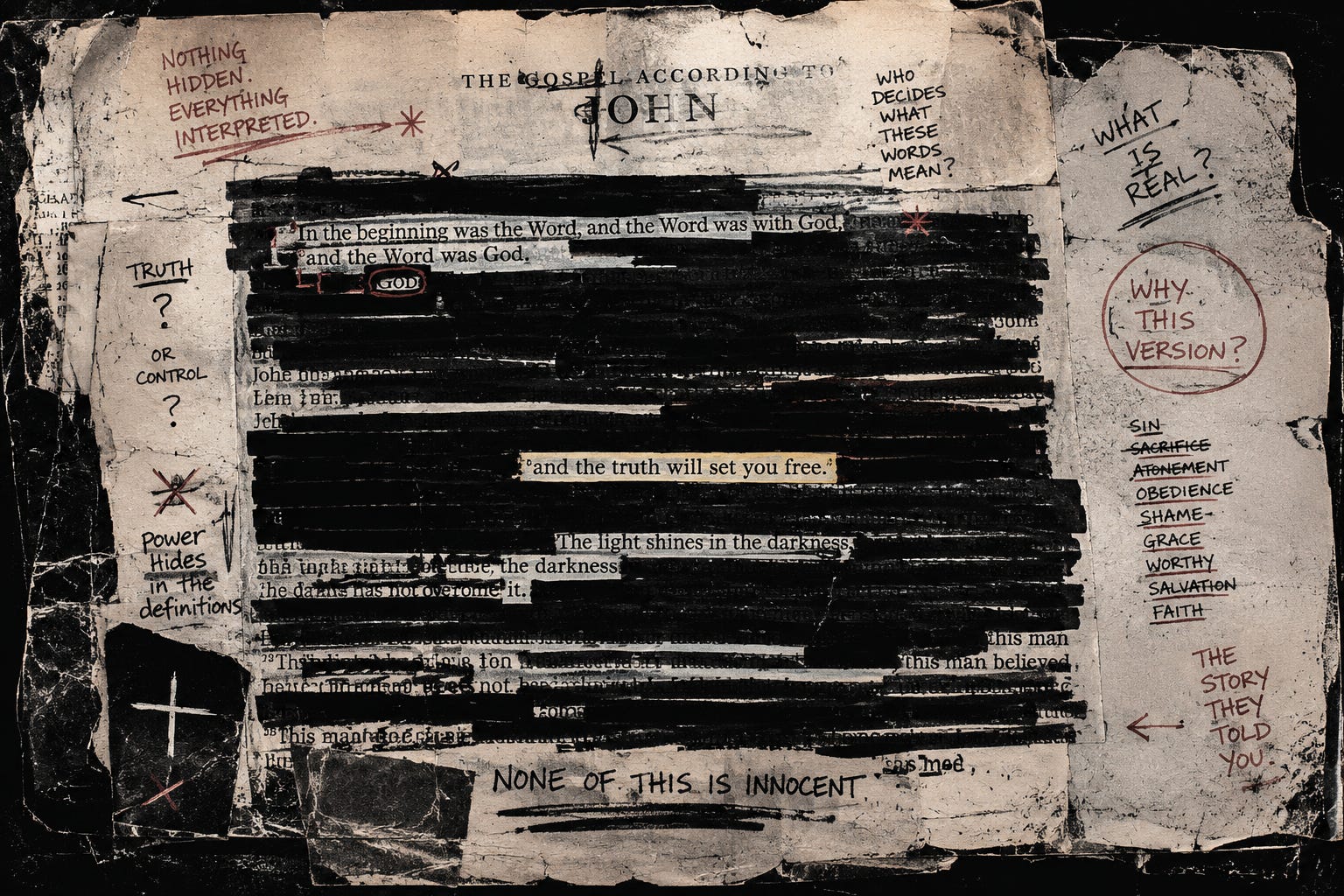
*“The limits of my language mean the limits of my world.” *
- Ludwig Wittgenstein
There was a period in my own deconstruction when I became almost obsessed with language.
I had spent years examining theology, biblical interpretation, church history, and the philosophical assumptions beneath Christianity. But my encounter with linguistics, postmodernism, and the philosophy of language opened an entirely different door.
Derrida was particularly disruptive for me. I had been trained in a religious world that depended upon the possibility of stable meanings: God, truth, sin, salvation, Scripture, man, woman, good, evil. These were not presented as human words carrying histories, assumptions, cultural influences, and contested meanings. They were treated as though they named reality directly.
The study of language made that confidence increasingly difficult to sustain.
I became fascinated by questions I had rarely thought to ask. Where does the meaning of a word actually reside? How much of what we call reality is already mediated by the language available to us? What happens when a community controls not only the answers people are permitted to give, but the vocabulary through which the questions themselves can be asked?
Postmodernism is often caricatured as the claim that nothing is true or that everything is merely subjective. That was never what interested me about it. What mattered to me was the challenge it posed to our confidence that our descriptions of reality are identical with reality itself.
That distinction became enormously important in my own deconstruction.
But it became equally important in my reconstruction. I did not want to exchange religious certainty for the certainty that every religious claim was false, or replace one vocabulary that claimed to explain everything with another. The deeper challenge was learning to hold language differently—to take words seriously without mistaking them for the realities they attempt to name.
Looking back, I consider the deconstruction of language one of the most consequential parts of my journey out of religion and toward the work I do today.
What follows is an exploration of why.
There is a strange moment that often arrives after religious deconstruction. You have relinquished what you once believed, yet something about the old world remains inside you. The doctrines have lost their authority. The institution no longer determines your choices. You might not believe in hell, divine judgment, original sin, biblical inerrancy, or even God. Still, your interior life sometimes behaves as though the old theology were watching.
A decision still carries the faint need for permission. Desire arrives under scrutiny. Disappointing someone feels less like an ordinary human failure than evidence of something morally wrong within. Uncertainty, rather than being recognized as a condition of existence, registers as a personal deficiency. Even after the idea of a divine plan has been abandoned, the unsettling suspicion remains that there is somehow a correct way to live and you are getting it wrong.
For years, I understood this primarily as the residue of religious conditioning. I still think that is true, but I have come to believe there is another way of understanding what is happening. Religious deconstruction is not only theological or psychological. It is also linguistic.
When we leave a religious world, we do not simply lose a collection of beliefs. We destabilize a language-world through which we learned to interpret reality, ourselves, other people, morality, suffering, desire, death, and meaning. The words through which existence became intelligible no longer hold the authority they once did.
But losing confidence in a language is not the same thing as ceasing to speak it.
The theology can disappear while its grammar remains: the old patterns still shaping how we judge ourselves, interpret experience, and decide what a life should be.
None of us begins life by encountering reality independently and then inventing a vocabulary adequate to describe what we have discovered. We arrive in a world already named.
Before we have the intellectual capacity to evaluate the claims being made around us, people are telling us what things are. They name objects, emotions, relationships, behaviors, identities, virtues, dangers, and possibilities. Gradually, the world ceases to be an undifferentiated field of experience and becomes a world populated by meaningful distinctions.
Language does much more than attach labels to things that already possess obvious meanings. It participates in determining which distinctions matter. Once something has been named, it becomes easier to notice. Once categories have been established, experience begins sorting itself through them.
A religious upbringing intensifies this process because religion offers language for nearly everything. It tells you not only what to call God but what to call yourself. It provides words for the body, desire, suffering, goodness, evil, death, sexuality, doubt, purpose, authority, belonging, and the future. It tells you what counts as spiritual and what counts as worldly, what constitutes faithfulness and what constitutes rebellion.
A child growing up inside such a world does not initially experience these terms as one possible vocabulary among many. They are simply the names of things.
“Sin” does not feel like an interpretive category. It feels like something that exists.
“God’s will” does not feel like a culturally transmitted concept. It feels like a feature of reality.
“Saved” and “lost” do not initially appear to be classifications produced by a particular theological tradition. They describe the human population.
Religious formation often occurs long before a person possesses the intellectual equipment necessary to distinguish between reality and the language being used to interpret it. By the time critical reflection becomes possible, the vocabulary has already become intimate. It has participated in constructing the self that is now attempting to examine it.
This is one reason religious deconstruction reaches so much deeper than changing your mind.
You are trying to question a language that has already shaped the mind doing the questioning.
*“Language is ‘a world-forming power.’” *
- Martin Heidegger
The twentieth-century philosopher Ludwig Wittgenstein, one of the twentieth century’s most influential philosophers of language, became increasingly interested in the way words acquire meaning through how they are used within particular communities and ways of life. Rather than imagining language as a collection of labels attached to independently existing meanings, he drew attention to what people actually do with words.
Consider the word “saved.”
Outside a religious setting, someone might be saved from drowning, financial ruin, an accident, or a disastrous relationship. The word assumes a danger from which someone has escaped. Within evangelical Christianity, however, “saved” participates in an entire theological world. To say that someone is saved immediately implies something about what they were saved from, why salvation was necessary, who accomplished it, what condition humanity is in, and what happens to those who remain unsaved.
One small word carries an entire cosmology.
The implications go beyond vocabulary. If an ordinary sexual thought becomes “lust,” anxiety about disappointing others becomes “conviction,” professional ambition becomes a “calling,” or changing your mind becomes “backsliding,” language is doing more than describing experience. Each word places what happened inside a larger story: lust implies moral transgression, calling assumes someone who calls, and backsliding establishes a direction in which one ought to be moving. Over time, these interpretations become so familiar that they are difficult to distinguish from the experiences themselves.
Words operate within networks of meaning. They borrow significance from one another, reinforce one another, and quietly establish the boundaries of what makes sense.
This is why losing one religious belief often produces consequences elsewhere. A person begins questioning hell and soon finds themselves reconsidering salvation. Salvation raises questions about sin. Sin raises questions about human nature. Human nature raises questions about scripture. Scripture raises questions about authority. Authority raises questions about God.
What initially looked like a loose collection of beliefs turns out to be an interconnected linguistic architecture.
Pull one beam from the structure and you begin hearing noises elsewhere in the house.
Ferdinand de Saussure, a foundational figure in modern linguistics, argued argued that language operates through relationships and differences. Words do not carry meaning as isolated containers. Much of their significance arises from how they differ from other words within a system.
Religion provides particularly vivid examples.
The sacred acquires meaning partly through its distinction from the secular. The saved are intelligible because there are the lost. Purity requires the possibility of impurity. Orthodoxy requires heresy. Belief gains significance in contrast with unbelief. Obedience exists in relation to rebellion.
These oppositions rarely remain abstract theological distinctions. They organize human perception.
If the world has been divided into sacred and secular, ordinary existence risks becoming spiritually inferior. If humanity is divided into saved and lost, encounters with other people are never entirely innocent; everyone occupies a metaphysical category. If thoughts are divided between faithful and doubtful, intellectual uncertainty acquires moral significance. If the body and spirit are placed in tension, bodily desire becomes something requiring surveillance.
A vocabulary has become an architecture for inhabiting existence.
This is one reason the aftermath of religious deconstruction often feels more disorienting than outsiders expect. Someone might say, “If you don’t believe it anymore, why does it still bother you?” The question assumes that beliefs operate like files stored in the mind. Delete the file and the problem should disappear.
Human beings are not built that way.
A religious worldview has often supplied the distinctions through which a person learned to perceive themselves and reality. When those distinctions collapse, the person does not simply become free. They also become disoriented.
The map has disappeared while they are still standing in the territory.
There is another layer to this problem. Much of religious language is metaphorical, although long familiarity makes us forget this.
George Lakoff, a cognitive linguist known for his work on metaphor and thought, demonstrated how deeply metaphor structures ordinary thought. Metaphor is not simply poetic decoration. We routinely understand one domain of experience through another. We speak of spending time, defending arguments, carrying burdens, falling in love, moving forward, feeling trapped, and finding our way.
Religion is saturated with these constructions.
God is above. Hell is below. Life is a journey. Sin is a stain. Salvation is rescue. Faith is sight. Doubt is wandering. Spiritual maturity is growth. Morality is a path. Death is departure. God is father, king, judge, shepherd, potter, and ruler.
Each metaphor illuminates something while concealing something else. Calling God “father” makes certain kinds of relationship imaginable and others less so. Describing sin as a stain suggests contamination and cleansing. Understanding doubt as wandering establishes certainty as home. Speaking of a “calling” interprets vocational desire through the image of a voice originating somewhere beyond the self.
Problems arise when metaphors cease to be recognized as metaphors and harden into reality itself.
A person does not merely use the metaphor of divine judgment. They begin experiencing their interior life as a courtroom. Thoughts become evidence. Desire becomes testimony. Failure requires a verdict. The self lives under examination.
Years after belief in the divine judge disappears, the courtroom sometimes remains.
This is where religious deconstruction becomes more complicated than determining whether particular doctrines are true. We also have to ask what metaphors trained us to experience ourselves in particular ways and whether those metaphors continue organizing our lives after their theological foundations have collapsed.
This raises a more unsettling possibility. Some experiences we remember as obviously religious were never experienced apart from the language that interpreted them. What I once described as “feeling convicted,” for example, came with a ready-made explanation for an uneasy feeling: God was showing me that something was wrong and calling me to respond. I had little reason to distinguish the feeling itself from the meaning I had been taught to give it.
The same question reaches into other parts of religious life. Was someone “called” to ministry, or did calling provide the available language for ambition, aptitude, belonging, and the desire to spend a life doing something meaningful? Was a person “backsliding,” or changing in ways their community had taught them to interpret as spiritual decline? Was doubt a spiritual crisis before a religious vocabulary made certainty the measure of faithfulness?
None of this proves that the experiences were unreal. The more interesting point is that experience and interpretation arrive so closely together that we easily mistake one for the other. Deconstruction therefore involves more than asking whether an explanation was true. It requires the harder work of returning to experience and asking what was actually there before the inherited language told us what it meant.
Over the years, I have spoken with many people who have left religion but are bewildered by how little freedom they initially feel. They expected disbelief to produce liberation. Sometimes it does. At other times, they discover that removing the explanation did not remove the structure through which they learned to experience themselves.
A person might no longer believe in original sin yet continue to assume there is something fundamentally wrong with them. Divine judgment has been rejected, but the habit of relentless self-accusation remains. God’s plan no longer explains the course of a life, while important decisions still provoke a search for some external sign of what is “right.” Even after leaving a controlling religious community, relationships may continue to be organized around compliance, approval, and the fear of exclusion.
These are not contradictions. They reveal the difference between changing beliefs and changing grammar.
Grammar operates beneath the individual sentences we speak. It supplies the underlying structure through which sentences become possible. In much the same way, a religious formation leaves behind patterns for organizing experience even after specific theological claims have been rejected.
This is why deconstruction often happens in stages. First, we question what we were taught to believe. Then we question the authority of those who taught it. Eventually, we begin to notice the deeper patterns that remain after both the beliefs and the authority have lost their hold.
Beneath all of this is something slower and more difficult: examining the habits of thought through which we learned to understand ourselves and the world. Without that deeper work, we might leave religion behind while continuing to see ourselves through the categories it gave us. We end up arguing against a world we have left while still using its language to make sense of our lives.
There is an uncomfortable turn in this conversation that those of us who have spent years around religious deconstruction need to face.
Leav…