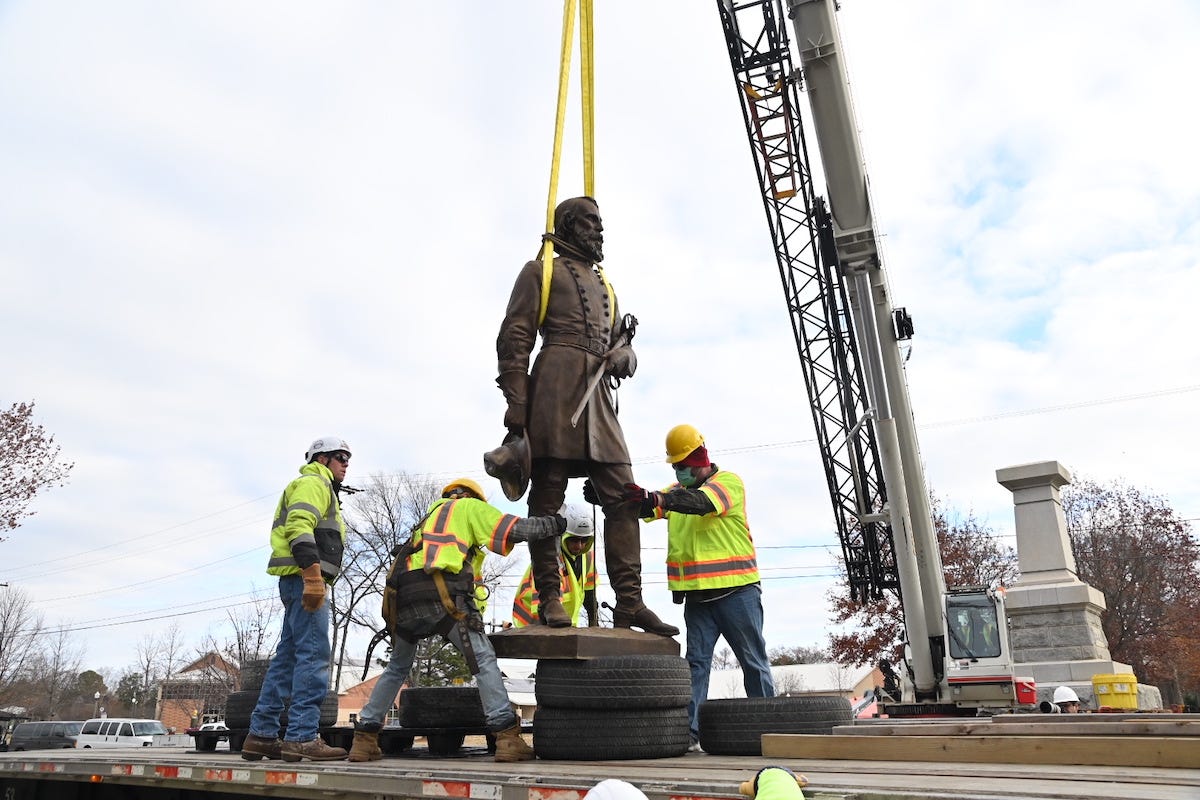
The removal of the last three Confederate statues from the former capital of the Confederacy in Richmond was little more than a formality. Democrats in the legislature were simply waiting for the moment when they could appropriate the necessary funds for their removal, but it is worth taking a few minutes to offer some perspective.
The three statues removed include:
Thomas J. “Stonewall” Jackson, a former instructor at the Virginia Military Institute who became Lee’s top general but died after a friendly-fire accident during the war. While lionized for his military skills, Jackson was a lifelong defender of slavery.
William “Extra Billy” Smith, who served as governor both in the 1840s and again at the end of the Civil War. He was also a Confederate general who owned enslaved people.
Dr. Hunter McGuire was a Confederate soldier and physician for the Southern army who amputated Jackson’s arm after that friendly-fire incident. McGuire, who died at the turn of the 20th century, supported slavery all his life.
Removal of all of Richmond’s Confederate statues was led by the city’s African American population and specifically the Black legislative caucus. It provides an interesting bookend to this story if we consider the story of the Jackson statue, which was dedicated in 1875 in Capitol Square.
If we were looking at this from a national perspective, we might suggest that the statue’s dedication came on the eve of the end of Reconstruction. It symbolized the return of white “Redeemer” control of another former Confederate state.
That would be a mistake.
In 1869 and under federal occupation, Virginia adopted the progressive Underwood Constitution, named after radical Republican judge John C. Underwood, who presided over the 1867 constitutional convention. It established, among other things Virginia's first free public school system and guaranteed universal manhood suffrage.
Backed by these new protections, African Americans successfully voted and elected approximately 100 Black representatives to the Virginia General Assembly. After ratifying the 14th and 15th Amendments, Virginia was officially readmitted to the Union on January 26, 1870, ending formal military Reconstruction.
It’s an important reminder that the end of Reconstruction was not inevitable throughout much of the former Confederacy. Virginia’s African American population took full advantage of the new constitution and remained politically active throughout the decade and, as we will see, into the early 1880s.
Black militia units were formed in Richmond and elsewhere. These organizations took part in Emancipation Day celebrations and constituted a visual reminder of the service of Black men in the United States army and their role in bringing the Confederacy to its knees in the spring of 1865.
And that brings us to the dedication of the Jackson statue in 1875.
Black militia companies applied to take part in the parade that would march through town preceding the official dedication ceremony. You might wonder why they would do so. After all, wouldn’t their participation constitute a tacit approval of such an honor for one of the most famous Confederate generals?
Not exactly.
Another way to understand their participation is as a form of protest or perhaps a reminder to the white community that the Confederacy did lose and that four million people were freed as a result. The sight of African American men marching in uniform and in lock step down Broad Street would, no doubt, be seen by the African American community in attendance as a symbol of their freedom and newly-won political influence.
Most white Southerners, on the other hand viewed it as an affront. At least former Confederate general and Lost Cause architect, Jubal Early, did so.
Writing to Virginia governor and former Confederate James Kemper, Early wrote their their participation in the ceremony would constitute, “an indignity to the memory of Jackson and an insult to all Confederates who shall attend the inauguration of the statue, and in fact to all who cannot attend.” Early threatened to resign from the organizing committee, stating “the sun shall not shine on me in Richmond on the day when such an outrage shall be committed.”
Numerous Virginia newspapers echoed Early’s outrage. The Lynchburg Virginian wrote that “It was surely quite enough that the friends of the dead leader, who had fought under and with him, assigned any place in the procession, to those who insult them by parade and banners on every anniversary of the surrender of General Lee, or of the Emancipation Proclamation.”
Don’t want to take out a subscription, but would like to support my writing? You can leave a couple bucks for a cup of coffee at my Venmo account. Every little bit helps. You can find me @Kevin-Levin-37.
The question about whether African Americans could take part in the dedication ceremony was essentially about whether they deserved a place in Virginia political life at all.
The statue’s dedication took place on October 26, 1875 without the participation of the city’s Black militia companies. African Americans understood that racial politics was fluid and that only their continued vigilance and even flexibility was necessary to remain involved and relevant.
From 1879 to 1883 Black Virginians formed the most successful racial coalition with former Confederate general William Mahone and the Readjuster Party. Control of the governor’s mansion and the state legislature completely transformed the commonwealth. African Americans were elected to positions at the state and local level, where they funded public education, created new hospitals, abolished the poll tax, settled the state debt, equalized the tax burden, and established Virginia State University.
The end of Reconstruction was not inevitable, but more to the point of this post, the proliferation of Confederate monuments and statues was not preordained. The protest surrounding the Jackson statue was about the balance of political power and African Americans understood that their voices and agenda not only mattered, but could be enacted depending on the circumstances.
That, of course, is the larger point and it brings us back to the news this week of these final statue removals in Richmond. Black Virginians were just waiting for the opportunity, once again, to legally push back and assert their political power over how the state is historically represented in its public spaces.
It turns out that Jubal Early could prevent African Americans from marching for only so long.