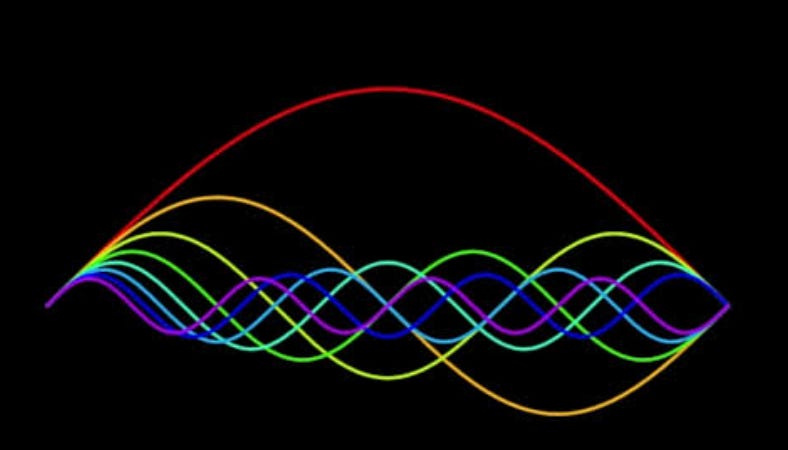
Take a look at this tweet by Massimo, one of my favorite X accounts. I love this account so much that I actually pay for a monthly subscription to help him out. It’s a non-stop stream of things of wonder and beauty:
What is the harmonic series? ▶This video on YouTube gives a lengthy (but very accessible) explanation. It’s easier for a clod like me to understand than the Wikipedia entry, but basically, the harmonic series are the frequencies produced by each note on the musical scale. These sounds all occur naturally. Massimo’s tweet shows how it seems to reproduce itself in the structure of a conch shell.
Is this just a coincidence. Not necessarily. This brings to mind the work of the late, great architect Christopher Alexander, who spent his professional lifetime studying natural order in design, and how the human brain responds to it when it is reproduced in architecture. He wrote the bestselling architecture book of all time, *A Pattern Language. *
In 𝕏this 2016 essay in * First Things*, Alexander explained how this path ultimately led him to God. It opens like this:
It has taken me almost fifty years to understand fully that there is a necessary connection between God and architecture, and that this connection is, in part, empirically verifiable. Further, I have come to the view that the sacredness of the physical world—and the potential of the physical world for sacredness—provides a powerful and surprising path towards understanding the existence of God, whatever God may be, as a necessary part of the reality of the universe. If we approach certain empirical questions about architecture in a proper manner, we will come to see God.
Only in the last twenty years has my understanding of this connection taken a definite form, and it continues to develop every day. It has led me to experience explicit visions of God, and to understand, in some very small measure, what kind of entity God may be. It has also given me a way of talking about the divine in concrete, physical terms that everybody can understand.
Alexander’s work is mind-blowing. You can read more about him and his work at the Center for Environmental Structure website, including a page for a series of four books in which he lays out the principles of his thought. The four books are in a series called “The Nature of Order”. I don’t think you can order them anymore through the website, and if you can find them, they will be expensive. I was fortunate enough to acquire the final of the four, “The Luminous Ground,” while it was still widely available. It’s one of those books that changes the way you see the world.
His basic thesis is that there is logos — order — built into the material world, into nature. In the structures and neighborhoods we build, we are happiest when those buildings and collections of building mimic these forms found in nature. For mysterious reasons, we resonate with them, in ways we simply do not with buildings constructed according to other criteria.
Here’s a key quote:
Yet, I believe some form of concrete connection to the “I” such as that which existed in the great early works of building, which their builders found through mystical religion, is necessary as an underpinning for a successful art of building. I believe this, because I find it to be a necessary precondition for the creation of living structure by human beings.
If I am right, that means that living structure, to an extent beyond the reach of my analysis so far, must — and will always — rely on its connection to the same ground which underlay traditional forms of mysticism. … In short, to create a living structure, we need a vision of the universe in which meaning exists, in which a vision of relatedness and self have a primary place. But it must be a vision whose feelings, whose depth of understanding, is as real for us — true and vibrant and real as part of daily life in the third millennium — as much as God was at home in Mozart’s heart.
That, I believe, is the challenge of our era.
It might sound like woo at first, but it’s not — though Alexander does cross the border between the material and the mystical, obviously. He writes: