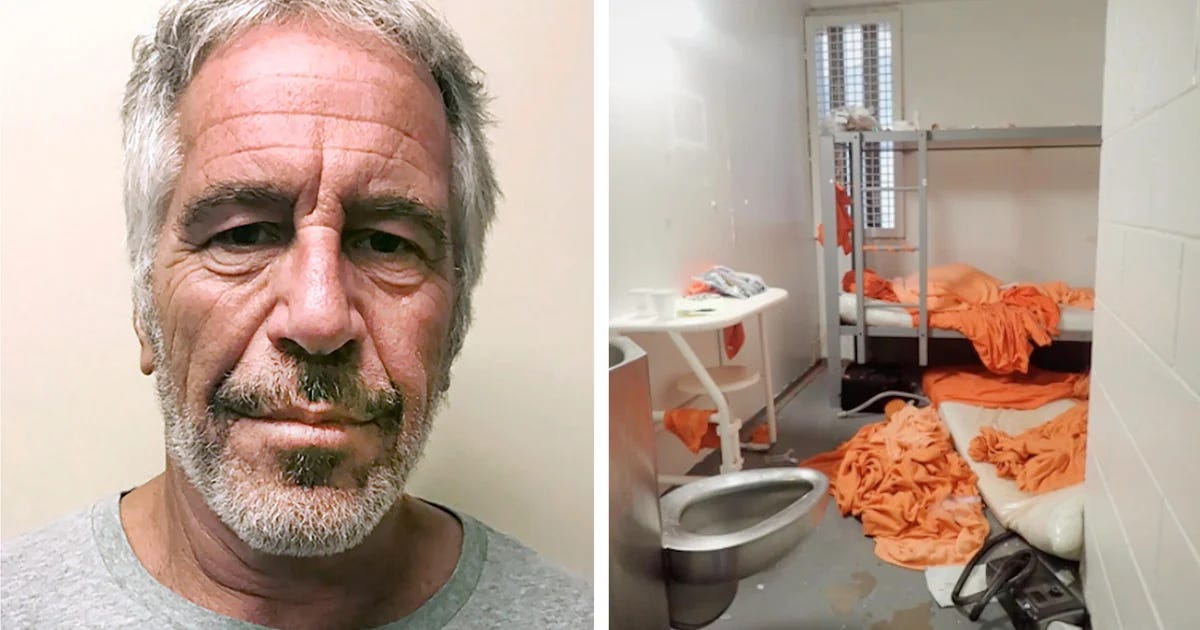
In this edition of the Lownie Report I talk to Mark Epstein, Jeffrey Epstein’s brother. Mark rarely gives interviews, and he agreed to speak to me just days after the forensic scientist Dr Michael Freeman presented his compelling and thorough analysis of Jeffrey’s death, which concludes that he was most likely strangled and did not kill himself.
Freeman spent the past year studying the autopsy photographs, medical records and reports that Mark handed over to him. Mark is clear that the work was Freeman’s own and that he did not commission it or pay for it. He saw the full findings for the first time at the presentation itself.
Freeman worked with Anders Eriksson, a professor of forensic medicine at Umeå University in Sweden, and Itiel Dror, a researcher specialising in bias in forensic decision making. Their analysis centres on the mark on Jeffrey’s neck. In a typical hanging the ligature leaves a relatively smooth, continuous mark that rises towards the point where the body is suspended. The mark on Jeffrey’s neck was deep and irregular and branched into a Y shape on one side, with a second mark beneath it, angled differently, which Freeman says cannot be explained by suspension from an anchor point above the body.
He also points to fingernail marks above the ligature line, an abrasion at the base of the neck, cuts and darkened tissue on the lips and a deep, fresh haemorrhage in the left shoulder muscle, which he interprets as evidence of blunt force trauma. Using a three dimensional model of Jeffrey’s body to test the guard’s account of finding him hanging from a bedpost, he concludes that Jeffrey was strangled from behind with narrow, knotted fabric. And he faults investigators for never testing Jeffrey’s fingernails for DNA. The New York City medical examiner’s office stands by its original ruling.
We go through the questions Mark has been asking for seven years. Why the two pathologists in the autopsy room, Dr Kristin Roman for the city and Dr Michael Baden for the family, felt unable to call it a suicide. How the Chief Medical Examiner, Dr Barbara Sampson, came to rule it a suicide within days when, Mark says, she was not at the autopsy and never saw the body. What the injuries suggest about how long Jeffrey had been dead before he was found. And what became of the ligature and his CPAP machine.
Mark also challenges Bill Barr’s claim that the prison footage showed nobody entering or leaving the tier, pointing to a blind spot on the staircase and an orange figure seen climbing it that night. He talks about the incident in July that was reported as a suicide attempt, which Jeffrey told his lawyer was an assault, the suicide note, the bail hearing Epstein was preparing for, and a prison headcount which he says came up one inmate short the following night, even after allowing for Jeffrey. I also share what a source in the FBI told me about who may have been responsible.
It was hearing Barr’s claim, Mark says, that convinced him there was a cover up. He also argues that Barr may have perjured himself when he told Congress under oath last year that Dr Baden came in after the autopsy, when, Mark says, Baden was there for the whole of it.
He ends with a call for Congress to set up an independent murder investigation, run by investigators from outside the Justice Department. As he puts it, the pool of people on that tier that night was small, and most of them are still alive. The list of people who could have arranged a killing inside a federal prison and had the Justice Department cover it up is, he says, smaller still.