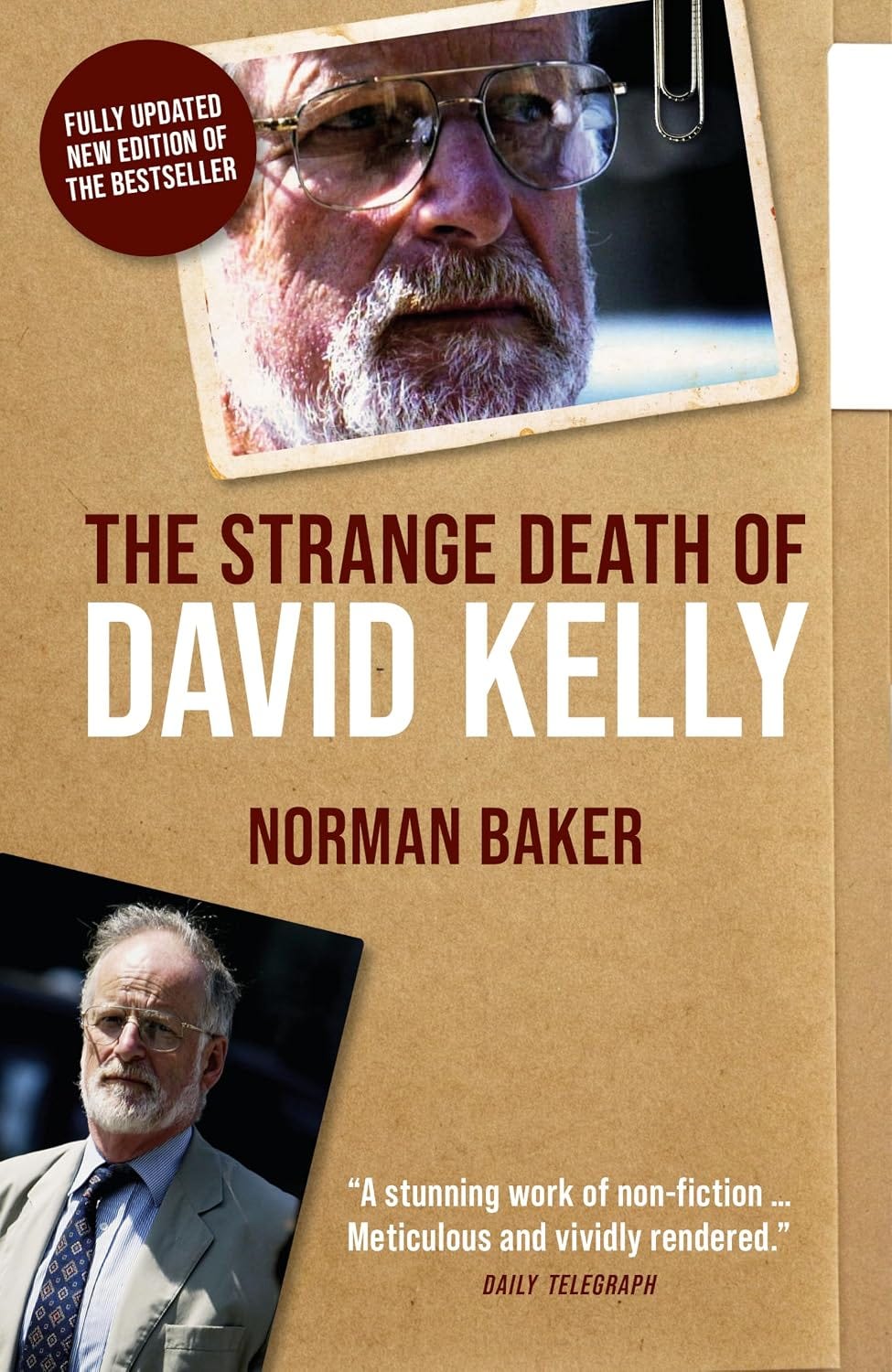
It was my pleasure to welcome back onto the Lownie Report this week to discuss his important and exhaustively researched book which has recently been updated in a new edition.
Norman began by reminding us who David Kelly was: the inspectors’ inspector, who had done a huge amount in the 1990s to uncover weapons of mass destruction in Russia and Iraq.
Within days of being named as the source for Andrew Gilligan’s BBC report that claimed the government had ‘sexed up’ a dossier prepared to persuade a reluctant public of the necessity of the war, Kelly was found dead on Harrowdown Hill, apparently of suicide. Two weeks later, Tony Blair’s official spokesman privately dismissed him as a Walter Mitty figure, a slur for which Downing Street was forced to apologise.
This desperate attempt to traduce Dr Kelly was made as the government scrambled to defend its case for a deeply unpopular war that many considered illegal, one that an estimated one to two million people had marched against in London in the largest demonstration in British history. It is all the more shocking given that he was so highly regarded he had been in the running for a knighthood.
In the days before his death, Dr Kelly had been cracking jokes, telling friends the worst was over and booking flights back to Iraq. He was also looking forward to his daughter’s wedding and was a devoted follower of the Bahá’í faith, which expressly forbade suicide. Five months before his death, he had told a British diplomat in Geneva that if Iraq were invaded, he would ‘probably be found dead in the woods’.
It’s hard to overstate the significance of Kelly’s death and the Hutton inquiry that followed it. The BBC lost its Chairman and Director General and arguably never again had quite the same confidence in standing up to the government of the day.
Norman gave up his front-bench job in the Liberal Democrats in order to write the book, and he leaves no stone unturned in looking at the myriad inconsistencies that cast doubt on the official version of events.
Norman and I discussed the questions and evidence that he lays out in the book. The knife was a blunt one Kelly had owned since boyhood. The ulnar artery is the width of a matchstick, and when Norman asked the National Statistician how many people had died that year from cutting it, the answer was one.
The paramedics found little blood. Of the 29 co-proxamol tablets he supposedly swallowed, only about half of one was found in his body, and he had always had issues swallowing tablets. A Freedom of Information request to Thames Valley Police revealed there were no fingerprints on the knife, the water bottle or anything else found beside him, although he was not wearing gloves.
Norman was scathing about the investigation into Kelly’s death. The coroner’s inquest was halted by a government minister and replaced by Lord Hutton’s non-statutory inquiry, in which no one gave evidence on oath and key witnesses, including Kelly’s close friend Mai Pederson, were never called.
A death certificate was issued before the inquiry began. A helicopter with thermal imaging flew over the spot where the body was later found and saw nothing. His dental records vanished and then reappeared. Lord Hutton then closed the papers for seventy years.
Norman makes the point that Hutton was not an obvious choice for such an inquiry, having never chaired anything like it before. His most recent inquiry had been into the diversion of a river in Northern Ireland.
Having spent years fighting to open files on Guy Burgess, Lord Mountbatten, the Windsors and the Yorks, I recognise the pattern only too well. It is the habit of the British establishment to lock up inconvenient files for a lifetime until all the key participants are safely dead and beyond accountability.
Norman also recalled several disturbing incidents from his time researching the book. The main computer in his constituency office was wiped within seconds of a warning appearing on screen, in a way Sussex Police could not explain. And when a security services source kept Kelly material in a country cottage, the cottage was broken into and only that material was taken.
We discussed who might have been responsible. Norman is careful to say he does not know, and he weighs several explanations, including Miles Goslett’s theory that Kelly died during questioning and a suicide scene was staged. He recalled Wouter Basson, the South African scientist known as Dr Death, telling him that all Western governments assassinate people. The book also looks at a series of mysterious deaths of scientists, mainly in America, though Norman found no clear link to Kelly.
While it is more than twenty years since Dr Kelly was found dead, it is no less urgent or crucial that the truth is properly investigated and that the important questions that Norman lays out in his book are finally answered.
The updated edition of The Strange Death of David Kelly is available here: https://link.amazon/B0c4Bx6ZS