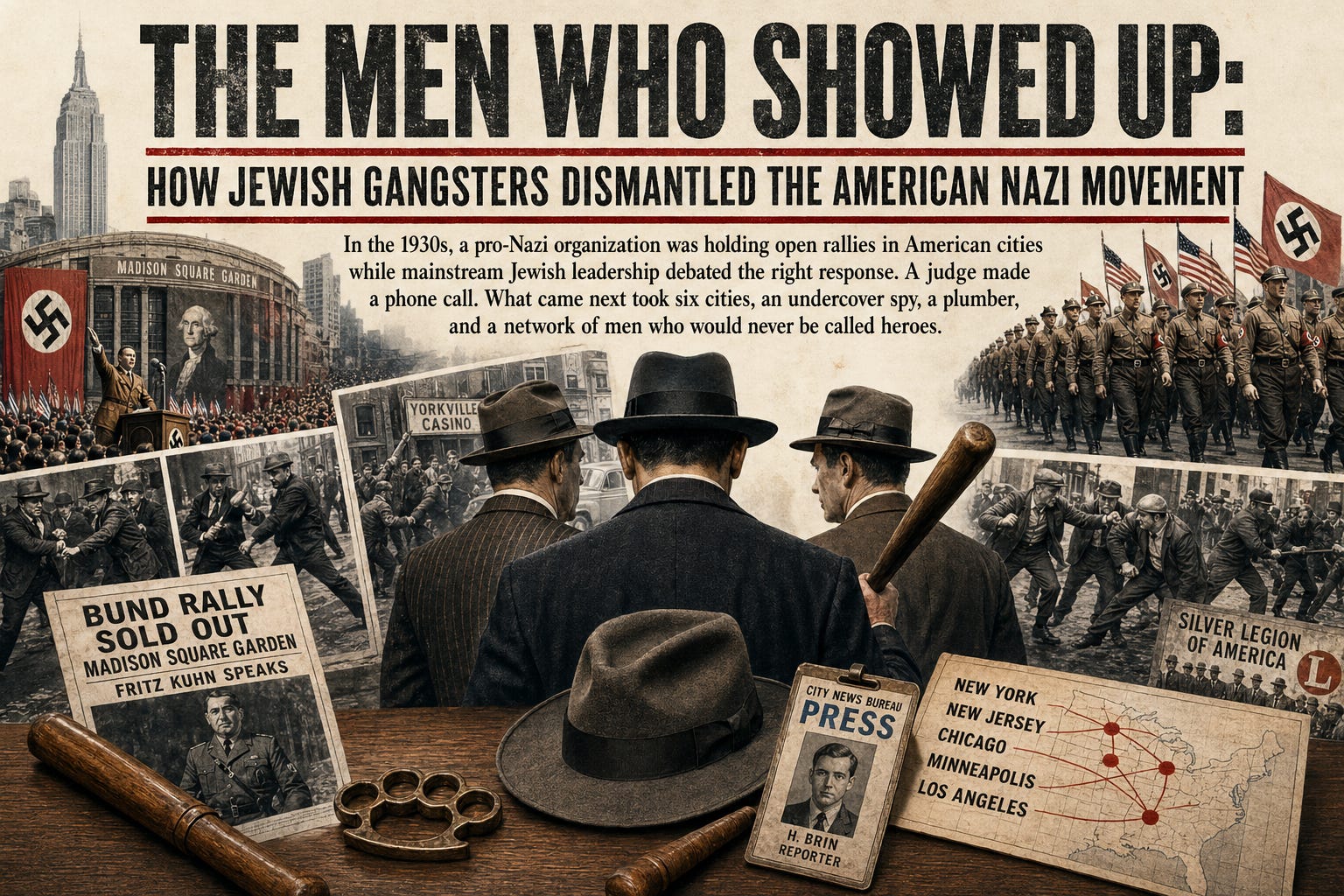
Madison Square Garden was sold out.
New York City, February 20, 1939. Twenty thousand people packed the most famous arena in the world that night. Not for a fight or a championship. They were there for a rally organized by the German American Bund, a pro-Nazi organization with tens of thousands of members and chapters in every state but one. Swastika flags hung from the rafters next to a forty-foot portrait of George Washington. The Bund’s national leader, Fritz Kuhn, stood at the podium and told the crowd that the United States needed to be reclaimed from Jews and communists.
The crowd cheered.
This wasn’t a back-room meeting. This was Midtown Manhattan, and what was happening inside that building was entirely legal.
The German American Bund was founded in 1936 as a successor to an earlier organization called the Friends of New Germany, which had been run directly out of Berlin. The Bund was designed to be an American organization rather than an arm of the German government, but its goals were no different. It existed to promote Nazi ideology on American soil and to build political support for Adolf Hitler’s regime.
Its leader, Fritz Kuhn, was a German-born chemist who had immigrated to the United States in 1928 and worked for the Ford Motor Company. He became a naturalized citizen in 1934 and two years later took command of the Bund, envisioning a strictly hierarchical organization modeled on Nazi Party structure. Kuhn called himself the Bundesführer. Members swore a loyalty oath to Hitler. They were required to purchase copies of Mein Kampf. The most committed members belonged to an armed paramilitary wing modeled on the Nazi Sturmabteilung, the SA, better known as the Brownshirts.
The Bund held rallies, marched through city streets in brown shirts and swastika uniforms, and ran a network of summer camps where children as young as eight were drilled in military formation and taught Nazi ideology. At its peak it claimed membership in every state except Louisiana. Its national headquarters sat at 178 East 85th Street in Manhattan.
And it operated all of this completely in the open, because under the First Amendment, it was allowed.
Hate speech laws didn’t exist in the 1930s. Jewish community leaders wanted the rallies stopped and had no legal mechanism to do it. The Bund marched because nobody with legal authority could make them stop.
This work is entirely reader-supported. By choosing a paid subscription, you allow me to continue this long-form research and bring these vital stories to light. Thank you for helping this Lioness roar for the truth.