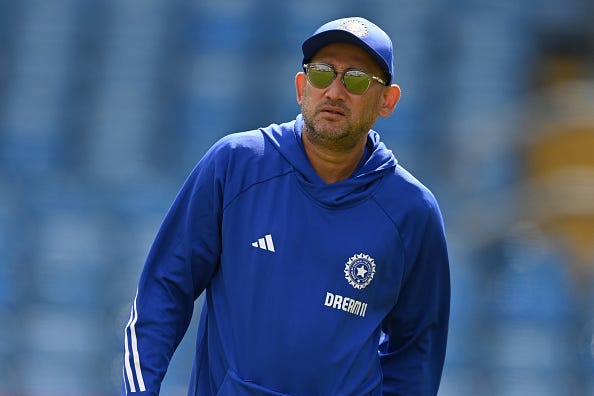
Selection is often described as a binary act: a player is picked or discarded, trusted or moved aside. Yet the more revealing question lies between those outcomes, because an international career is shaped not merely by whether opportunity arrives, but by how much continuity a player receives before judgment hardens.
Ajit Agarkar’s tenure as chairman of India’s senior selection committee offers a useful period to examine that distinction. Since July 2023, India have remodelled large parts of their batting across formats, and opportunity has rarely followed output in a simple, linear way.
To measure that, we devised Effective Opportunity Units, or EOU. Every white-ball innings counts as one full unit, while an appearance in which a batter does not reach the crease is worth 0.35; a cap records presence, but not necessarily a genuine batting chance.
India’s West Indies Test and ODI squads had already been selected when Agarkar took charge, so those decisions are excluded. The analysis begins with the first squad chosen under his chairmanship in each format.
The distinction matters most for middle and lower-order batters, whose opportunities are often dictated by circumstance. Rinku Singh has appeared in 48 T20Is during the period but batted only 35 times, reducing what looks like a 48-match runway to 39.55 EOU.
Jitesh Sharma’s case is similarly compressed. Sixteen appearances produced only 12 batting innings and 13.40 EOU, showing how cap counts can exaggerate the evidence on which a player is supposedly being judged.
At the other end sit players whose selection translated into sustained exposure. Tilak Varma accumulated 60.05 EOU and Abhishek Sharma 58.35, giving both enough time to be assessed through success and failure rather than isolated innings.
The contrast between Abhishek and Ruturaj Gaikwad is the clearest of the period. Gaikwad scored 498 runs from 12 innings at an average of 62.25 and a strike rate of 150, yet his runway ended at 12.70 EOU and his last T20I came in July 2024.
Abhishek received almost five times as much effective opportunity, and that confidence endured through failure. During one stretch, he followed a 59 with 43, 10, 16, 3, 1, 8 and 2, yet India persisted rather than abandoning the experiment.
Against Afghanistan, he responded with 82, 39 and 108. That sequence illustrates the value of genuine security: Abhishek was permitted to fail without being compelled to reinvent himself after every poor score, whereas Gaikwad’s excellent numbers could not preserve his place once India’s preferred T20 profile changed.
Yashasvi Jaiswal belongs to the same argument. He scored 723 T20I runs at 36.15 and a strike rate of 164.32, yet has not played the format since July 2024, suggesting that his disappearance owed less to statistical decline than to a hierarchy being rewritten around him.
The ODI sample is even starker because India have played comparatively little cricket in the format. Sanju Samson received three appearances but only two batting innings in the Agarkar period, worth 2.35 EOU, and those innings produced 12 and 108.
That century remains his most recent ODI innings. Sai Sudharsan similarly scored 127 runs at 63.50 across three consecutive matches before disappearing from the format, while Rajat Patidar received only one ODI innings.
Test cricket supplies a contrasting model. Patidar was given three consecutive Tests and six innings against England despite repeated failures, eventually finishing with 63 runs at 10.50; whatever the result, India had afforded him a coherent audition rather than disconnected chances.
Sarfaraz Khan received six Tests across two blocks, while Dhruv Jurel’s initial opportunity developed into sustained involvement. Devdutt Padikkal’s chances were more dispersed, reinforcing the idea that the shape of an opportunity can matter almost as much as its volume.
The Agarkar era resists an easy description as either ruthless or patient. Its defining feature was selective patience: certain players were afforded enough security to fail, recalibrate and succeed, while others produced quickly but discovered that India’s tactical priorities had moved elsewhere.
That is what EOU ultimately exposes. A cap records presence, but runway measures belief, and under Agarkar those quantities were rarely identical; India increasingly selected not simply according to who had accumulated the most runs, but according to who best embodied the team they were trying to build.