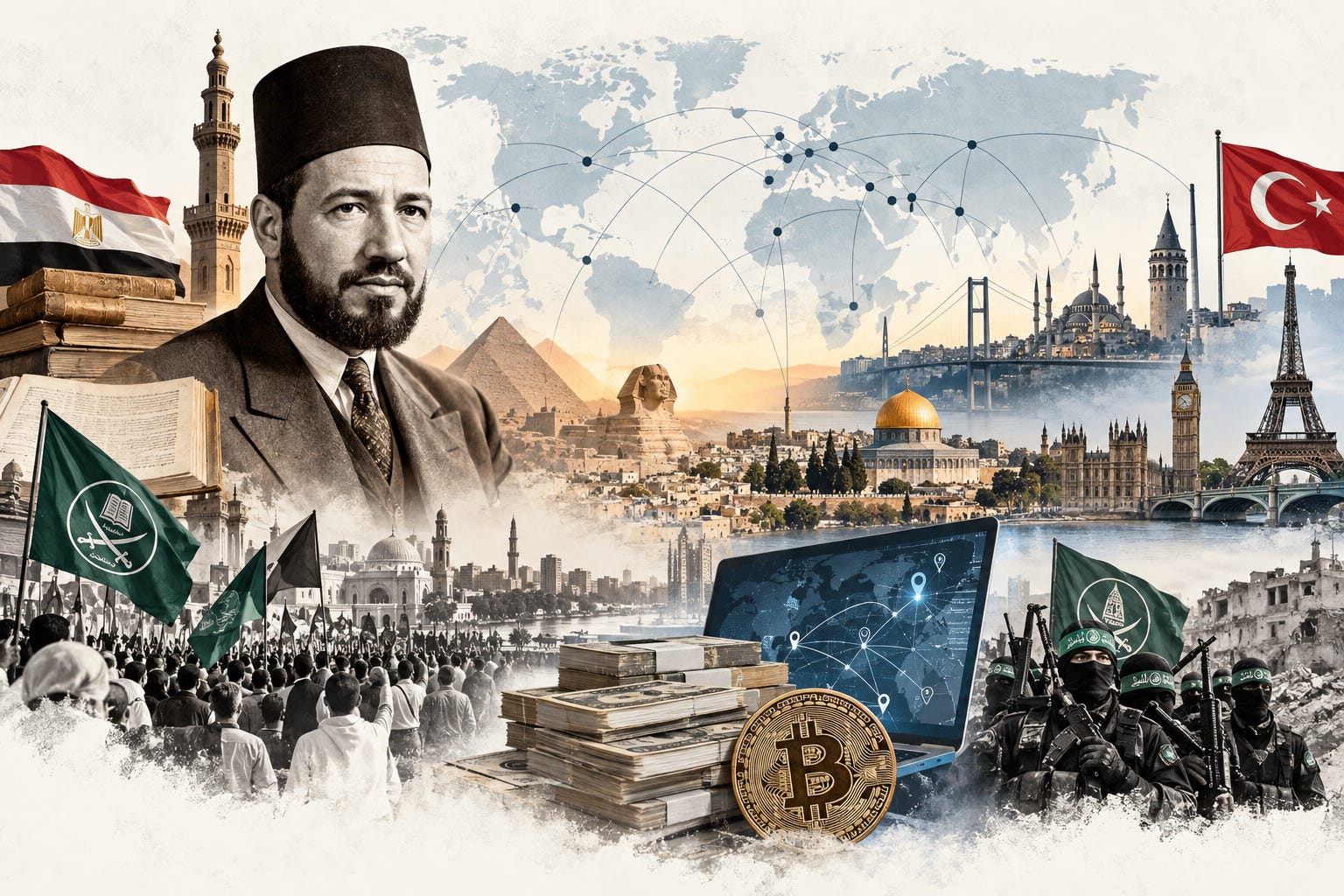
In 1928, 22-year-old Hassan al-Banna founded the Muslim Brotherhood in Ismailia, Egypt. British troops were stationed in the country, and al-Banna wanted Egypt governed according to Islamic principles. His first supporters included six workers from the Suez Canal Company who shared his concerns about foreign influence and the direction Egyptian society was taking.
Al-Banna was a schoolteacher…he understood how to reach people. The Brotherhood began with religious lessons and meetings before opening schools, clinics, and charities. Members organized workers, published newspapers, preached in mosques, and recruited supporters. Families received services that were often difficult to get elsewhere, while the organization taught that Islam should guide government, education, and the law.
By the 1940s, the Brotherhood had established a secret armed group known as the Special Organization. Its members participated in violent attacks, and the Egyptian government grew increasingly alarmed. In December 1948, Prime Minister Mahmoud al-Nuqrashi ordered the Brotherhood dissolved. A Brotherhood member assassinated him shortly afterward.
Al-Banna condemned the assassination, but he didn’t live much longer. On February 12, 1949, he was shot and killed in Cairo. He was 42 years old, and the movement he had founded with six supporters had grown into a major religious and political organization with an underground armed wing.
The Brotherhood initially welcomed the military overthrow of King Farouk in 1952, but its relationship with Gamal Abdel Nasser soon collapsed. Following an assassination attempt against Nasser in 1954, Egyptian authorities blamed the Brotherhood and launched a crackdown. Thousands of members were imprisoned, and several leaders were executed.
One of the prisoners was Sayyid Qutb, whose writings would influence generations of Islamist activists. Qutb argued that societies claiming to be Muslim had abandoned Islamic principles and returned to a condition of ignorance. His ideas influenced more radical Islamist movements, although Brotherhood members disagreed over his teachings and the use of violence. Egypt executed him in 1966.
Under Anwar Sadat and Hosni Mubarak, the Brotherhood remained officially banned but regained room to operate. Members participated in professional associations, maintained charitable institutions, and ran for parliament as independents. Arrests continued, and members left Egypt for work, education, or refuge from political persecution.
Saudi Arabia and other Gulf countries employed Egyptian teachers, academics, and professionals, including Brotherhood members. Others settled in Europe, where they became involved in mosques, religious associations, publishing, and community organizations. Some maintained close relationships with the Egyptian leadership. Others developed institutions that operated independently.
When protests forced Hosni Mubarak from office in February 2011, the Brotherhood was one of Egypt’s best-organized political movements. Its Freedom and Justice Party won a major share of parliamentary seats, and longtime Brotherhood member Mohamed Morsi was elected president in June 2012.
Morsi’s presidency divided Egypt. Opponents accused him of concentrating power and weakening democratic safeguards, while supporters argued that established institutions were determined to prevent him from governing. Millions demonstrated against him. On July 3, 2013, the military under Abdel Fattah el-Sisi removed him from office.
Brotherhood supporters protested Morsi’s removal. In August, Egyptian security forces dispersed protest camps in Cairo, killing hundreds of people in what became known as the Rabaa massacre. The government arrested senior Brotherhood leaders, seized property, and designated the organization a terrorist group in December 2013. Morsi remained imprisoned until his death during a court hearing in 2019.
Many Brotherhood members fled to Türkiye and Britain. Istanbul became an epicenter for Egyptian opposition broadcasters, while London sheltered Brotherhood-associated figures who had been active there for years. Rival leadership factions emerged, disputing appointments and authority over the movement.
Turkey’s government had opposed Morsi’s removal, and Qatar maintained relationships with prominent Brotherhood-associated figures. But national Brotherhood movements had developed different political interests and leadership structures. Jordan’s Brotherhood participated in parliamentary politics, while the Palestinian Brotherhood had already produced an armed organization that would become one of Israel’s most dangerous enemies.
In Gaza, Sheikh Ahmed Yassin spent years developing a religious and social movement associated with the Palestinian Muslim Brotherhood. His organization operated through mosques, educational activities, and charitable institutions.
When the First Intifada began in December 1987, Yassin and other Palestinian Brotherhood figures founded Hamas. Its 1988 covenant identified the organization with the Muslim Brotherhood, called for Israel’s destruction, and included antisemitic conspiracy theories. Hamas carried out shootings, bombings, and other attacks against Israelis, and the United States designated it a Foreign Terrorist Organization in 1997.
Hamas also operated charitable and social institutions that helped build public support. It won Palestinian legislative elections in 2006 and seized control of Gaza from Fatah forces in 2007. A political document issued in 2017 changed parts of its public presentation, but Hamas continued refusing to recognize Israel and maintained its armed wing.
American investigators had already spent years examining a charity headquartered in Richardson, Texas, that collected millions of dollars for Palestinians.